Vibe Coding & AI Website Builders: Can They Really Replace a Developer? (Reality Check)
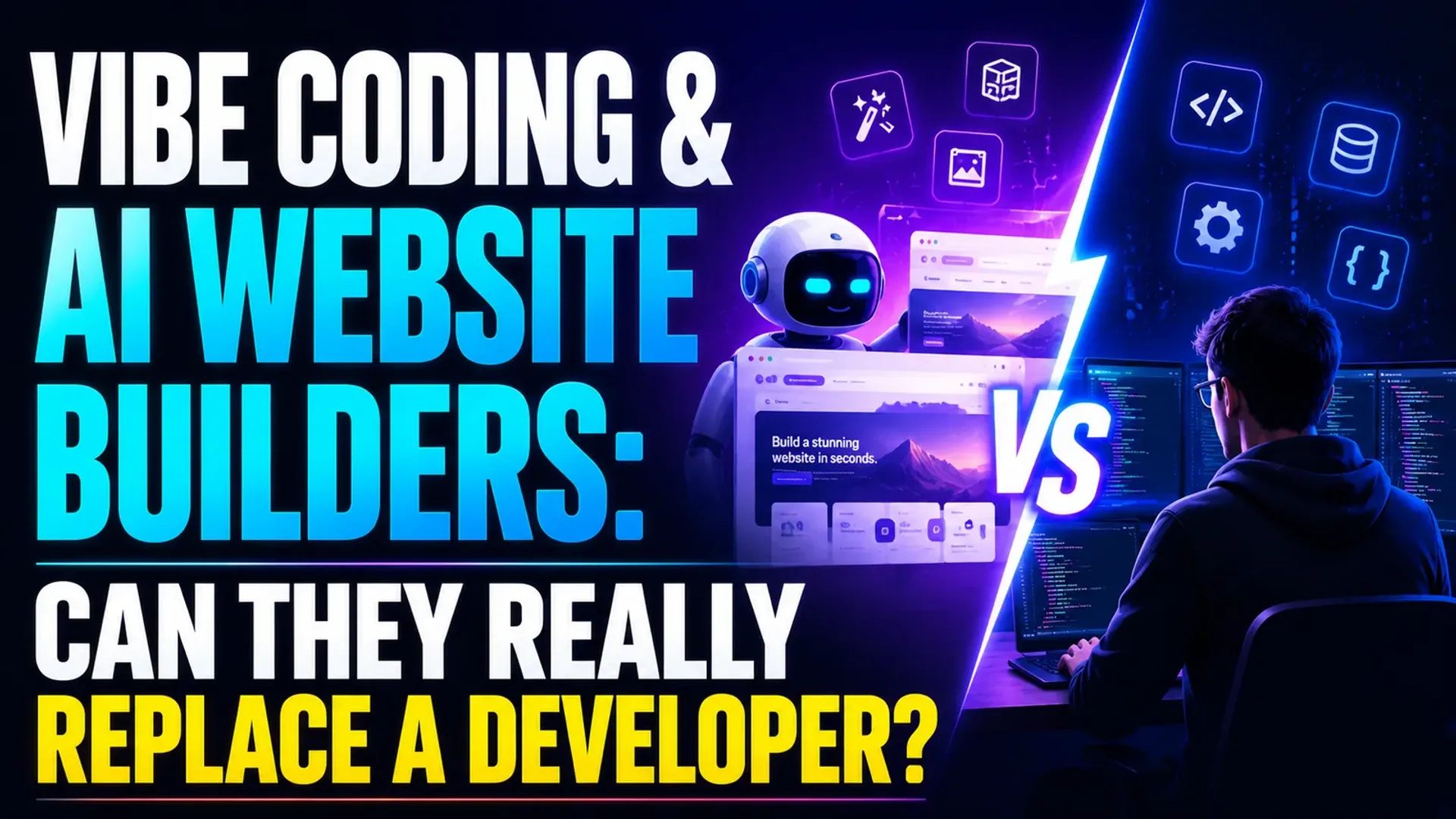
You can now describe a website in a sentence and watch it appear. Type "a clean SaaS landing page with a pricing table and a signup form," and an AI builder returns something that looks shippable in seconds. This is vibe coding — building software by describing intent in plain language instead of writing every line by hand — and it has genuinely changed what a non-technical founder can do in an afternoon.
So the question on every business owner's mind is fair: if a tool can generate a working site from a prompt, why hire a developer at all? The honest answer is nuanced. These tools are remarkable, and they're also frequently oversold. Knowing exactly where the line sits is the difference between shipping fast and quietly accumulating problems you'll pay for later.
Let's cut through the hype and look at what AI builders actually do well, where they fall apart, and how to make a decision you won't regret in six months.
What vibe coding and AI builders are genuinely great at
Credit where it's due. For a specific set of jobs, these tools are the fastest option that has ever existed. If your goal fits inside their sweet spot, using them is simply the smart move.
- Prototypes and proof-of-concept. When you need to show an idea to a co-founder, an investor, or a customer, a clickable draft in an hour beats a polished build in three weeks.
- MVPs for validation. If you're testing whether anyone wants the thing at all, an AI-generated first version lets you learn cheaply before committing real budget.
- Simple landing pages and campaigns. A single marketing page with a form and a clear call to action is well within reach, especially for short-lived promotions.
- Internal tools and throwaway experiments. Dashboards or utilities that a handful of people use, where polish and scale don't matter, are ideal candidates.
The common thread: low stakes, short lifespan, or a job that's mostly about speed of learning. In those cases, a good design-led approach layered on top of an AI draft can get you surprisingly far.
The best use of an AI builder is to answer a question fast — not to become the permanent foundation of your business.
Where AI builders quietly fall short
The trouble starts when a quick prototype becomes the thing you're actually running your company on. The gaps below rarely show up on day one. They show up when it's expensive to fix them.
Scalability and performance
AI-generated code often prioritizes "it works" over "it works at scale." Bloated markup, unoptimized assets, and inefficient data handling are common. That's fine for ten visitors and painful for ten thousand. Real web development is as much about how a system behaves under load as it is about how it looks.
Security
A generated app can look complete while leaving forms, authentication, and data handling exposed. AI tools don't reliably reason about your specific threat model, compliance requirements, or how attackers actually probe a site. For anything touching customer data or payments, that's not a corner you want cut.
Custom logic and integrations
The moment your needs get specific — a bespoke checkout flow, a CRM sync, role-based permissions, a pricing engine — prompt-based tools tend to stall or produce brittle workarounds. This is precisely where experienced engineers earn their keep, and where thoughtful custom AI development can be built into a product rather than bolted on.
Ownership, SEO, and maintenance
- Ownership. Some platforms lock your site inside their ecosystem. If you can't cleanly export your code and data, you don't fully own your business's most important digital asset.
- SEO. Clean semantic structure, fast load times, and crawlable architecture are frequently afterthoughts in generated output. If organic traffic matters, this is a real cost.
- Maintenance. Code you didn't write and don't understand is hard to debug, extend, or hand to a team later. Technical debt compounds quietly.
How to decide: a simple framework
You don't need to pick a tribe. You need to match the tool to the job. Ask yourself three questions before you start.
- How long does this need to last? A two-week campaign page and a five-year core product deserve completely different answers.
- What's the cost of it breaking? If a bug means a mildly annoyed visitor, move fast. If it means leaked data or lost revenue, invest properly.
- How custom and connected is it? The more your idea depends on unique logic and integrations with other systems, the sooner an AI builder hits its ceiling.
A practical pattern many smart teams use: validate with AI, then build for real. Use a builder to prove demand and pin down requirements, then invest in a proper build once you know it's worth it. If you're unsure where your current site stands, a free website audit is a low-risk way to spot the gaps before they become emergencies.
The bottom line
AI website builders and vibe coding are not a threat to good developers — they're a powerful new tool that raises the floor for everyone. They're excellent for prototypes, MVPs, and simple pages, and they let you learn faster than ever. But they are not a substitute for a secure, scalable, genuinely owned product when the stakes are real.
The winning move isn't "AI or a team." It's knowing when each one is the right call. Use the fast path to find out what to build. Use craftsmanship to build the thing that lasts.
Can I launch my real business website with just an AI builder?
For a simple brochure site or a short campaign, often yes. For anything with custom logic, customer data, payments, or serious SEO ambitions, you'll usually outgrow it quickly — and migrating later tends to cost more than building it properly the first time.
Is AI-generated code safe to use in production?
It can be a helpful starting point, but it should be reviewed for security, performance, and maintainability before it touches real users. Treat generated code as a draft written by a fast but inconsistent junior developer, not as finished, production-ready work.
Will hiring a developer make me slower than using AI?
Not necessarily. Experienced teams increasingly use AI tools themselves to accelerate the early stages, then apply real engineering where it matters. You get the speed and the durability, rather than trading one for the other.
Not sure whether your next build calls for a quick AI draft or a proper custom foundation? Book a free call and we'll give you a straight answer — no jargon, no upsell, just the right path for where your business actually is.
Related reading: custom website vs website builder · why most small-business websites fail
Tap the button and Google will show you our new articles more often — in Search, Top Stories and AI Overviews.
Have a project in mind?
Let’s turn it into an intelligent product. Book a free 30-minute discovery call.
Start your project →