The Creative Testing Playbook: How Performance Agencies Find Ads That Actually Scale
There is a moment every performance marketer eventually experiences.
An ad is working.
The numbers look great.
CTR is healthy. CPA is low. ROAS is strong.
So naturally, the team does what seems logical.
They increase the budget.
And then the numbers start moving in the wrong direction.
CPA rises.
CTR falls.
Conversions slow down.
The audience seems to have stopped responding.
Someone says:
“The ad is fatigued.”
So the team makes another version.
Then another.
Then another.
Different headline.
Different background.
Different thumbnail.
But somehow, nothing really changes.
This is where a lot of brands misunderstand creative testing.
Creative testing isn't about making more ads.
It's about discovering which ideas, messages, formats and executions have the potential to produce better business results.
And once you understand that difference, creative testing becomes much more systematic.
Why the old “make more ads” approach doesn't work
Let's say you're running a campaign for a SaaS company.
Your best-performing ad says:
“Stop wasting 10 hours every week on manual reporting.”
It works.
So you create five more versions:
“Save 10 hours every week.”
“Stop wasting time on reports.”
“Automate your reporting.”
“Save time with automated reporting.”
“Get your reports done faster.”
You now have six ads.
But you don't really have six ideas.
You have one idea wearing six different shirts.
That's a problem because you're testing execution rather than strategy.
If the original message stops working, all six variations are likely to struggle for the same reason.
A stronger testing approach would introduce fundamentally different hypotheses:
Time: “Stop wasting 10 hours every week.”
Money: “Cut reporting costs without hiring another analyst.”
Stress: “Stop spending Friday afternoons building reports.”
Risk: “Eliminate the reporting errors your team keeps finding.”
Speed: “Turn a five-hour reporting process into five minutes.”
Competitive advantage: “Your competitors already automated this.”
Now you're testing different reasons for someone to care.
That's real creative testing.
Start with the customer, not the ad format
Before producing a single video, image or carousel, you need to understand the person you're trying to persuade.
Not just demographics.
Not:
“Women, 25–44, interested in skincare.”
That's audience targeting.
Creative strategy needs something deeper.
You want to know:
What problem are they actually trying to solve?
What have they already tried?
What frustrates them?
What do they fear?
What do they want to become?
What objections stop them from buying?
What would make them believe your claim?
What language do they use when describing the problem?
That information becomes your creative raw material.
And often, the best insights aren't hiding inside a marketing brainstorm.
They're already sitting inside your business.
Look at:
Sales calls
Customer reviews
Support tickets
Reddit discussions
Product reviews
Search queries
CRM notes
Competitor reviews
Comments on your social posts
Your customers are constantly telling you how to market to them.
You just have to listen.
Step 1: Build your creative hypothesis
Every test should start with a hypothesis.
For example:
We believe small-business owners will respond better to a message about saving money than a message about saving time.
That's testable.
Now create two genuinely different concepts.
Concept A
“Save 10 hours every week.”
Concept B
“Do more without hiring another employee.”
Same product.
Different motivation.
Now the performance data becomes useful.
If Concept B wins significantly, you've learned something about your audience.
And that insight can influence the next ten pieces of creative.
This is much more valuable than simply knowing:
“Ad B got a 17% higher CTR.”
The number tells you what happened.
The hypothesis helps you understand why it happened.
Step 2: Separate the variables
This is where creative testing becomes scientific.
If you change everything at once, you don't know what caused the result.
Imagine you have:
New hook
New visual
New offer
New CTA
New landing page
And conversions increase by 30%.
Great.
But what actually caused the improvement?
You don't know.
Maybe the hook did it.
Maybe the offer did it.
Maybe the landing page did it.
Maybe all three.
That's why structured testing matters.
You don't necessarily need to test only one tiny variable every time. In real-world advertising, that can be too slow.
Instead, think in layers.
Layer 1: Concept
What is the big idea?
Layer 2: Angle
Why should someone care?
Layer 3: Hook
How do we earn attention?
Layer 4: Execution
How do we present it?
Layer 5: Offer
What are we actually asking them to take?
This gives you a framework for understanding what's working.
Step 3: Test hooks aggressively
The first few seconds of a social ad can determine whether someone keeps watching or keeps scrolling.
And that means your opening deserves serious attention.
Consider these two openings.
Version A:
“Today we're going to talk about how businesses can improve productivity.”
Nobody is exactly racing to hear the second sentence.
Now:
Version B:
“Your team isn't slow. Your workflow is.”
That's a different proposition.
Or:
“You're probably paying someone to do this manually.”
Or:
“This task should have disappeared five years ago.”
Or:
“If your marketing team still does this every morning, you're wasting money.”
These hooks create curiosity.
But curiosity alone isn't enough.
The rest of the ad needs to deliver on the promise.
That's why a good hook isn't clickbait.
It's a contract.
You make a promise in the opening.
Then you keep it.
Step 4: Don't confuse CTR with success
This is one of the biggest mistakes in creative testing.
An ad gets a fantastic click-through rate.
Everyone celebrates.
Then you look at the sales numbers.
Nothing happened.
Why?
Because you optimized for attention instead of business results.
A controversial or curiosity-driven headline can generate clicks very easily.
But if those clicks come from people who were never going to buy, your beautiful CTR is basically a distraction.
This is why creative performance should be evaluated across the funnel.
For example:
Attention
Thumb-stop rate
Video views
Hook rate
Engagement
CTR
Landing-page views
Engagement rate
Conversion
Leads
Purchases
Conversion rate
CPA
Business
Revenue
ROAS
Customer acquisition cost
Customer lifetime value
The exact metrics depend on the campaign.
But the principle stays the same:
The closer you get to actual business outcomes, the more valuable the signal becomes.
Step 5: Test the message before obsessing over production quality
This one is particularly important for creative agencies.
A beautifully produced video can still be a terrible advertisement.
And a person sitting in their bedroom talking into an iPhone can sometimes outperform it.
That doesn't mean production quality doesn't matter.
It means production quality cannot rescue a weak idea.
Imagine two ads.
Ad A
A $20,000 cinematic production.
Drone shots.
Professional actors.
Perfect lighting.
Beautiful transitions.
But the message is:
“Experience the future of productivity.”
Ad B
A founder records a simple 30-second video.
“We were spending six hours every Monday building reports. Here's how we reduced that to 20 minutes.”
Which one is more compelling?
You don't know until you test.
That's the point.
Creative testing removes assumptions.
Step 6: Test formats, not just headlines
Different formats communicate different things.
A testimonial can build trust.
A product demo can reduce uncertainty.
A founder video can create familiarity.
A comparison can simplify a decision.
A UGC-style video can feel native to the platform.
A carousel can explain multiple benefits.
A static image can communicate one strong idea quickly.
Meta's current advertising guidance emphasizes creative diversification because different creative formats and concepts can help its delivery systems find more relevant opportunities. Meta Blueprint: Creative Diversification
So don't ask:
“Which format is best?”
Ask:
“Which format is best for communicating this particular idea?”
That's a much better question.
Step 7: Test emotional angles
Most businesses talk about features.
Customers buy outcomes.
And outcomes aren't always rational.
Suppose you're selling an accounting service.
You could say:
“Automated bookkeeping with monthly financial reports.”
Technically accurate.
But compare that with:
“Stop wondering whether your business actually made money this month.”
Same service.
Completely different emotional impact.
The first describes a feature.
The second describes a problem the customer feels.
That gives you another testing framework.
Rational angles
Save money
Save time
Increase efficiency
Improve productivity
Emotional angles
Reduce stress
Feel in control
Look more professional
Stop worrying
Avoid embarrassment
Gain confidence
Identity angles
Become a better leader
Run a smarter business
Look like a category leader
Build something independent
You don't know which angle will win until you test.
Step 8: Let the data tell you what to make next
This is where the testing process becomes powerful.
Suppose you test six creative concepts.
| Creative | Angle | CTR | Conversion Rate | CPA |
|---|---|---|---|---|
| A | Save time | 1.8% | 3.2% | $72 |
| B | Save money | 1.4% | 4.8% | $51 |
| C | Reduce stress | 2.1% | 2.7% | $81 |
| D | Customer story | 1.6% | 5.1% | $47 |
| E | Product demo | 1.9% | 4.2% | $56 |
| F | Competitor comparison | 2.4% | 2.1% | $93 |
The highest CTR is F.
But the best CPA is D.
If you're optimizing purely for clicks, you might choose F.
If you're optimizing for business performance, D is much more interesting.
And now you have a new hypothesis:
Customer stories may be particularly persuasive for this audience.
So you make more customer-story creative.
Different customers.
Different problems.
Different outcomes.
Same underlying insight.
That's how winning creative gets scaled.
Step 9: Scale the idea, not the exact ad
Here's another common mistake.
A brand finds a winning ad and immediately scales it.
Same creative.
Same hook.
Same visual.
More money.
Eventually, people get tired of seeing it.
Instead, find the underlying idea that made it work.
Imagine your winning ad is:
“We saved six hours every Monday by automating our reports.”
Don't make 50 copies of that exact video.
Turn the insight into a creative family.
Founder version
“We used to spend Monday mornings doing this manually.”
Customer testimonial
“I can't believe we used to spend six hours on this.”
Product demo
“Here's what replaced those six hours.”
Comparison
“Manual reporting vs automated reporting.”
Pain-point version
“Still spending Monday morning building reports?”
ROI version
“Six hours every week = 312 hours a year.”
One winning idea.
Multiple executions.
That's how you create scale without creating boredom.
Step 10: Know when to kill an ad
Not every creative deserves more time.
Sometimes the answer is simply:
It's not working.
But don't kill an ad because it had a bad first few hours.
Give the test enough data to become meaningful.
The right threshold depends on:
Budget
Conversion volume
Audience size
Sales cycle
Campaign objective
Historical performance
A $50 product and a $50,000 enterprise contract obviously require very different testing timelines.
There's no universal:
“Kill an ad after 1,000 impressions.”
rule.
Instead, look for meaningful patterns.
Is the hook consistently weak?
Is CTR significantly below your normal range?
Are people clicking but refusing to convert?
Is CPA deteriorating as spend increases?
Is frequency rising while engagement falls?
Is the creative attracting the wrong audience?
The goal isn't to kill ads quickly.
It's to learn quickly.
Creative fatigue is not always creative fatigue
When performance declines, teams often blame fatigue.
But several different things can produce the same symptom.
Maybe people have seen the ad too many times.
Maybe the audience is too small.
Maybe the offer isn't competitive anymore.
Maybe a competitor launched something better.
Maybe the landing page changed.
Maybe the market changed.
Maybe the ad was never particularly strong and the initial performance came from a small pocket of highly responsive users.
That's why good performance teams don't immediately say:
“Let's make another ad.”
They ask:
“What changed?”
That's the beginning of diagnosis.
AI is changing the economics of creative testing
This is where things get particularly interesting.
Traditionally, testing 20 creative concepts could be expensive.
You needed:
Copywriters
Designers
Video editors
Actors
Shooters
Motion designers
Production time
AI is changing parts of that equation.
Meta, Google and other major advertising platforms are increasingly incorporating AI into creative generation, asset adaptation and campaign optimization. Google's Performance Max, for example, can evaluate creative assets using performance signals such as impressions, clicks, conversions and conversion value. Google Ads — Evaluate Performance Max Results
This means agencies can potentially test more concepts without dramatically increasing production costs.
But there's a catch.
AI makes production cheaper.
It doesn't make strategy optional.
If you don't know what you're testing, AI will simply help you produce more mediocre ads faster.
The new creative advantage isn't production
It's learning speed.
Think about two agencies.
Agency A produces four polished ads every month.
Agency B produces twelve concepts, tests them, identifies the strongest three, develops variations, learns from the results and feeds those insights into the next month's creative.
Agency A might produce better-looking work.
Agency B may learn faster.
And in performance marketing, learning speed can become a competitive advantage.
Because every campaign can answer questions.
Which problem matters most?
Which audience responds?
Which promise creates demand?
Which proof point builds trust?
Which format works?
Which hook gets attention?
Which offer converts?
The agency that learns these things faster can make better decisions faster.
The creative testing loop
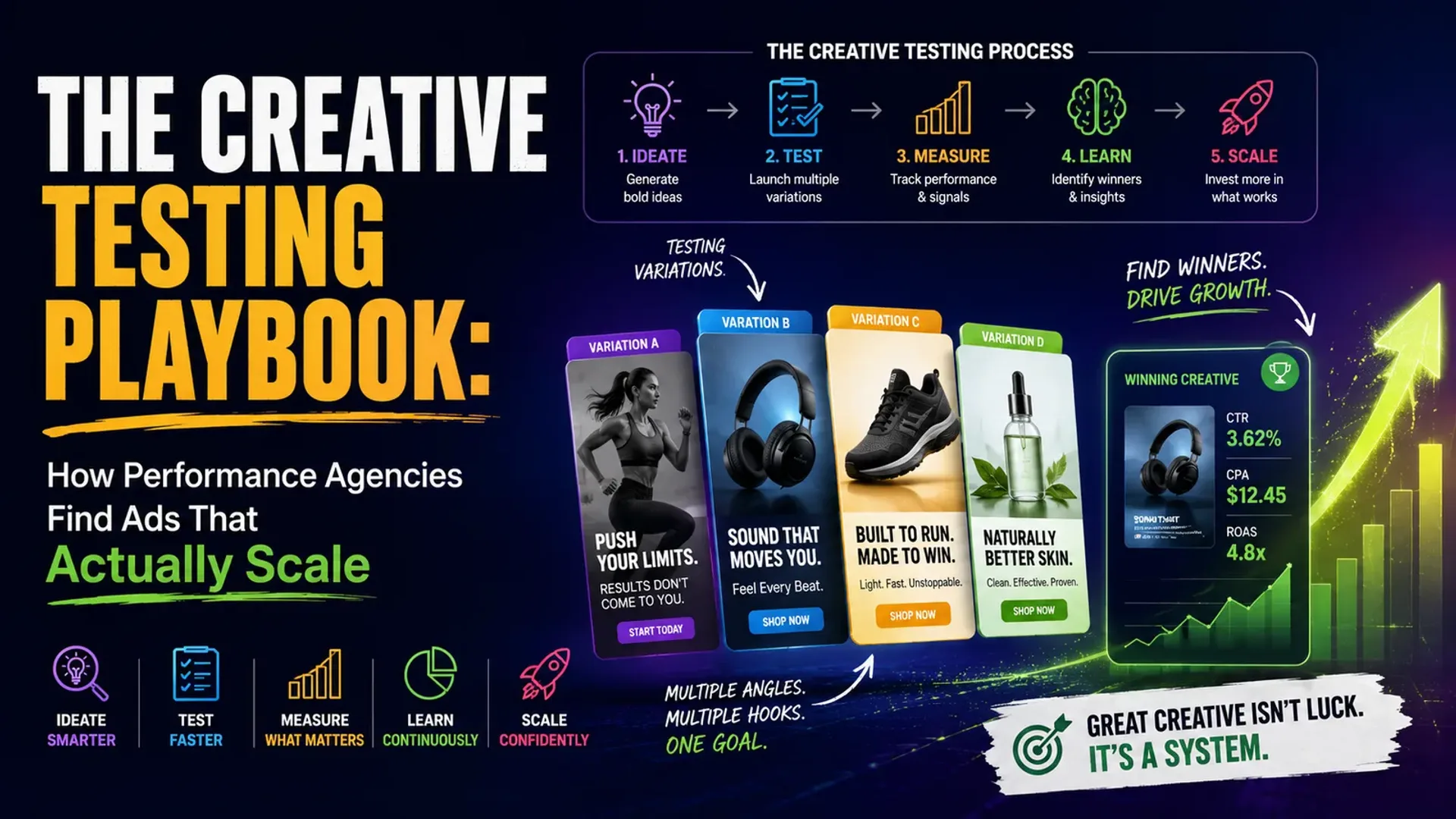
A strong testing system can be surprisingly simple:
Research → Hypothesis → Create → Test → Measure → Learn → Iterate
Then repeat.
The important part is that the loop actually closes.
A lot of companies test ads.
Far fewer document what they learned.
Even fewer turn those learnings into the next creative brief.
That's where the real value gets lost.
Imagine your team discovers that:
“Customers respond much better when we talk about avoiding hiring costs than when we talk about productivity.”
That shouldn't live inside a Meta Ads dashboard.
It should become part of your marketing knowledge.
It should influence:
New ads
Landing pages
Website copy
Sales decks
Email campaigns
Social content
SEO content
Brand messaging
One test can improve much more than one campaign.
What a good creative testing brief looks like
Before production starts, your creative team should be able to answer a few basic questions:
Who are we talking to?
What problem are we addressing?
What do we believe this audience cares about?
What is our hypothesis?
What is the core message?
What proof do we have?
What action do we want?
What are we testing against?
What metric will determine success?
If nobody can answer those questions, you probably aren't ready to make the ad.
You're ready to make something.
That's different.
The best ad isn't the one your team loves
This might be the hardest lesson for creative teams.
You can spend days perfecting an ad.
Everyone in the office loves it.
The client loves it.
The founder loves it.
The creative director loves it.
Then the audience sees it and says:
“No thanks.”
That's not failure.
That's information.
Performance marketing gives creative teams something incredibly valuable:
an audience that can answer back.
Not through a focus group.
Not through someone's opinion.
Through behavior.
They watched.
They skipped.
They clicked.
They didn't click.
They bought.
They didn't buy.
And if you're willing to listen, that behavior can make your next piece of creative significantly better.
The real creative testing advantage
Creative testing isn't about producing the most ads.
It's about asking better questions.
Instead of:
“Which thumbnail looks better?”
Ask:
“Which promise makes this audience care?”
Instead of:
“Should we make another Reel?”
Ask:
“What new idea haven't we tested yet?”
Instead of:
“Why did our ROAS drop?”
Ask:
“Which part of the customer journey changed?”
Instead of:
“Can AI make 50 variations?”
Ask:
“What 5 ideas are actually worth testing?”
That's the difference between creative production and creative strategy.
And increasingly, that's the difference between an agency that simply makes ads and an agency that helps businesses grow.
The future of performance creative is a learning system
The best performance agencies won't simply have the best designers.
They won't necessarily have the biggest production teams.
They'll have the ability to connect three things:
Human insight.
Creative thinking.
Performance data.
Human insight tells you what people care about.
Creative thinking turns that insight into something worth watching.
Performance data tells you whether it actually worked.
Then the process starts again.
That's the playbook.
Not:
Make → Launch → Hope.
But:
Understand → Hypothesize → Create → Test → Learn → Improve.
Because the goal of creative testing isn't to find one perfect ad.
There probably isn't one.
The goal is to build a system that keeps finding better ideas than the ones you had yesterday.
And when that system works, performance marketing becomes something much more valuable than buying clicks.
It becomes a continuous process of discovering what makes people care—and turning those insights into growth.
Tap the button and Google will show you our new articles more often — in Search, Top Stories and AI Overviews.
Have a project in mind?
Let’s turn it into an intelligent product. Book a free 30-minute discovery call.
Start your project →