Brand vs Performance Marketing: Why Smart Companies Stop Treating Them Like Two Different Teams
There is a meeting almost every marketing team has had.
Someone opens the budget spreadsheet and asks:
“How much should we put into brand, and how much should we put into performance?”
Then the conversation starts.
The performance team wants more money for paid search, Meta, retargeting and conversion campaigns.
The brand team wants budget for video, content, social media, events and awareness.
Finance wants everything tied to revenue.
The CEO wants growth.
And somewhere in the middle, marketing ends up trying to prove which side is “right.”
But there is a problem with the question itself.
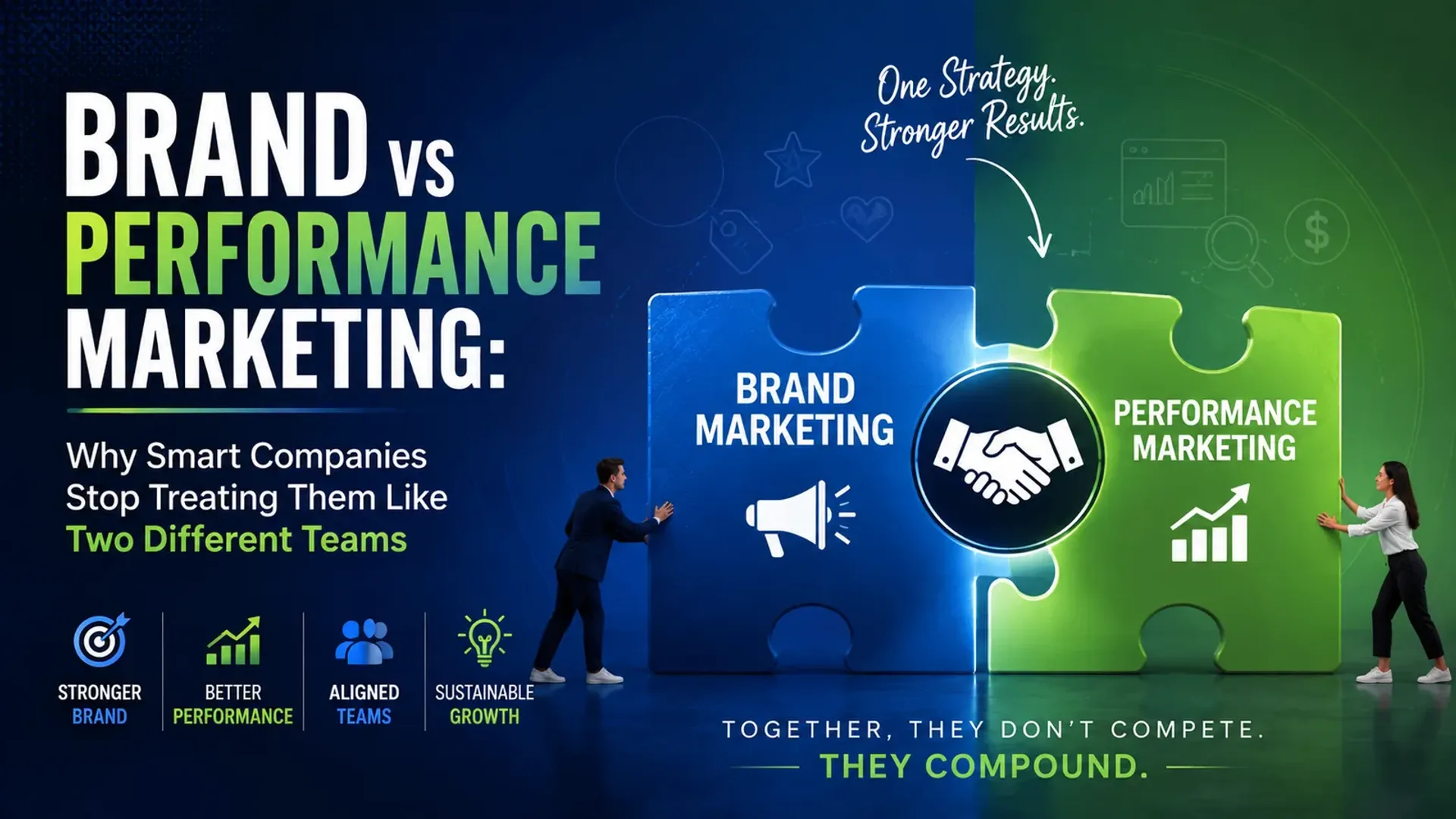
Brand and performance were never supposed to be two competing marketing strategies.
They are two different jobs within the same growth system.
One creates demand.
The other captures it.
One makes people remember you.
The other gives them a reason to act.
And when companies force these two functions to compete for the same budget, they often end up optimizing for the thing that is easiest to measure rather than the thing that actually grows the business.
The performance marketing trap
Performance marketing became incredibly popular for an obvious reason.
It gives you numbers.
You can see impressions.
Clicks.
CPC.
CTR.
Leads.
Conversions.
CPA.
Revenue.
ROAS.
If you spend $10,000 and generate $35,000 in tracked revenue, you have something concrete to show your CFO.
Brand marketing is harder.
If someone watches your brand film today and searches for your company six months later, which campaign gets credit?
If someone sees your logo ten times before finally buying, which impression caused the sale?
If a customer chooses you because your brand feels more trustworthy than a cheaper competitor, where does that appear in your Google Ads dashboard?
It usually doesn't.
And that's one reason businesses have increasingly shifted money toward performance.
Nielsen's 2024 Annual Marketing Report found that 70% of marketers planned to prioritize performance marketing over brand-building initiatives, even though long-term ROI remained one of their major goals.
The attraction is understandable.
When budgets are under pressure, it feels safer to invest in something you can measure tomorrow.
But marketing doesn't always work on a tomorrow timeline.
The problem with measuring everything like a conversion
Imagine you're launching a new coffee brand.
Nobody knows you.
Nobody has heard of you.
Nobody has searched for your brand.
You run Google Search Ads.
You get very little demand.
So you conclude:
“Google isn't working.”
But Google didn't fail.
There simply wasn't enough existing demand to capture.
Now imagine that, for six months, you run distinctive social content, creator campaigns, outdoor advertising and video that introduce the brand to your market.
People start recognizing the packaging.
They hear the name.
They see reviews.
They talk about it.
Then one day, they search:
“[Brand name] coffee.”
Now your Google campaign looks fantastic.
High conversion rate.
Strong ROAS.
Low CPA.
But here's the interesting part:
Google didn't create all that demand by itself.
The brand did.
This is why looking at individual channels in isolation can produce misleading conclusions.
Nielsen has made a similar point in its recent research, arguing that brand building and performance marketing are interdependent rather than mutually exclusive.
Performance marketing is excellent at harvesting demand
This is where performance marketing is incredibly powerful.
Someone searches:
“best CRM for small business.”
They're already interested.
Someone clicks a retargeting ad after visiting your pricing page.
They're interested.
Someone searches your brand name.
They're interested.
Someone watches three product videos and then receives a demo offer.
They're interested.
Performance marketing is exceptionally good at taking that existing intent and turning it into action.
That's why it belongs in almost every modern marketing strategy.
But there is a limit.
You can't harvest demand forever if you aren't creating new demand.
Eventually, you're competing for the same people, the same searches and the same customers.
And that's where brand comes in.
Brand marketing creates the preference performance marketing needs
Brand isn't just a fancy logo.
It isn't your color palette.
It isn't a brand guideline PDF that nobody opens after the design team finishes it.
A brand is, in very practical terms, the collection of associations people have with your company.
What do they think you are good at?
Do they trust you?
Do they remember you?
Do they understand what makes you different?
Would they consider you if a competitor offered a similar product?
Would they pay a little more for you?
Those things eventually affect performance.
And there is some interesting evidence behind this.
In January 2026, the IPA published an analysis of 812 advertising campaigns from its Effectiveness Databank.
Among for-profit campaigns that achieved very large increases in brand trust, 93% also reported at least one very large business effect, such as substantial growth in sales, market share or profit.
Across all for-profit campaigns in the database, that figure was 66%.
That's a significant difference.
Trust isn't just a “brand metric.”
It can influence business outcomes.
The customer doesn't think in funnels
This is another reason the brand-versus-performance debate feels increasingly outdated.
Marketers love funnels.
Awareness.
Consideration.
Conversion.
Retention.
Nice and neat.
Real people aren't.
A potential customer might see your Instagram Reel in the morning.
Read a Reddit discussion about your product at lunch.
Watch a YouTube review two weeks later.
Search your competitor.
Visit your website.
Forget about you.
See your ad again.
Ask a friend.
Come back three months later.
Then buy.
There isn't a little arrow floating above their head saying:
“Congratulations. You have now entered the consideration stage.”
Their journey is messy.
And every interaction contributes something.
Nielsen's research on full-funnel marketing makes exactly this point: short-term performance and long-term brand effects need to be connected rather than treated as separate systems.
Here's where companies get themselves into trouble
A common structure looks like this:
Brand team
“Let's build awareness.”
Performance team
“Let's generate leads.”
Content team
“Let's increase engagement.”
SEO team
“Let's get traffic.”
Sales team
“Why aren't these leads converting?”
Everyone has a dashboard.
Everyone has KPIs.
Everyone is technically doing their job.
And yet the customer experiences one company.
Not five departments.
If the brand says:
“We're premium.”
But the performance ads scream:
“CHEAP! 50% OFF! BUY NOW!”
You've created a contradiction.
If your brand talks about simplicity but your landing page has seven CTAs, 14 navigation options and three competing offers, you've created another contradiction.
If your social content feels human but your paid ads sound like they were written by a legal department, you've created another.
The problem isn't that any one team is bad.
The problem is that the teams aren't building the same story.
Brand should make performance easier
Here's a useful way to think about the relationship.
Brand doesn't replace performance.
Brand makes performance more effective.
Imagine two companies selling almost identical products.
Company A is completely unknown.
Company B is familiar, trusted and distinctive.
Both run the same Google campaign.
Both bid on the same keyword.
Both have similar landing pages.
Who do you think has an easier time convincing someone to click?
And who has an easier time convincing them to buy?
Recognition changes the equation.
Trust changes the equation.
Familiarity changes the equation.
A strong brand can reduce the amount of convincing required at the bottom of the funnel.
That's one reason building a brand shouldn't be treated as money taken away from performance.
It can be an investment in future performance.
And performance should make brand smarter
The relationship works in the other direction too.
Performance data can be incredibly useful for brand teams.
Suppose you test five different messages in paid advertising.
One talks about price.
One talks about speed.
One talks about convenience.
One talks about status.
One talks about reliability.
The reliability message produces fewer clicks—but dramatically better conversion rates and higher customer value.
That's a signal.
Maybe the market doesn't just want the product.
Maybe reliability is part of the reason people choose the brand.
Performance data can help uncover those patterns.
The mistake is treating performance marketing as nothing more than a sales machine.
It can also be a giant, constantly running research laboratory.
The 60:40 rule isn't a magic formula
You've probably heard the famous 60:40 split.
Roughly 60% of advertising investment toward long-term brand building and 40% toward short-term activation.
The principle comes from the work of Les Binet and Peter Field and their research into advertising effectiveness.
But don't turn that into another spreadsheet rule.
Your business isn't identical to every company in the IPA Effectiveness Databank.
A new startup with limited cash flow may need a different balance from an established consumer brand.
A B2B company with a six-month sales cycle will have different requirements from an ecommerce company selling $30 products.
A seasonal business will behave differently from a subscription business.
The point isn't:
“Always spend exactly 60% on brand.”
The point is:
Don't sacrifice long-term demand just because short-term performance is easier to measure.
The IPA's latest 2026 work goes even further, warning that the industry's growing obsession with efficiency and short-term metrics can undermine long-term effectiveness.
That's an important distinction.
Efficiency asks:
“Did we get more from the money we spent?”
Effectiveness asks:
“Did the money we spent actually help the business grow?”
Those aren't always the same question.
What happens when performance becomes the entire strategy?
Let's say your company has a fantastic performance marketing engine.
You have paid search.
Paid social.
Retargeting.
Affiliate marketing.
Email automation.
Everything is optimized.
For a while, growth looks great.
Then something happens.
Your acquisition costs start rising.
Your audience gets saturated.
Your competitors start bidding on the same keywords.
Your ads start looking similar.
Your discounts become bigger.
Your customers become more price-sensitive.
Suddenly, the performance machine that once looked unbeatable starts getting expensive.
Why?
Because everyone is fighting over the same bottom-of-funnel demand.
This is what happens when you spend too much time harvesting and not enough time planting.
The strongest brands don't choose between the two
Look at the companies that have managed to become both memorable and commercially effective.
They don't treat advertising as:
Brand OR conversion.
They create campaigns that can do both.
A strong brand campaign can make someone remember you.
A strong performance campaign can give that person the final reason to act.
A social video can build familiarity.
A retargeting ad can bring someone back.
A great landing page can remove friction.
A customer review can build trust.
A sales promotion can create urgency.
None of these things have to work alone.
They're pieces of the same system.
So what should a modern marketing team actually do?
Start by stopping the argument over ownership.
Instead of asking:
“Is this a brand campaign or a performance campaign?”
Ask:
“What job does this piece of marketing need to do?”
Maybe the job is to introduce the company.
Maybe it's to create demand.
Maybe it's to build trust.
Maybe it's to capture existing demand.
Maybe it's to convert a warm audience.
Maybe it's to bring back an existing customer.
Then choose the right creative, channel and measurement system for that job.
This sounds obvious.
But it changes how teams operate.
Build one customer story
Your brand campaign, social content, paid ads and website shouldn't feel like they're coming from four different companies.
They can have different formats.
They can have different objectives.
But the underlying positioning should be consistent.
Measure more than last-click revenue
Revenue matters.
Of course it does.
But so do awareness, consideration, branded search, direct traffic, customer acquisition cost, repeat purchase, conversion rate, market share and customer value.
The right metrics depend on the job the marketing is doing.
Let performance data influence creative
Don't wait six months for a brand study to tell you what customers care about.
Your campaigns are already generating signals.
Use them.
Give brand time to work
A brand isn't built in a two-week campaign.
The IPA's 2026 research emphasizes the importance of sustained investment: brands are built over years even though business performance is often judged quarter by quarter.
That doesn't mean brand campaigns shouldn't be accountable.
It means they need to be evaluated on the timescale on which they can realistically create an effect.
The agency model needs to change too
This is perhaps the biggest opportunity.
Traditional agencies often separate their services.
Branding agency.
Creative agency.
Media agency.
Performance agency.
SEO agency.
Web agency.
Then the client has to somehow make all these pieces work together.
But the customer doesn't experience them separately.
They experience one brand.
That's why the modern agency needs to operate more like a connected growth partner.
The creative team should understand performance.
The performance team should understand brand.
The web team should understand conversion.
The strategy team should understand all three.
And everyone should understand the customer.
That's when the work starts getting interesting.
Brand builds the reason. Performance captures the moment.
This is probably the simplest way to think about it.
Brand answers:
“Why should I remember you?”
“Why should I trust you?”
“Why are you different?”
“Why would I choose you?”
Performance answers:
“Why should I act now?”
“Where do I click?”
“What should I buy?”
“How do I get started?”
One creates preference.
The other converts preference into action.
And sometimes the same piece of creative can do both.
That's the sweet spot.
The future isn't brand versus performance
The industry has spent years trying to divide marketing into neat categories.
Brand people versus performance people.
Creative versus media.
Awareness versus conversion.
Long-term versus short-term.
But customers don't care about those organizational boundaries.
They care about whether your company is relevant, credible, memorable and worth choosing.
And modern marketing needs to deliver all four.
The smartest companies won't ask:
“How much should we spend on brand versus performance?”
They'll ask:
“How do we build demand, capture demand and make every part of that journey reinforce the same brand?”
That's a much harder question.
But it's also a much better one.
Because ultimately, growth doesn't happen when brand wins.
And it doesn't happen when performance wins.
Growth happens when they work together.
Tap the button and Google will show you our new articles more often — in Search, Top Stories and AI Overviews.
Have a project in mind?
Let’s turn it into an intelligent product. Book a free 30-minute discovery call.
Start your project →