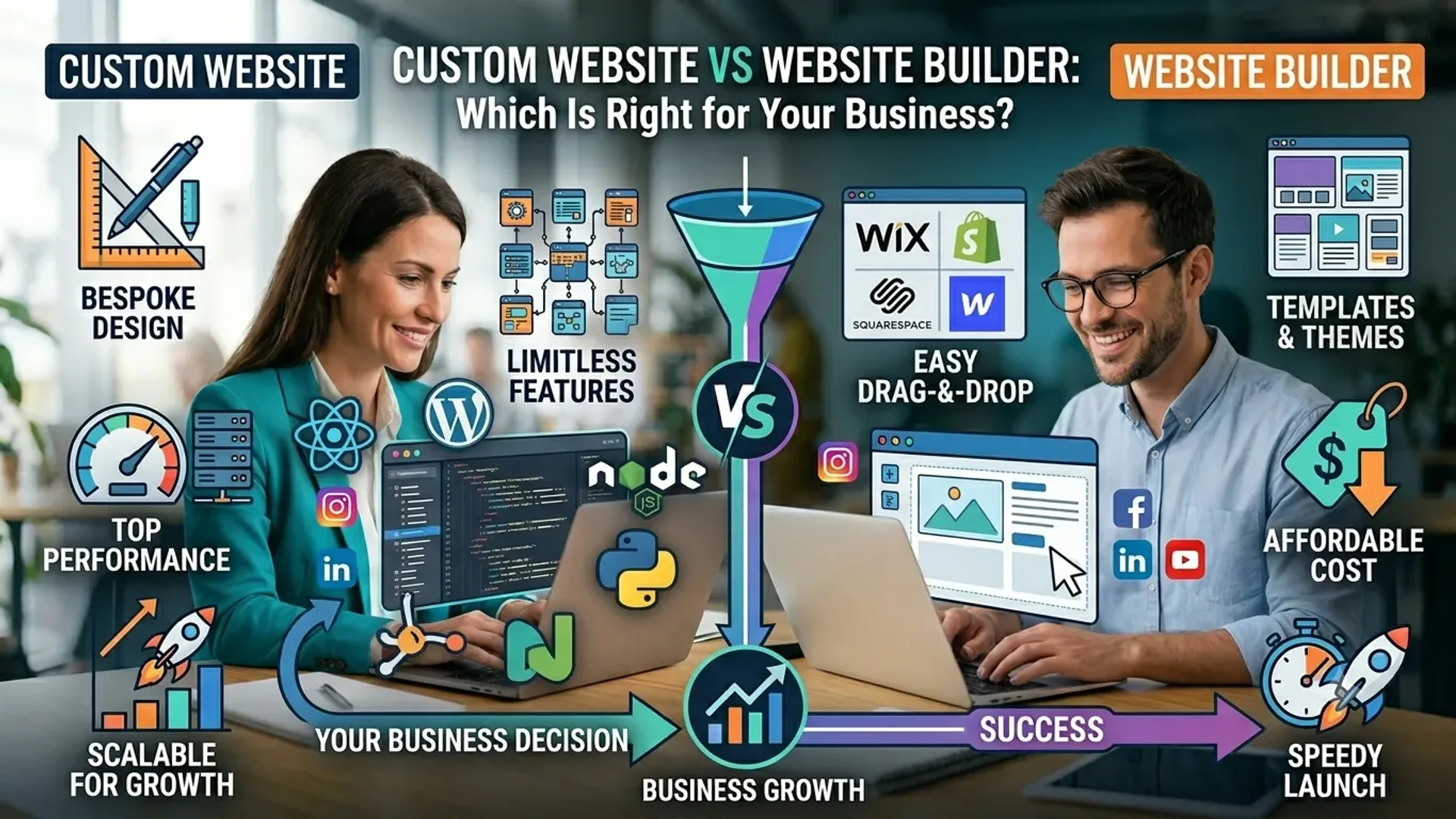
Sarah runs a boutique event-planning business. She's booked solid, getting referrals, and her current site — a Squarespace template she knocked together in a weekend three years ago — is starting to feel like a liability. Enquiries trickle in but rarely convert. The booking form sends data nowhere useful. Her Instagram looks sharp; her website looks like a placeholder. She's had two web agencies quote her between £4,000 and £9,000 for a custom build, and she keeps going back to her Squarespace dashboard wondering if she's overthinking it.
This is the decision that trips up more business owners than almost any other. It feels simple — "pay less and DIY it" versus "pay more and do it properly" — but the real calculus is messier. The wrong choice in either direction costs you, just in different ways and on different timelines.
This guide won't tell you custom is always better. It isn't. But it will give you an honest breakdown of what each option actually costs, where each breaks down, and the specific signals that tell you it's time to stop patching a template.
What We're Actually Comparing
Website builders — Wix, Squarespace, Webflow (to a degree), Shopify for e-commerce — give you a hosted environment, a visual editor, pre-built templates, and a monthly subscription. Everything runs on their infrastructure, under their rules.
Custom web development means a site built from scratch (or on a framework like WordPress, Laravel, or Next.js) by a developer or agency, hosted on infrastructure you control, designed specifically for your business logic. You own the code. You own the data. You control what it can do.
Neither is inherently superior. They solve different problems for businesses at different stages. The mistake is applying a stage-one solution to a stage-three problem — or spending £8,000 on a custom build when a £20/month Squarespace plan would have done the job for the next two years.
The Real Cost Comparison: Upfront vs Total Cost of Ownership
The builder pitch is compelling on paper: get online for £15–£30 a month, no developer needed. A custom site might cost £3,000–£15,000 to build, plus ongoing hosting and maintenance. The gap looks enormous until you do the maths over five years.
Website builder — what you actually spend
- Monthly subscription: £15–£50/month depending on plan and add-ons
- Third-party plugins and integrations: these add up fast — a booking tool here, a CRM connector there, an email marketing add-on — often another £30–£100/month
- Premium templates: one-off £50–£200
- Freelancer fixes: most business owners end up paying someone to do things the editor can't handle easily — £500–£1,500 over the life of the site
- Five-year total: easily £4,000–£7,000, with no asset at the end (you don't own any of it)
Custom website — what you actually spend
- Build cost: £3,000–£12,000 for a professional small-business site (varies by complexity and agency)
- Hosting: £10–£50/month depending on setup
- Maintenance/updates: £100–£300/month if managed, or periodic freelance fees
- Five-year total: £9,000–£20,000 — but with an asset you own, performance built to your needs, and no platform dependency
The builder wins on cash flow. The custom site often wins on return — if it's converting better, ranking higher, and saving you staff time through automation. If neither is true, you're just paying more for the same outcome.
"The cheapest website is the one that converts. A £500/month custom site that turns visitors into clients beats a £20/month template that doesn't."
Speed, SEO, and Performance: Where Builders Quietly Lose
This is the conversation most builder salespeople skip. Page speed matters — Google uses it as a ranking signal, and visitors abandon slow pages fast. Studies consistently show that a one-second delay in load time can cut conversions by 7%. That's not a rounding error.
Most website builders, particularly Wix and older Squarespace versions, produce heavier pages than necessary. They load platform-level JavaScript, tracking scripts, and editor infrastructure that your visitor's browser has to parse before your content even appears. A Wix site loading in 4.5 seconds and a custom Next.js site loading in 1.2 seconds are not equivalent products — they just look similar in a screenshot.
There's also the question of SEO control. Builders have improved here — you can edit title tags, meta descriptions, and alt text in most of them. But canonical tags, structured data, crawl directives, and server-side rendering behaviour are harder to control than on a custom build. For a local service business ranking for a handful of terms, the builder is usually fine. For a site competing across dozens of pages and locations, those limitations compound.
For a deeper look at what's holding your site back, this post on why websites don't generate leads covers the pattern in detail.
Flexibility, Ownership, and What Happens When You Want to Change Something
Here's a scenario that plays out constantly. A business grows and decides to add an online booking system with payment processing, automated confirmation emails, and a client portal. On a custom site: doable. On Squarespace: you're limited to what the platform supports natively or via approved third-party apps. Non-standard use cases get stuck.
Ownership is the other dimension people underestimate. With a builder, you don't own the underlying technology. If the platform changes its pricing, kills a feature, or shuts down, you're migrating on their timeline. With a custom site on your own hosting, you control the code, the data, and the infrastructure.
Webflow sits in an interesting middle ground — it offers more design flexibility than Wix or Squarespace and produces cleaner code, but you're still on their platform and still constrained by what their CMS and hosting can do. It's a reasonable option for design-heavy sites that don't need complex backend logic.
Integrations and Automation: The Hidden Dividing Line
This is where the Wix-vs-custom-website question gets interesting for businesses that are actually trying to grow.
Modern businesses run on connected systems. Your CRM needs to know when someone fills in a form. Your booking system needs to sync with your calendar and fire a confirmation email. Your lead nurture sequence needs to trigger based on what pages someone visited.
Builders support some of this via Zapier and native integrations — but at the surface level. You can connect Wix to Mailchimp. What you can't do is build a custom webhook that fires on a specific condition, passes data through logic, and updates three systems simultaneously without code the builder won't let you run.
Custom development opens up this entire layer. And increasingly, this is where the ROI on a proper build lives — not in the design, but in the automation it enables. If you're thinking about connecting your website to a CRM, booking engine, or AI-driven lead qualification system, the web development page outlines what's possible when you're not working within a template's constraints.
When a Website Builder Is Genuinely the Right Call
This matters. Too many web agencies (including some good ones) talk every client into a custom build when a builder would have served them fine for years. Here's when a builder makes sense:
- You're validating a business idea. You need to exist online, get some feedback, and see if there's demand. Spending £8,000 on a custom site before you have product-market fit is a bad bet.
- Your website is genuinely a brochure. If your leads come via referrals and word of mouth, and the website just needs to look credible and list your services, a well-built Squarespace or Webflow site does that perfectly.
- You have a small, fixed budget and time to learn. A capable builder with a clean template, well-written copy, and proper on-page SEO will outperform a cheap custom build done by a poorly briefed developer.
- Your integration needs are simple. If you just need a contact form and an email list signup, you don't need custom development.
- You change your content frequently and want to do it yourself. Modern builders have excellent visual editors. Some custom CMSes are brilliant; others are painful to use without developer help.
When Custom Web Development Pays Off
Equally, there are clear situations where the builder stops serving you — and often, businesses limp along past these signals for 12–18 months longer than they should.
- Your conversion rate is a problem. If you're getting traffic and not converting it, a builder template is rarely the tool for a serious CRO programme. A custom build lets you test, instrument, and optimise at a level templates don't allow.
- You need integrations the platform can't support. Once you need a custom API integration, real-time data, or multi-system automation, custom is the only realistic path.
- You're investing in SEO at scale. Programmatic pages, custom structured data, advanced technical SEO — these require control over the codebase.
- Your brand requires a unique design. Templates, no matter how customised, have a ceiling. If your competitor's site and your site look like they came from the same Squarespace library (they probably did), that's a brand problem.
- You're processing significant e-commerce volume. Shopify handles a lot, but once you need custom fulfilment logic, bespoke product configurators, or tight ERP integration, you're in custom territory.
- The site is a genuine business asset. If the website is responsible for generating most of your revenue, treating it as a cost centre rather than an investment is the wrong mental model.
You've Outgrown Your Template When...
Here's the checklist. If three or more of these are true, you're probably past the point where patching a builder is the right move:
- Your developer or VA has hit a wall trying to make the builder do something it wasn't designed for
- You've added so many third-party integrations that your monthly tool spend rivals what a custom build would have cost
- Your page speed scores are consistently poor and the platform is the reason
- You've had to turn down a feature or automation because "the website doesn't support it"
- You look at competitors with strong organic search presence and your template is structurally preventing you from matching their SEO architecture
- Customers complain that your site is hard to navigate or doesn't work on mobile
- You're embarrassed to send someone to your website
- You need user accounts, a client portal, or gated content
- You're handling enough online revenue that a 0.5% improvement in conversion rate is worth several thousand pounds a year
"The question isn't 'can my builder do this?' It's 'how much time and money am I spending making it work when it wasn't designed for this?'"
Actionable Takeaways
- Run your current site through Google PageSpeed Insights. If your mobile score is below 60, that's costing you in search and conversions regardless of platform.
- List every third-party tool you're paying for to extend your builder's functionality. Add up what you're actually spending monthly.
- Check against the "outgrown" checklist above. Three or more is a signal.
- If you're in the "right call for a builder" bucket, optimise what you have: better copy, faster images, cleaner navigation, and a clearer CTA on every page before you spend anything else.
- If you're evaluating a custom build, ask any prospective agency to show you how they handle performance, SEO architecture, and CMS usability — not just design work.
- Get a free website audit before you make the call. You might be fixable; you might need a rebuild. You won't know until someone looks properly.
Frequently Asked Questions
Is Wix good enough for a small business website?
For many small businesses — local services, early-stage brands, consultants, simple e-commerce — Wix is genuinely good enough. The editor is capable, the templates are clean, and it won't limit you if your needs stay simple. Where it struggles is performance at scale, complex integrations, and advanced SEO. If your site is a credibility tool rather than a revenue engine, Wix can serve you well for years.
How much does a custom website cost compared to a website builder?
A basic custom website typically starts at £2,500–£4,000 for a small agency or freelancer, and £7,000–£15,000 for a more complex site with integrations. A website builder costs £15–£50/month but accumulates costs through add-ons, plugins, and workarounds. Over five years, the gap narrows significantly — especially when you factor in the value of what the custom site can do for your business that the builder can't.
Can I migrate from a website builder to a custom site later?
Yes, and it's done all the time. The main costs are recreating content, redirecting URLs to preserve SEO equity, and migrating any form or database data. The longer you wait, the more entangled your business processes become with the builder's tools — which is one reason not to delay the switch once you've outgrown it.
Should I use a website builder or hire a web developer?
Start by being honest about what you need the site to do. If it needs to generate leads, convert paid traffic, or integrate with your CRM, a developer gives you considerably more to work with. If it just needs to exist and look credible, a builder is faster and cheaper. The decision comes down to what role the website plays in your revenue model.
Does a custom website rank better on Google than a website builder site?
Not automatically — a badly built custom site will rank worse than a well-optimised Squarespace site. But a custom site gives you more control over the technical factors that influence rankings: page speed, URL structure, structured data, and crawl behaviour. For competitive industries where technical SEO is a real lever, that control matters. For local businesses in lower-difficulty searches, a builder's SEO tools are often sufficient.
What's the fastest way to know if my website is holding my business back?
Run it through Google PageSpeed Insights and Search Console. Then ask yourself: if a potential client arrived cold, would they trust you enough to get in touch? If the honest answer is no, the site is costing you business — whatever platform it's on.
The Honest Answer
The custom website vs website builder question doesn't have a universal answer. It has a right answer for your business, at this stage, with these goals. A builder is often the smart choice when you're early, simple, or testing. A custom build is the necessary choice when you're growing, integrating systems, and treating the website as a commercial asset rather than an online business card.
What's rarely right is staying on a platform you've outgrown. The cost of inaction — slow load times, missed conversions, integrations you can't build — tends to exceed the cost of acting.
If you're not sure which side of the line you're on, the free website audit is a good starting point. It's a real look at what your site is doing well, where it's losing you business, and whether your current platform can realistically fix the problems — or whether it's the problem. If you already know you need a proper build and want to talk through what that looks like for your business, the web development service page is the place to start.
Tap the button and Google will show you our new articles more often — in Search, Top Stories and AI Overviews.
Have a project in mind?
Let’s turn it into an intelligent product. Book a free 30-minute discovery call.
Start your project →