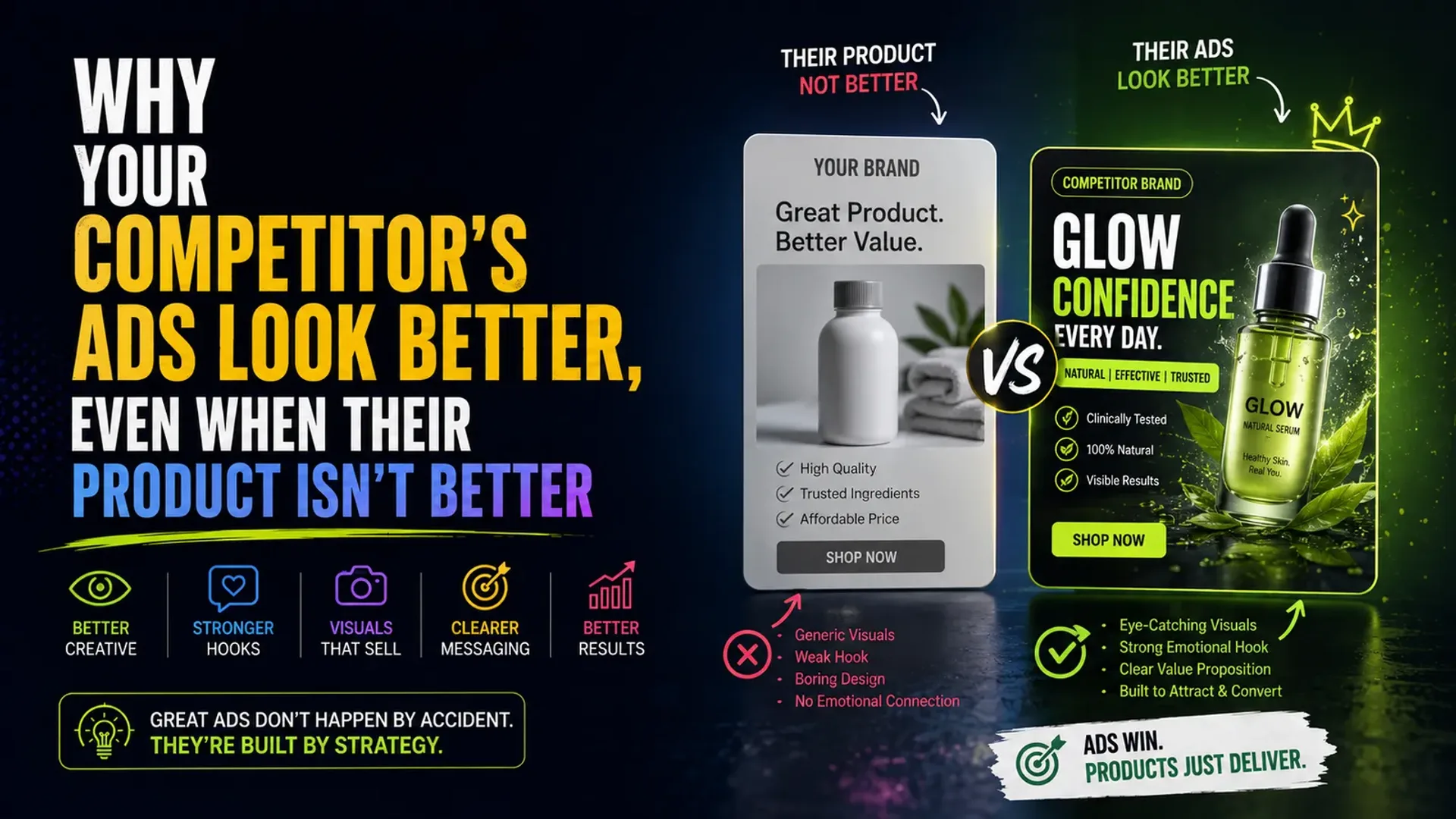
You've probably seen this happen.
You know your product is good.
Maybe it's even better than the competitor's.
Your team has spent months improving it.
You've got better features.
Better customer support.
Better technology.
Maybe even a better price.
Then you open Instagram.
And there they are.
Your competitor.
Their ad has 2 million views.
The comments are full of people saying things like:
“I need this.”
“Where do I buy it?”
“This is exactly what I've been looking for.”
And you look at your own campaign.
Silence.
The natural reaction is:
“Their marketing budget must be bigger.”
Maybe.
But that's not always the answer.
Sometimes your competitor isn't winning because they have a better product.
They're winning because they've made their product easier to understand, easier to remember and easier to want.
And that's a very different problem.
People don't buy the best product. They buy the product that makes the most sense to them.
This is one of the hardest things for businesses to accept.
Companies know their products incredibly well.
They know every feature.
Every specification.
Every improvement.
Every technical advantage.
So when they create advertising, they naturally want to explain all of it.
The problem is that customers don't have the same level of interest.
They aren't studying your product.
They're trying to solve a problem.
That's why a technically superior product can lose to an inferior one.
The better product isn't always the better choice in the customer's mind.
And marketing happens in the customer's mind.
Your competitor may simply be better at framing the problem
Imagine two project-management software companies.
Product A has:
37 features
AI automation
Advanced reporting
Custom dashboards
50 integrations
Product B has fewer features.
Its ad says:
“Stop asking your team for project updates.”
That's it.
No feature list.
No technical explanation.
No giant screenshot of the dashboard.
Just a problem.
And suddenly, Product B feels easier to understand.
A manager who's spent every Monday chasing status updates immediately gets it.
That's positioning.
The company isn't necessarily saying:
“We have the best project-management software.”
It's saying:
“We solve a problem you already hate.”
That's much more powerful.
The brain doesn't want more information
This is where marketing meets psychology.
Humans are exposed to an enormous amount of information every day.
Ads.
Emails.
Notifications.
Videos.
News.
Messages.
Product recommendations.
Social posts.
Search results.
Your potential customer doesn't have enough attention to deeply evaluate every option.
So the brain uses shortcuts.
Research in behavioral science has repeatedly shown that people rely on heuristics—mental shortcuts that help them make decisions without processing every piece of information available.
One particularly relevant concept is processing fluency: information that is easier to understand or process can feel more familiar, credible or appealing.
That doesn't mean people automatically choose the simplest product.
It means that clarity reduces the mental effort required to understand your proposition.
And advertising has a very small window to achieve that clarity.
Your competitor may simply be winning that race.
Look at the difference between features and meaning
Consider a hypothetical accounting platform.
Its website says:
“Cloud-based accounting infrastructure with automated reconciliation, real-time reporting and multi-entity financial management.”
Sounds impressive.
Now imagine an ad saying:
“Know where your money went before the month ends.”
Same product.
Different communication.
The second statement gives the customer something they can picture.
It connects the product to an outcome.
That's what great creative does.
It translates what the product is into why the customer should care.
Your competitor might not have better ads. They might have better ideas.
This distinction matters.
A good-looking ad isn't necessarily a good ad.
You can spend $50,000 producing a beautiful campaign and still communicate nothing.
Meanwhile, someone with a phone, a decent idea and a customer who genuinely understands the problem can produce something far more effective.
This is particularly obvious on platforms such as TikTok, Instagram and YouTube.
People aren't sitting there waiting for advertisements.
They're consuming entertainment and information.
So the creative has to earn attention.
Meta's advertising guidance increasingly emphasizes creative diversification—different concepts, formats and visual approaches—because different creative can help its systems find more opportunities among different audiences. Meta Blueprint — Creative Diversification
That means your competitor might not be winning because they found some secret targeting trick.
They might simply have more compelling creative inputs.
The hook changes everything
Let's take a simple example.
You're an agency selling marketing services.
Your ad says:
“We provide full-service digital marketing solutions for growing businesses.”
Technically fine.
Also incredibly easy to ignore.
Now compare:
“Your marketing agency is sending you reports. But are they sending you customers?”
Different.
It creates tension.
It challenges the status quo.
It speaks directly to a frustration.
And most importantly, it creates a reason to keep watching.
That's the job of a hook.
Not to explain everything.
To earn the next five seconds.
Your competitor may understand the customer's pain better
This is where good creative usually begins.
Not inside Photoshop.
Not inside Premiere Pro.
Not inside Ads Manager.
Inside customer research.
Let's say you're selling a virtual assistant service.
You might think the customer wants:
“A highly trained virtual assistant.”
Maybe.
But after talking to customers, you discover what they actually say is:
“I can't keep spending my evenings doing admin work.”
Now you have something.
The product hasn't changed.
The audience hasn't changed.
The price hasn't changed.
But the message has.
Instead of selling a VA, you're selling their evenings back.
That's much more emotionally powerful.
Your best marketing language may already exist
One of the most underrated sources of advertising ideas is your own customer base.
Read your reviews.
Not just the five-star ones.
Read the three-star reviews.
Read the complaints.
Read support conversations.
Listen to sales calls.
Look at emails from prospects.
Search Reddit.
Read competitor reviews.
Pay attention to the words people use.
If ten customers independently describe your product as:
“The easiest tool we've ever implemented.”
That's not just a customer comment.
It could be positioning.
If people repeatedly say:
“We finally stopped worrying about this.”
That's marketing language.
If prospects repeatedly ask:
“Will this work with my existing system?”
That's an objection.
Your customers are essentially writing your creative brief for you.
You just need to collect the patterns.
Stop trying to explain everything in one ad
This is one of the biggest mistakes brands make.
They want the customer to know:
What the product does
How it works
Why it's different
How much it costs
What features it has
Who it's for
Why the company was founded
Why they should trust it
So they put all of it into one video.
The result?
A 60-second corporate monologue.
And the customer is gone after six seconds.
Your ad doesn't need to tell the entire story.
It needs to make the next step feel worthwhile.
Think of your advertising as a series of conversations.
The first ad earns attention.
The next explains the problem.
Another demonstrates the solution.
Another handles objections.
Another provides proof.
Another makes the offer.
You don't need one ad to do everything.
The competitor's visual identity might be doing more work than you realize
Sometimes the difference isn't the copy.
It's recognition.
Think about brands you can recognize without seeing their name.
A particular color.
A typeface.
A photography style.
A packaging shape.
A distinctive sound.
A recurring character.
A visual treatment.
These assets become shortcuts.
You see them and immediately know who is speaking.
That's enormously valuable in a crowded advertising environment.
Your competitor might have spent years building those associations.
You can't necessarily recreate them with one campaign.
But you can start building your own.
Distinctiveness matters
There is a reason so many brands end up looking the same.
Same fonts.
Same gradients.
Same stock photos.
Same laptop mockups.
Same “AI” graphics.
Same smiling office teams.
Same generic corporate language.
The result is predictable.
Everyone becomes visually interchangeable.
And when everyone looks the same, nobody gets remembered.
The challenge isn't simply to look “professional.”
Every serious company can do that.
The challenge is:
Can someone recognize your brand before they see your logo?
That's a much higher standard.
But don't confuse distinctive with weird
There is another trap.
Some brands hear:
“We need to stand out.”
And respond by making everything strange.
Crazy typography.
Random animations.
Unrelated colors.
Shock value.
A confusing headline.
That's not differentiation.
That's noise.
Good creative should be distinctive and relevant.
The visual should help communicate the idea.
The tone should match the audience.
The message should still make sense.
Standing out isn't the objective.
Being remembered for something relevant is.
Your competitor may simply be more confident
There's another psychological difference you see in advertising.
Some brands are afraid to make a clear claim.
So they write:
“We aim to help businesses potentially improve productivity through innovative solutions.”
Nobody knows what that means.
Meanwhile, the competitor says:
“We cut reporting time by 80%.”
One sounds safe.
The other sounds confident.
Of course, confidence without evidence is just marketing theatre.
A strong claim needs proof.
Case studies.
Customer numbers.
Demonstrations.
Reviews.
Data.
Before-and-after results.
But when you can substantiate the claim, being specific is usually more powerful than hiding behind vague language.
Proof changes everything
Suppose your competitor says:
“The world's leading marketing platform.”
You say:
“Trusted by 4,000 businesses.”
Which is more useful?
The second.
Because it's concrete.
Or imagine:
“Our software makes your business more efficient.”
versus:
“Customers reduced manual reporting time by an average of 7.4 hours per week.”
Again, the second gives the brain something to evaluate.
That's why proof should be treated as a creative asset.
Not something you hide on a case-study page.
Use it.
Show it.
Demonstrate it.
Make it part of the story.
The strongest ads often show the problem before the product
This is another reason competitor ads can feel more compelling.
They don't immediately start talking about themselves.
They start with you.
Your problem.
Your frustration.
Your situation.
Your desired outcome.
Only then do they introduce the product.
Think about the difference.
Product-first
“Our platform uses advanced AI to automate business workflows.”
Problem-first
“Your team shouldn't need five people to move information from one spreadsheet to another.”
The second makes you want to know what the solution is.
That's the power of tension.
Problem → consequence → solution.
Instead of:
Product → features → features → features.
Don't copy your competitor. Deconstruct them.
If your competitor's advertising is outperforming yours, don't immediately recreate their design.
Study it.
Ask:
What are they saying?
Who are they saying it to?
What problem are they highlighting?
What emotion are they using?
What proof are they showing?
What happens in the first three seconds?
What makes the creative recognizable?
What objection are they handling?
What action are they asking for?
Then ask the most important question:
“What customer insight are they exploiting that we're ignoring?”
That's where competitive analysis becomes useful.
Copying their ad won't give you their advantage.
Understanding the thinking behind it might.
Build a creative competitor matrix
You can make this surprisingly simple.
Take your five biggest competitors and analyze 20–30 pieces of their advertising.
Look for patterns.
| Element | Competitor A | Competitor B | Competitor C |
|---|---|---|---|
| Primary promise | Save time | Save money | Reduce risk |
| Main audience | Founders | SMBs | Enterprise |
| Hook style | Problem | Statistic | Question |
| Visual style | UGC | Product demo | Premium |
| Proof | Testimonials | Case studies | Logos |
| CTA | Book a demo | Start free | Learn more |
| Emotional angle | Relief | Control | Confidence |
After a while, patterns appear.
Maybe everyone talks about price.
That's an opportunity to talk about speed.
Maybe everyone uses polished studio videos.
That's an opportunity to use authentic customer stories.
Maybe everyone focuses on features.
That's an opportunity to focus on outcomes.
The goal isn't to be different for the sake of being different.
It's to find an open position in the customer's mind.
Performance data should be part of the creative process
Competitive research tells you what other brands are saying.
Your own campaign data tells you what your audience actually responds to.
And this is where creative and performance marketing need to work together.
Suppose your competitor's ads focus heavily on discounts.
You test a different angle:
“You don't need another discount. You need a product that actually works.”
It performs surprisingly well.
Now you've learned something.
Your audience might be less price-sensitive than you thought.
Or maybe the audience is tired of promotional advertising.
Either way, the data has given your creative team a new direction.
This is why performance marketing shouldn't simply be:
Creative → Ads Manager → Report
It should be:
Insight → Creative → Test → Data → New Insight → New Creative.
Sometimes the problem really is the product
We should be honest about this too.
Better marketing cannot fix everything.
If your competitor has:
A genuinely better product
Better distribution
Better pricing
Better customer service
Better retention
Better reviews
then creative alone won't save you.
Marketing can amplify an advantage.
It can clarify an advantage.
It can make an advantage easier to understand.
But it can't manufacture long-term customer satisfaction.
If your churn is terrible, don't solve it with better ads.
If customers hate the product, don't spend more on branding.
If your offer is uncompetitive, don't blame the media buyer.
Sometimes the best marketing decision is fixing the thing being marketed.
The real competitive advantage is clarity
The brands that consistently communicate well tend to have something in common.
They know exactly what they want to be known for.
Not ten things.
One or two things.
When someone hears the company name, there is an immediate association.
That's the goal.
Not:
“We do everything.”
But:
“They're the company that helps businesses do X.”
Clarity makes advertising easier.
It makes creative easier.
It makes sales easier.
It makes website copy easier.
It makes targeting easier.
It makes the entire marketing system more coherent.
So why does your competitor's advertising look better?
It may not actually be better.
It may simply be:
More relevant.
More distinctive.
More specific.
More emotionally resonant.
Easier to understand.
Better positioned.
Better supported by proof.
More consistent over time.
And those differences compound.
A single clever ad might get attention.
But a clear position repeated consistently across hundreds of customer interactions can build something much more valuable:
memory.
The answer isn't “make prettier ads”
If you're losing attention to a competitor, don't automatically redesign everything.
Start with the fundamentals.
Ask:
What do we want to be known for?
What problem do we solve better than anyone else?
What does our customer actually care about?
What language do they use?
What proof can we show?
What does our competitor own in the customer's mind?
What position is still available to us?
Then turn those answers into creative.
That's where great advertising begins.
Not with a template.
Not with a trend.
Not with whatever font is currently popular on Instagram.
With an insight.
Because your competitor may have a bigger budget.
They may have a bigger team.
They may have more followers.
They may even have a better product.
But if you understand your customer better, you can still find something incredibly valuable:
a better reason for them to choose you.
And sometimes, that's all great advertising really is.
Finding that reason.
Making it impossible to miss.
And saying it in a way people actually remember.
Tap the button and Google will show you our new articles more often — in Search, Top Stories and AI Overviews.
Have a project in mind?
Let’s turn it into an intelligent product. Book a free 30-minute discovery call.
Start your project →