Founder-Led Marketing: Why Your Personal Brand Now Outsells Your Company Page
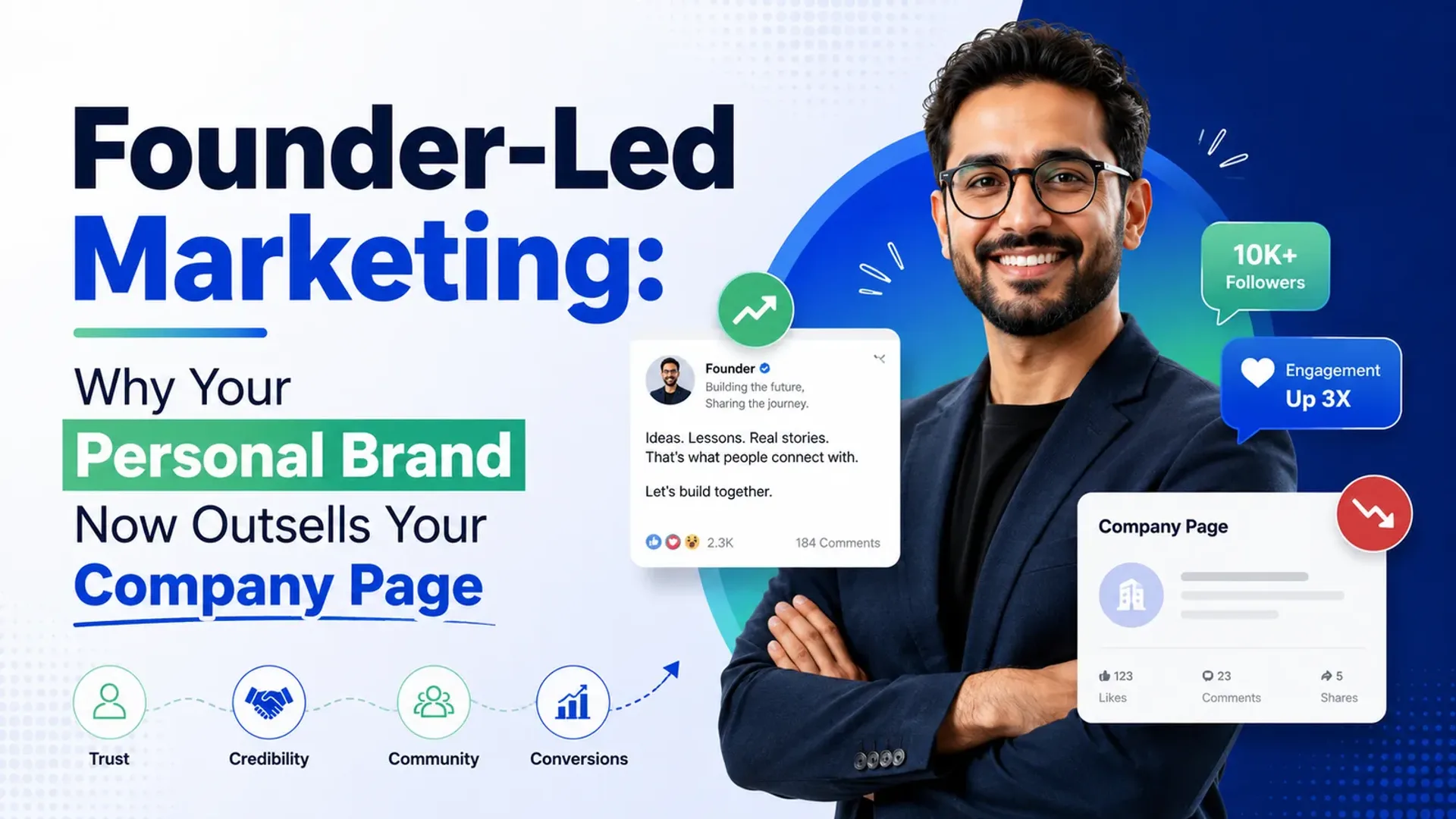
Scroll your feed and count the corporate posts you actually stopped for. Probably close to zero. Now count the ones from a real person sharing a sharp opinion, a hard-won lesson, or a story from inside their business. That gap is the whole argument for founder-led marketing. People do not build relationships with logos. They build them with other people.
This is not a soft, feel-good trend. It is a structural shift in how attention and trust work online. Company pages are treated as advertising and quietly ignored. Individuals are treated as humans and given the benefit of the doubt. When a founder or executive shows up consistently with a genuine point of view, they earn something a brand account almost never can: reach, replies, and belief.
The result is a personal brand that compounds into pipeline. Below is why it works and exactly how to build it without turning into a cringey LinkedIn caricature.
Why People Follow People, Not Logos
Three things make the individual outperform the institution online.
- Trust is personal. We are wired to trust faces and voices, not brand guidelines. A founder admitting a mistake reads as honest. A company page saying the same thing reads as crisis PR.
- Algorithms favor humans. On platforms like LinkedIn and X, content from individuals tends to travel further than content from company pages, because people engage with people. That engagement is the fuel these feeds run on.
- Opinions cut through. A brand account hedges everything to avoid offense, which makes it forgettable. A person can take a stance, and a clear stance is what earns attention and separates you from the wall of beige corporate content.
Nobody has ever forwarded a company mission statement to a friend. They forward the founder who said the thing everyone was thinking.
How Founder-Led Marketing Builds Pipeline
This is where skeptics push back: nice for vanity, but does it sell? It does, through a chain that is slower than an ad but far stickier.
- You share genuine points of view consistently, so the right people start recognizing your name.
- Recognition turns into trust as your audience sees you show up again and again with useful thinking.
- Trust means that when they, or someone in their network, have a problem you solve, you are the first name that comes to mind.
- Warm, inbound conversations replace cold outreach, and they close faster because trust already exists.
That is the compounding effect. Every post is a small deposit into a reputation that pays out in inbound demand over time. It also makes every other channel work harder, because a strong personal presence lifts your social media marketing and warms up your paid and outbound efforts too.
How to Actually Build a Personal Brand
Most people overcomplicate this. You do not need a studio, a ghostwriting team, or a viral hit. You need a clear point of view and the discipline to show up.
Pick your platform and your lane
For most founders and executives, LinkedIn and X are where the business audience lives. Choose based on where your buyers actually spend time. Then decide what you want to be known for, a specific set of topics you can speak on with real authority. Depth beats breadth.
Share a genuine point of view
The content that works is not news summaries or motivational quotes. It is your actual perspective:
- Lessons you learned the hard way, including the failures.
- Opinions on where your industry is heading and why the consensus is wrong.
- Behind-the-scenes decisions and the reasoning behind them.
- Frameworks and mental models you use to make calls.
The test is simple. Could a competitor have posted the exact same thing? If yes, it is too generic. Your experience is the moat.
Tell stories, not bullet-point brags
People remember narratives. A specific story about a deal that went sideways teaches more, and sticks longer, than a list of achievements. Show the tension, the decision, and what you learned. Vulnerability, used honestly, builds more trust than polish.
Be relentlessly consistent
Consistency beats intensity every time. A steady rhythm you can sustain for a year matters more than a burst of ten posts that then goes silent. The audience, and the algorithm, reward people who keep showing up. Momentum is the whole game.
Balancing Personal and Company Brand
The obvious worry: if everything rides on the founder, what happens to the company brand, and what happens if that person leaves? Handle it deliberately.
- Use the personal brand as the front door. The founder earns the attention and trust, then points people toward the company's work, products, and team.
- Build more than one voice. Encourage several leaders and team members to develop their own presence, so trust is distributed rather than resting on a single person.
- Keep the values aligned. The founder's public voice should reflect what the company genuinely stands for, so the two reinforce each other instead of pulling apart.
Done well, the personal and company brands become a flywheel. The founder's reach drives attention to the business, and the business's credibility gives the founder something real to talk about. If you want that flywheel reflected across your website and campaigns, strong brand marketing and a site that converts the attention are what turn followers into customers. A look at the right examples shows how the personal and the polished can work together.
The Bottom Line
Your company page will keep posting into a void that mostly ignores it. Your face, your voice, and your point of view can build a relationship that turns into pipeline. Founder-led marketing wins because trust is personal, attention flows to humans, and a clear opinion beats corporate caution. It is slower than buying ads and far more durable. Start showing up as yourself, consistently, with something real to say, and let it compound.
What if I am not comfortable being the face of the brand?
Start small and let it grow. You do not need to be charismatic or controversial, just genuine and consistent. Share what you know in your own voice. Comfort builds with reps, and you can develop other team voices alongside yours so the weight is shared.
How long before founder-led marketing pays off?
It is a compounding play, not a quick win. Expect to invest months of consistent posting before recognition turns into real inbound conversations. The upside is that the trust you build keeps working long after any single campaign would have stopped.
Should I still run the company page?
Yes, but treat it as support, not the star. The company page handles announcements, credibility, and proof, while the founder drives attention and relationship. If you want help coordinating both, reach out and we will help you build the system.
Related reading: social media marketing · building your own brand
Tap the button and Google will show you our new articles more often — in Search, Top Stories and AI Overviews.
Have a project in mind?
Let’s turn it into an intelligent product. Book a free 30-minute discovery call.
Start your project →