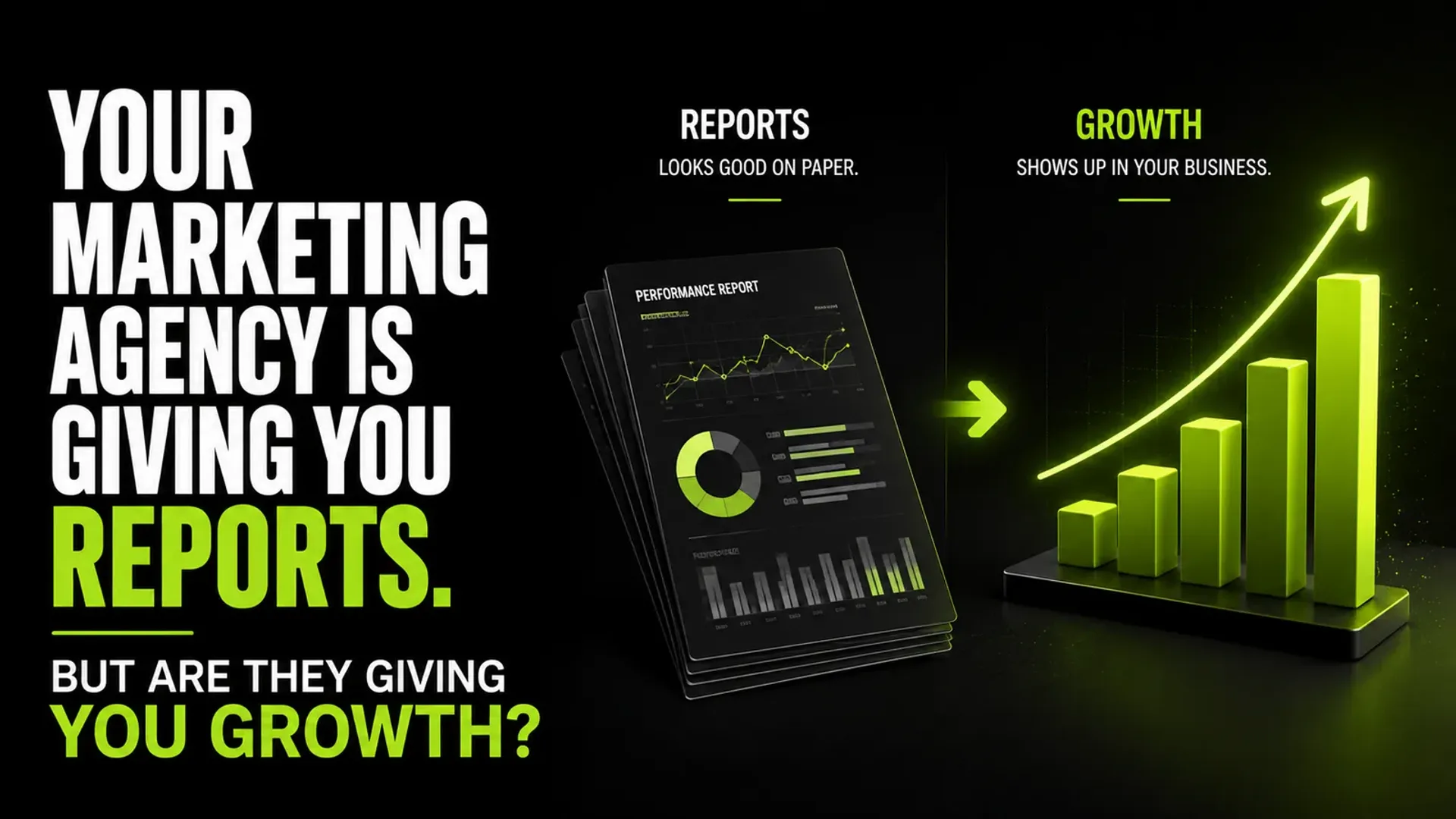
Every month, the report arrives.
A nice PDF.
Twenty or thirty pages.
Graphs.
Charts.
Percentages.
Impressions.
Clicks.
CTR.
CPC.
Leads.
Reach.
Engagement.
Maybe even a big green number showing that ROAS went up.
Everyone looks at it.
Someone says:
“Looks good.”
The meeting ends.
And then, a few days later, someone in the management team asks the question that the report should have answered in the first place:
“So, are we actually growing?”
Silence.
Because there is a big difference between marketing activity and business growth.
And unfortunately, many companies are still paying agencies to report the first while expecting the second.
A report can be completely accurate and still be useless
Let's make one thing clear.
There's nothing wrong with reporting.
Good marketing needs measurement.
You need to know what happened.
You need to understand how campaigns performed.
You need to know where your money went.
The problem is when reporting becomes the end product.
Imagine your agency tells you:
“We generated 4.2 million impressions this month.”
Okay.
What did those impressions do for the business?
Or:
“Website traffic increased by 38%.”
Great.
Did revenue increase?
Did qualified leads increase?
Did conversion rates improve?
Did the sales team close more business?
Or:
“Our CTR improved by 21%.”
Good.
Did the additional clicks produce customers?
A metric can improve while the business doesn't.
That's why marketing reporting needs context.
Vanity metrics are not necessarily useless
Let's be fair.
Reach isn't useless.
Impressions aren't useless.
CTR isn't useless.
Engagement isn't useless.
They can all provide useful information.
The problem is treating them as business outcomes.
If your objective is brand awareness, reach might be one of the most important metrics.
If your objective is lead generation, leads and qualified leads matter more.
If you're running an ecommerce campaign, revenue, contribution margin and customer acquisition cost matter far more than how many people clicked a button.
The metric should match the job.
The problem with “more”
Marketing reports often celebrate increases.
Traffic up 40%.
Impressions up 60%.
Leads up 25%.
Engagement up 80%.
It all sounds positive.
But “more” is not automatically better.
Suppose you generated 1,000 leads last month.
This month you generated 1,500.
Sounds like growth.
Then the sales team tells you that only 30 of those leads were actually qualified.
Last month, 50 were qualified.
You generated more leads and created a worse sales pipeline.
What happened?
Your marketing performance may have actually declined.
That's why good reporting needs to follow the customer beyond the first conversion.
Leads aren't revenue
This is one of the biggest mistakes in performance marketing.
A dashboard says:
“500 leads generated.”
The agency celebrates.
The sales team looks at the list and says:
“Most of these aren't serious buyers.”
Now you have a problem.
A cheap lead isn't necessarily a good lead.
You might generate leads for ₹100 each.
Your competitor might generate them for ₹500.
It looks like you're winning.
But if your ₹100 leads rarely buy and your competitor's ₹500 leads become customers, who actually has the better campaign?
The answer is obvious.
Yet marketing dashboards often make the first number look more impressive.
The metric that matters is often further down the funnel
For many businesses, the real journey looks like:
Impression → Click → Lead → Qualified Lead → Sales Opportunity → Customer → Revenue
Every step loses people.
And that's normal.
The important thing is knowing where the losses are happening.
Let's say:
100,000 impressions
↓
4,000 clicks
↓
500 leads
↓
120 qualified leads
↓
40 sales opportunities
↓
15 customers
Now imagine another campaign:
100,000 impressions
↓
2,500 clicks
↓
300 leads
↓
150 qualified leads
↓
60 sales opportunities
↓
25 customers
Which campaign is better?
The second one.
Even though it produced fewer clicks and fewer leads.
This is why agencies need to understand the whole funnel, not just the part they control.
Your agency should know what happens after the lead
This is a simple question every performance agency should be able to answer:
“What happens to the leads we're generating?”
If the answer is:
“We don't know. That's handled by the sales team.”
then you're missing half the picture.
The agency doesn't necessarily need to run the sales department.
But it should understand what happens to the leads.
Which campaigns produce qualified prospects?
Which audiences become customers?
Which creative attracts serious buyers?
Which campaigns generate cheap leads that never close?
Without that information, optimization becomes guesswork.
Marketing attribution isn't as simple as the dashboard makes it look
A customer might see your Instagram ad today.
Search your company on Google tomorrow.
Read three reviews.
Come back directly a week later.
Then speak to sales.
Then purchase.
Which channel gets credit?
Depending on your attribution model, the answer could be very different.
This is one reason marketers should be careful about treating platform-reported results as the complete truth.
Google itself notes that different attribution models can assign conversion credit differently across customer touchpoints. Google Ads, About attribution models
The platform data is useful.
It just isn't the entire customer journey.
ROAS is useful, but it isn't the whole business
ROAS is one of the most popular metrics in paid advertising.
For good reason.
It helps you understand the revenue attributed to advertising relative to the advertising spend.
But ROAS can also create a very narrow view of marketing performance.
Imagine two campaigns.
Campaign A
Spend: ₹10 lakh
Revenue: ₹40 lakh
ROAS: 4x
Campaign B
Spend: ₹10 lakh
Revenue: ₹30 lakh
ROAS: 3x
Campaign A looks better.
But now add customer value.
Suppose Campaign A attracts one-time buyers with low repeat purchase rates.
Campaign B attracts customers who continue buying for three years.
Suddenly the picture changes.
This is why customer acquisition cost, gross margin, customer lifetime value and retention can matter alongside ROAS.
The right measurement framework depends on the business.
Growth is not one metric
A growing business might see:
More customers.
Higher revenue.
Better retention.
Higher customer value.
Improved margins.
Stronger brand preference.
More organic demand.
Lower dependence on paid acquisition.
Marketing can influence all of these.
But not all of them will show up in a monthly ad report.
That doesn't mean they shouldn't be measured.
What should a good agency report actually tell you?
At the end of a reporting period, you should be able to answer five questions.
1. What happened?
The basic numbers.
Spend.
Traffic.
Leads.
Conversions.
Revenue.
2. Why did it happen?
This is where analysis starts.
Did the creative improve?
Did audience quality change?
Did competition increase?
Did the offer work better?
Did the landing page improve?
3. What did we learn?
This is often missing.
Maybe customer testimonials worked better than product-focused ads.
Maybe a particular audience converted at twice the rate.
Maybe a certain offer generated volume but poor-quality leads.
These are useful learnings.
4. What are we changing?
A report should lead to decisions.
New creative.
New audience strategy.
Landing-page changes.
Budget changes.
Offer changes.
Testing priorities.
5. What should we expect next?
Nobody can predict marketing perfectly.
But the agency should be able to explain what it is trying to achieve next and why.
That creates accountability.
A good report tells a story
Numbers without context are just numbers.
Compare these two reports.
Report A
Impressions: 2.4M
Clicks: 41,200
CTR: 1.72%
Leads: 1,180
CPA: ₹740
ROAS: 3.2
Report B
Performance improved because our new problem-focused creative increased qualified traffic.
The campaign generated 1,180 leads at an average CPA of ₹740. While overall lead volume increased 18%, the bigger improvement came from lead quality. The percentage of leads reaching the sales-qualified stage increased from 12% to 19%.
The strongest creative was the customer-story format, which generated fewer clicks than the product-demo ads but produced significantly better downstream conversion.
Next month, we'll expand customer-story creative, test two new problem-focused angles and reduce spend on the audience producing low-quality leads.
Which one would you rather receive?
The first gives you data.
The second gives you information you can act on.
Reporting should create accountability
An agency should be able to say:
“This was the goal.”
“This is what we did.”
“This is what happened.”
“This is what we learned.”
“This is what we're changing.”
That creates a clear chain between activity and outcome.
Without that chain, marketing becomes a collection of tasks.
Posts were published.
Ads were launched.
Emails were sent.
Reports were delivered.
Meetings were held.
But none of those things automatically mean the business grew.
Your agency should know your numbers
A performance agency should understand more than your advertising budget.
It should know, at least at a useful level:
Average order value
Customer acquisition cost
Conversion rate
Lead-to-customer rate
Customer lifetime value
Gross margin
Sales cycle
Retention
The exact metrics depend on the business.
But if an agency is managing your growth campaigns without understanding the economics of your business, it is difficult for them to make good decisions.
For example, imagine your average customer generates ₹50,000 in gross profit over their lifetime.
You may be comfortable spending ₹10,000 to acquire that customer.
Another company with a ₹5,000 lifetime gross profit cannot afford the same acquisition cost.
The ad platform doesn't know your entire business model.
Your agency should.
Cheap acquisition isn't always good acquisition
This deserves its own point.
Suppose Agency A delivers customers at:
₹1,000 CAC
Agency B delivers customers at:
₹1,500 CAC
Agency A looks better.
But then you discover:
Agency A customers generate ₹3,000 of gross profit.
Agency B customers generate ₹12,000.
Suddenly, the “more expensive” agency is producing a much better business outcome.
This is why the cheapest lead or customer isn't necessarily the best one.
Unit economics matter.
Marketing reports should connect to sales
For B2B companies especially, this becomes critical.
The marketing team may generate the lead.
The sales team may close it three months later.
If marketing is judged only on the number of leads generated, it has no incentive to optimize for quality.
If sales is judged only on closed revenue, it may blame marketing for poor leads.
Both teams need visibility into the same journey.
A modern agency should help connect those dots.
CRM data.
Campaign data.
Landing-page data.
Sales outcomes.
Revenue.
The more connected the data becomes, the better the decisions.
Technology can make reporting easier
This is one area where automation and AI can genuinely help.
Instead of spending hours manually preparing spreadsheets, agencies can automate data collection and dashboard updates.
That means less time formatting reports and more time analyzing what they mean.
But there is an important distinction:
Automated reporting is not automated strategy.
A dashboard can tell you that CPA increased.
It cannot automatically understand your business context.
A human still needs to ask why.
What should you ask your agency every month?
You don't need to ask for another 40-page report.
Ask these questions instead:
What was our biggest win this month?
What was our biggest problem?
What changed compared with last month?
What did we learn about our customers?
Which creative worked best and why?
Which campaign should we reduce or stop?
Where are we losing customers in the funnel?
What are we testing next?
What do you need from us?
These questions force the conversation away from activity and toward decisions.
The best agency meetings aren't about defending the report
A bad agency meeting often feels like a presentation.
The agency shows slides.
The client nods.
Everyone tries to explain why the numbers look the way they do.
A good meeting feels more like a working session.
Here's what happened.
Here's why we think it happened.
Here's what we learned.
Here's what we're changing.
Here's what we need to test next.
The difference is subtle.
But it changes the relationship completely.
Don't confuse marketing activity with marketing progress
Publishing 30 posts is activity.
Generating 2 million impressions is activity.
Launching 15 ads is activity.
Sending 50,000 emails is activity.
Getting 500 leads is activity.
Progress is different.
Progress might be:
Lower customer acquisition cost.
Higher conversion rate.
More qualified leads.
Higher customer value.
More revenue.
Better retention.
Stronger brand demand.
The job of an agency is not to keep everyone busy.
It's to move the business forward.
Growth needs both short-term and long-term thinking
There is another reason reports can become misleading.
Some marketing works immediately.
Some marketing takes time.
A paid search campaign can generate a conversion today.
A brand campaign might influence someone six months from now.
SEO may take months to compound.
Content can continue generating traffic long after publication.
Customer retention can improve gradually.
If everything is evaluated on a 30-day window, long-term investments can look worse than they actually are.
At the same time, “brand building” should not become an excuse for poor performance.
Good marketing requires both perspectives.
What is working now?
What are we building for later?
Your agency should be able to explain the trade-offs
There will always be trade-offs.
You may be able to generate more leads by lowering qualification standards.
You may increase ROAS by focusing on existing high-intent customers.
You may increase reach by spending more at the top of the funnel.
You may improve short-term revenue while hurting long-term brand perception.
There is rarely one perfect answer.
The agency's job is to explain the trade-off and recommend the option that makes the most sense for the business.
The report should answer one bigger question
After all the charts, numbers and analysis, you should be able to answer:
“Are we getting closer to the business goal?”
If the goal is revenue, you should understand how marketing contributed to revenue.
If the goal is qualified leads, you should understand lead quality.
If the goal is market expansion, you should understand whether you're reaching and converting the new market.
If the goal is brand growth, you need appropriate brand and demand indicators.
The exact answer will change.
But the question should always be there.
Marketing agencies need to be more accountable
The industry has become very good at showing activity.
There are endless dashboards.
Endless metrics.
Endless screenshots.
Endless case studies.
But clients don't really need more evidence that marketing happened.
They need evidence that marketing mattered.
That means agencies have to become better at connecting their work to business outcomes.
Not every result will be directly attributable.
Not every campaign will win.
Not every experiment will work.
That's okay.
What matters is that the agency is honest about what happened and clear about what comes next.
The best report may be the shortest one
A useful marketing report doesn't need to be 50 pages.
Sometimes the most valuable report could fit on one page:
What happened: Paid traffic increased 22%, while conversion rate fell 8%.
Why: Most additional traffic came from a broader audience segment with lower intent.
What we learned: The new audience responds better to educational creative than direct product ads.
What we're doing: Shift creative strategy, tighten audience controls and test a new landing page.
Expected outcome: Improve qualified conversion rate while maintaining acquisition volume.
That's enough to have a meaningful conversation.
The rest can live in the dashboard for anyone who wants to dig deeper.
A good agency doesn't just show you what happened
It helps you understand what to do next.
That's the real difference.
Anyone can export numbers.
Most platforms already do it automatically.
The value of an agency is interpretation.
Experience.
Context.
Strategy.
Creative thinking.
Decision-making.
Knowing when a number matters and when it doesn't.
Knowing when to keep going.
Knowing when to stop.
Knowing what to test next.
And most importantly, knowing how marketing connects to the actual business.
So the next time your agency sends you a beautiful report full of green arrows, don't just ask:
“Did the numbers go up?”
Ask:
“What did we actually learn?”
“Did the business move forward?”
“What are we going to do differently next?”
Because a marketing agency shouldn't just give you a report at the end of the month.
It should give you a clearer path to the next one.
Tap the button and Google will show you our new articles more often — in Search, Top Stories and AI Overviews.
Have a project in mind?
Let’s turn it into an intelligent product. Book a free 30-minute discovery call.
Start your project →