For a long time, agencies competed on size.
“200+ marketing professionals.”
“500+ experts.”
“Teams across 12 countries.”
“100 specialists under one roof.”
It sounds impressive.
And sometimes it is.
But here's a simple question.
Does a bigger agency always produce better marketing?
Not really.
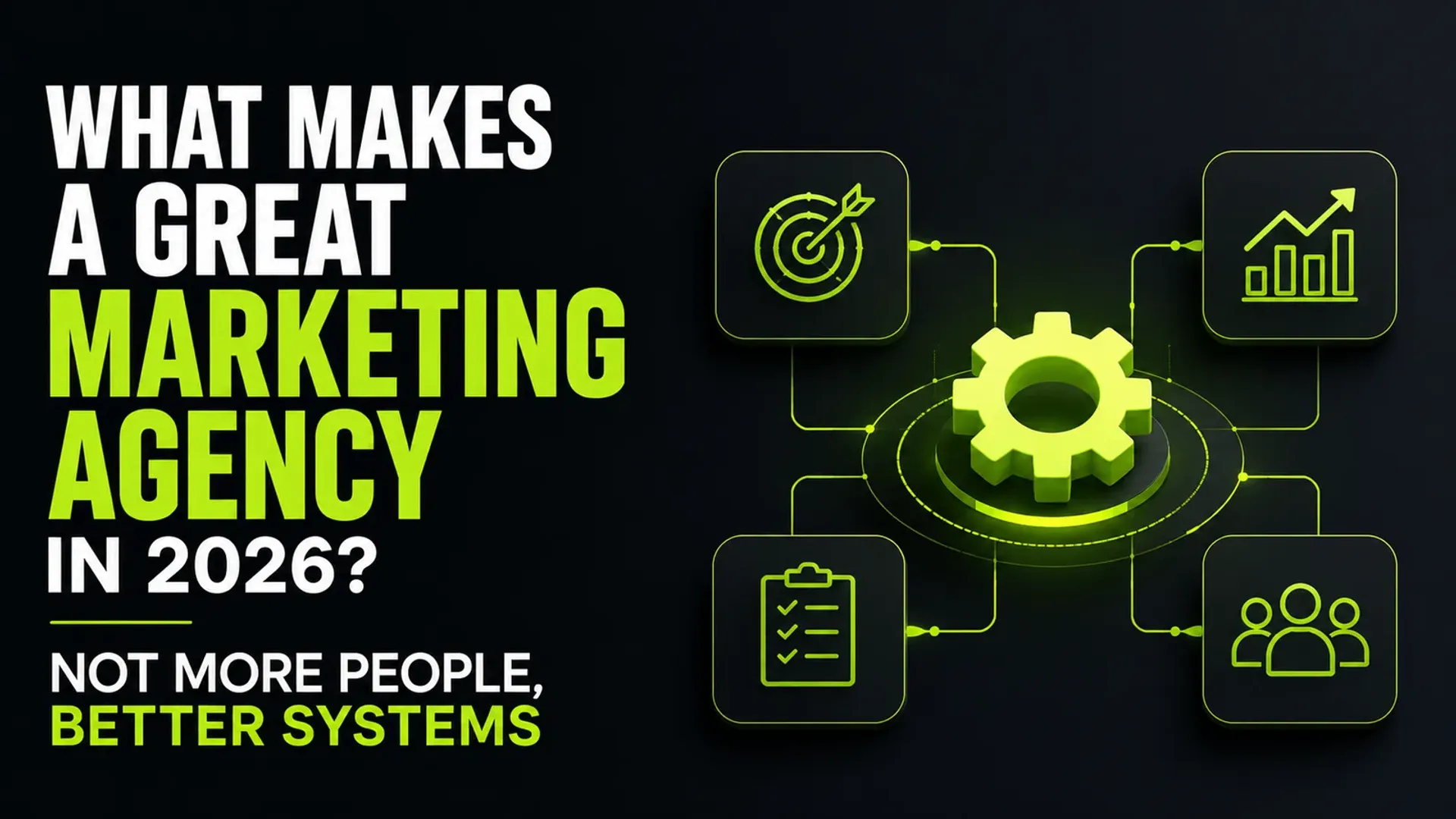
In 2026, the agencies that stand out will not necessarily be the ones with the biggest teams. They will be the ones that know how to bring together people, technology, data, creative thinking and strategy without making the whole process unnecessarily complicated.
That is where the real difference is starting to show.
The agency headcount game
The traditional agency model was built around people.
You needed a strategist. Then an account manager. Then a copywriter. Then a designer. Then a media buyer. Then a developer. Then an SEO specialist. Then an analyst.
As the agency got more clients, it hired more people.
More services meant more specialists. More specialists meant more coordination. More coordination meant more meetings.
Eventually, a simple campaign could involve a surprisingly large number of people.
There is nothing wrong with having a large team. Large teams can bring a lot of experience and expertise.
The problem starts when team size becomes the main selling point.
Because clients are not paying an agency for the number of people sitting in its office.
They are paying for better marketing and better business results.
That distinction matters more today than it did a few years ago.
Technology has changed the equation
Marketing platforms are already doing a lot of work that used to require manual intervention.
Google's Performance Max, for example, uses AI to help with bidding, targeting, budget allocation and the combination of creative assets. Google Ads, Performance Max
Meta is moving in the same direction. Its advertising systems use AI for areas such as ad ranking, audience matching and creative optimization. In January 2026, Meta said it had doubled the GPU capacity used to train its latest ad ranking model, GEM. Meta, 2026: AI Drives Performance
This does not mean marketers are becoming less important.
It means the type of work marketers should spend their time on is changing.
If a machine can handle repetitive reporting, asset resizing or certain parts of campaign optimization, why should a highly paid strategist spend half their day doing those things manually?
They shouldn't.
Their time is better spent understanding customers, developing ideas, looking at the numbers and deciding what to do next.
More people do not automatically mean better work
This is easy to overlook.
It sounds logical that a team of 50 should be better than a team of 10.
But marketing is not a simple numbers game.
Every additional person in a project can create another communication point.
A campaign can start with the client, move to the account manager, then strategy, creative, copy, design, media, analytics and back again to the client.
By the time everyone has reviewed it, the original idea may have changed five times.
The problem isn't the people.
The problem is how the work moves between them.
A good agency should have enough structure to keep things moving without turning every small decision into a meeting.
Speed matters more than ever
Marketing does not wait for agencies.
A competitor can launch a new campaign tomorrow.
A trend can disappear within a week.
An ad can perform brilliantly for a few weeks and then suddenly slow down.
Consumer behaviour changes.
Platforms change.
Creative formats change.
AI tools change.
If an agency needs three weeks to approve and launch a new idea, it may already be late.
This is why speed has become a real competitive advantage for agencies.
Not reckless speed.
Useful speed.
The ability to see something, understand it, make a decision and act on it.
A smaller team with clear responsibilities can sometimes move much faster than a large organization with several layers of approval.
Systems do not mean removing people
The word “systems” sometimes makes people think of automation replacing humans.
That is not what a good agency system should do.
A good system removes unnecessary work so people can spend more time on the work that actually requires judgment.
Take reporting as an example.
If an agency spends five hours every week copying campaign numbers into spreadsheets and formatting the same report, that is not a great use of anyone's time.
Automate it.
Build a dashboard.
Connect the data.
Let the system handle the repetitive part.
Then use the saved time to answer more important questions.
Why did performance change?
Which creative worked?
Which audience became expensive?
Where are people dropping off?
What should we test next?
That is where human thinking becomes valuable.
AI is changing what clients should expect
A few years ago, producing a large number of creative assets required a lot of time.
Copywriters had to write every variation.
Designers had to create every size.
Editors had to produce every version.
Now AI can speed up many of those tasks.
Images can be generated or adapted quickly.
Copy can be turned into multiple variations.
Videos can be edited faster.
Assets can be resized for different placements.
Research can be summarized in minutes.
That is useful.
But there is an important catch.
If every agency can produce 50 versions of an ad, producing 50 versions of an ad is no longer much of a competitive advantage.
The important question becomes:
Which 5 ideas are actually worth testing?
That is strategy.
The agency's job is moving upstream
As production becomes easier, thinking becomes more important.
If AI can help generate:
• Headlines
• Images
• Video concepts
• Landing page copy
• Social posts
• Ad variations
then the difficult part is no longer creating something.
The difficult part is deciding what should be created in the first place.
What problem are we solving?
Who are we talking to?
What do they actually care about?
What makes this offer different?
What proof do we have?
What objection needs to be addressed?
What should we test first?
These are questions that still require judgment.
Technology can help answer some of them, but it does not remove the need for people who understand marketing.
A great agency should be willing to challenge the brief
This is one of the biggest differences between a vendor and a strategic agency.
A vendor says:
“Tell us what you want and we'll make it.”
A good agency should sometimes say:
“Let's first make sure that's actually what you need.”
A client might say:
“We need more leads.”
After looking at the funnel, the agency may discover that the real problem is lead quality or sales follow-up.
Another client might say:
“We need more website traffic.”
The bigger problem might be that the existing traffic is not converting.
Someone might ask for more ads when the actual issue is a weak offer.
Blindly following the brief can make an agency very efficient at solving the wrong problem.
A good agency should be comfortable asking difficult questions when the situation calls for it.
Marketing does not happen one channel at a time
Customers do not think in terms of departments.
They do not say:
“Today I will interact with the brand team.”
Then:
“Tomorrow I will interact with the performance marketing team.”
They simply see a brand.
Maybe they see an Instagram ad in the morning.
Later they search the company on Google.
They visit the website.
They read a review.
They see another ad a few days later.
They speak to a salesperson.
Then they buy.
That journey can involve several different marketing channels.
This is why a good agency needs to understand how those pieces fit together.
Brand.
Creative.
Paid media.
SEO.
Website.
Landing pages.
Conversion.
CRM.
Retention.
You do not necessarily need one agency to do every single thing. But the agency you choose should at least understand how its work affects the rest of the customer journey.
An agency should understand your business, not just your ad account
There is a big difference between these two conversations.
The first agency says:
“Your CPA increased by 18% this month.”
The second says:
“CPA increased because our strongest audience is becoming more expensive, our main creative has started losing engagement and the current offer is not performing as well as it did last month. We think these are the three things worth testing next.”
The first statement tells you what happened.
The second helps you decide what to do.
That is the difference between reporting and strategy.
Reports are not strategy
Marketing teams have access to more data than ever.
You can see:
• Impressions
• Clicks
• CTR
• CPC
• Leads
• CPA
• ROAS
• Reach
• Engagement
The problem is rarely a lack of numbers.
The problem is knowing what those numbers actually mean.
A 20 page report full of charts does not automatically make an agency strategic.
A useful report should help answer a few basic questions:
What worked?
What didn't?
Why?
What did we learn?
What are we changing?
If the client still has to figure out the answers themselves, the report has not done its job.
The best agencies build feedback loops
A campaign should not end when the report is sent.
The report should help shape the next campaign.
The process should look something like:
Launch → Measure → Learn → Create → Test → Measure → Improve
The important part is the learning.
If an ad works, you should understand why.
If an ad fails, you should understand why.
Maybe a particular customer problem created a stronger response.
Maybe a testimonial worked better than a product demo.
Maybe one landing page converted much better on mobile.
Maybe a particular offer attracted lots of leads but very few serious buyers.
Those are not just campaign results.
They are insights about the business.
Good agencies remember what they learn
This sounds simple, but it makes a huge difference.
Agencies should document useful learnings instead of starting from scratch every month.
For example:
“Founders respond better to cost-saving messages.”
“Customer testimonials perform better than polished brand videos.”
“Case-study ads generate fewer leads but better-quality leads.”
“Mobile visitors are converting significantly lower than desktop visitors.”
Over time, these observations create something valuable.
Context.
An agency that has worked with a company for three years should understand that business differently from an agency that has just received the first brief.
That accumulated knowledge can become one of the biggest advantages of a long-term agency relationship.
Context is becoming more valuable in an AI world
AI can write a headline in seconds.
It can create an image.
It can summarize a report.
It can generate variations.
But it does not automatically understand your business.
It does not automatically know which customer complaints matter most.
It does not know which sales objection keeps appearing on calls.
It does not know which campaign failed six months ago and why.
It does not know which competitor keeps taking customers from you.
That context has to come from somewhere.
This is one reason good agency relationships are still valuable.
The value is not simply in producing things.
It is in knowing what should be produced and why.
The client should not have to manage the agency
This is another simple test.
After hiring an agency, does your workload become lighter or heavier?
If you are constantly:
• Chasing updates
• Asking for reports
• Following up on deadlines
• Coordinating different teams
• Repeating the same information
• Checking whether basic tasks were completed
then something is wrong.
An agency should not create another project-management job for the client.
The client should be able to focus on the business while the agency takes responsibility for its part of the work.
Process should make creative work easier
Some people think processes kill creativity.
Usually, bad processes do.
Good processes do the opposite.
A clear process for research, briefing, production, approvals, campaign launches and reporting gives creative people more room to focus on ideas.
The goal is not to make every campaign identical.
The goal is to remove unnecessary confusion.
Once the basic workflow is reliable, the team has more time to experiment.
That is what a good agency system should achieve.
What should you actually ask an agency before hiring them?
Forget the number of employees for a moment.
Ask questions that reveal how they think.
How do you decide what to test?
How do you measure creative performance?
What happens when a campaign doesn't perform?
How do you connect advertising with landing page performance?
How are you using AI in your workflow?
How do you report campaign learnings?
Who will actually work on our account?
How often do you test new creative?
How do you decide when to stop an underperforming campaign?
What happens if you disagree with our brief?
The answers will tell you much more than a presentation showing how many people work at the agency.
A great agency should make marketing simpler
Before hiring an agency, marketing can sometimes feel like a mess.
Too many platforms.
Too many reports.
Too many opinions.
Too many suppliers.
Too many meetings.
Too many things happening at the same time.
The right agency should make that simpler.
You should be able to understand:
What are we trying to achieve?
What are we doing?
What is working?
What is not working?
What have we learned?
What are we changing next?
That's it.
You do not need more complexity.
You need someone who can make sense of the complexity that already exists.
The agency of the future will be different
The traditional agency model rewarded scale.
More people.
More offices.
More departments.
More clients.
That model is not going to disappear overnight.
But the definition of a good agency is changing.
The strongest agencies will combine:
Good people.
Good systems.
Good technology.
Strong creative thinking.
Useful data.
Clear communication.
Fast learning.
Deep knowledge of the client's business.
AI will make many marketing tasks faster.
Automation will remove repetitive work.
Advertising platforms will continue to automate more campaign decisions.
That does not make agencies irrelevant.
It makes the standard higher.
The real advantage is not doing more
It is knowing what matters.
A weak agency can impress you with output.
“Here's 50 posts.”
“Here's 30 ad variations.”
“Here's a 40 page report.”
A better agency can tell you:
“Here's what we learned.”
“Here's why it matters.”
“Here's what we're changing.”
That is the difference between activity and progress.
And in 2026, businesses don't need another agency that simply produces more marketing.
They need an agency that can connect the pieces.
The creative idea to the media strategy.
The media strategy to the landing page.
The landing page to the conversion.
The conversion to revenue.
And the results back into the next marketing decision.
That's what a modern marketing agency should be.
Not necessarily the biggest agency.
Not the agency with the longest list of services.
Not the agency with the biggest office.
The agency with the people, systems and thinking needed to turn marketing into measurable growth.
Tap the button and Google will show you our new articles more often — in Search, Top Stories and AI Overviews.
Have a project in mind?
Let’s turn it into an intelligent product. Book a free 30-minute discovery call.
Start your project →