Creative Fatigue Is Killing Your ROAS: How to Know When It’s Time to Kill an Ad
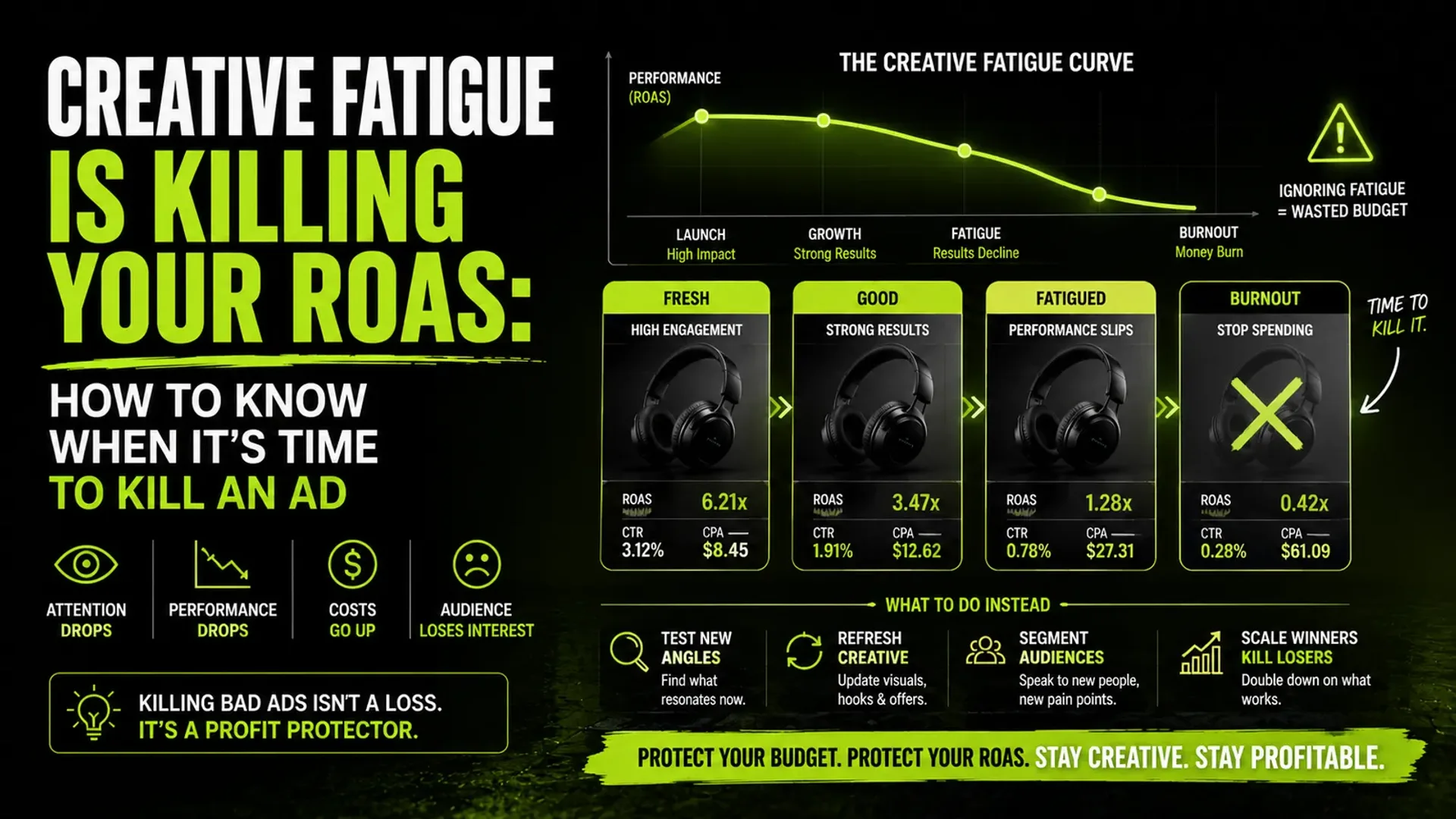
There is a point in almost every paid advertising campaign when something strange happens.
The ad that was once your best performer suddenly starts behaving like a completely different ad.
CTR drops.
CPC starts climbing.
CPA goes up.
ROAS starts falling.
The first reaction is usually:
“The audience is tired of seeing it.”
Maybe.
But creative fatigue is not always as simple as “people have seen this ad too many times.”
Sometimes the creative is genuinely exhausted.
Sometimes the audience is too small.
Sometimes the offer isn't competitive anymore.
Sometimes the competition has changed.
Sometimes your landing page is the problem.
And sometimes the ad was never as strong as you thought—it simply benefited from a temporary pocket of highly responsive users.
The challenge for a performance marketer is knowing the difference.
Because killing a winning ad too early can be expensive.
Keeping a dying ad alive can be even more expensive.
What exactly is creative fatigue?
Creative fatigue happens when an audience becomes less responsive to an advertisement after repeated exposure.
The creative hasn't necessarily changed.
The product hasn't necessarily changed.
But the audience's response has.
You've seen it before.
You watch the same YouTube ad for the fifth time.
You see the same Instagram Reel every other day.
A brand keeps showing you the same discount.
Eventually, you stop noticing it.
That's the human side of fatigue.
But there is also a performance side.
If the same creative is repeatedly shown to the same audience, engagement can decline and the economics of the campaign can deteriorate.
This is why creative fatigue matters so much in performance marketing.
You're not just losing attention.
You're potentially paying more to get the same result.
Frequency is a clue, not a diagnosis
One of the first metrics marketers look at when performance drops is frequency.
Frequency simply tells you, on average, how many times someone in your audience has been exposed to your ad.
A rising frequency can be a warning sign.
But there is no universal number where you can say:
“At 3.7 frequency, every ad is officially fatigued.”
It doesn't work like that.
A frequency of 5 could be perfectly healthy for a retargeting campaign.
A frequency of 2 could be enough to create problems in a very small audience.
It depends on:
- Campaign objective
- Audience size
- Buying cycle
- Creative quality
- Product category
- Price point
- Number of competing ads
- Placement
- Time period
That's why frequency should be viewed alongside other signals.
If frequency is increasing while CTR is falling and CPA is rising, you have a much stronger case for fatigue.
The classic fatigue pattern
A common pattern looks something like this:
Phase 1: Launch
The creative is fresh.
People haven't seen it before.
Performance is strong.
Phase 2: Learning
The platform identifies responsive pockets of the audience.
Performance stabilizes.
Phase 3: Scale
You increase spend.
The ad reaches more people.
Performance may remain healthy—or begin to soften.
Phase 4: Saturation
The most responsive people have already seen the creative.
Frequency rises.
Engagement starts falling.
CPA begins increasing.
Phase 5: Fatigue
The creative struggles to generate the same results.
At this point, continuing to spend heavily on the same creative can become inefficient.
The mistake is waiting until Phase 5 to start thinking about the next creative.
Don't wait for the ad to completely die
This is one of the biggest differences between reactive and proactive performance marketing.
A reactive team waits until:
“ROAS is terrible. We need new ads.”
A proactive team asks:
“What creative are we going to test next week?”
The second approach is healthier.
Creative development should be continuous.
Not because every ad needs to be replaced every seven days.
But because you never know when the current winner will stop winning.
Think of it like a football team.
You don't wait until your entire starting eleven is injured before developing substitutes.
You build depth before you need it.
Your creative pipeline works the same way.
Five signs your creative may be fatigued
1. CTR is consistently declining
If people are becoming less interested in your ad, one of the first places you may see it is click-through rate.
Suppose your creative started with:
CTR: 2.4%
Then moved to:
2.0%
Then:
1.7%
Then:
1.3%
A decline by itself doesn't prove fatigue.
But if the trend is persistent and other metrics are deteriorating too, it deserves investigation.
The important word is consistently.
One bad day doesn't mean your creative is dead.
A sustained decline is much more meaningful.
2. CPA keeps increasing
This is the metric that usually gets everyone's attention.
You launch at:
CPA: ₹800
A few weeks later:
₹950
Then:
₹1,150
Then:
₹1,400
Again, don't immediately blame the creative.
Your conversion rate could have fallen.
Your landing page could have changed.
Your offer could have become less attractive.
Your competitors could be bidding more aggressively.
But if CPA is rising while CTR is falling and frequency is increasing, creative fatigue becomes a much more likely explanation.
3. Frequency is climbing
If the same people are seeing your ad repeatedly, eventually the novelty disappears.
This is particularly important when your audience is small.
Imagine you're targeting 50,000 people with a $500,000 campaign.
You don't have an infinite number of people to reach.
Your creative is going to appear repeatedly.
If you're targeting a massive audience, the situation can be completely different.
This is why you should never copy someone else's frequency “rule” without understanding their campaign.
4. Engagement quality is declining
Not all engagement is equally valuable.
You might notice:
- Fewer meaningful comments
- Fewer shares
- Lower video watch time
- More negative reactions
- More people hiding or skipping the ad
- Lower-quality traffic
The exact signals available depend on the platform and campaign setup.
But the principle is simple:
If people are becoming less interested, the creative may be losing its impact.
5. Your audience can predict the ad
This is less scientific, but surprisingly useful.
Imagine someone seeing your ad and thinking:
“Oh, this one again.”
That's fatigue in human language.
If your customers can finish the first sentence of your ad because they've heard it 30 times, it's probably time to introduce something new.
But sometimes the creative isn't the problem
This is where experienced marketers separate themselves from dashboard operators.
Performance drops.
Someone says:
“Creative fatigue.”
New ads are produced.
Nothing improves.
Why?
Because the actual problem was somewhere else.
Your offer changed
Maybe your competitor launched a better discount.
Maybe the seasonal demand disappeared.
Maybe customers became more price-sensitive.
Your audience changed
Perhaps the platform expanded delivery.
Perhaps the campaign started reaching colder users.
Perhaps your targeting changed.
Your landing page changed
The ad still works.
People click.
But the landing page loads slowly or communicates the offer poorly.
Your tracking broke
Sometimes the business is still getting customers.
The reporting simply isn't capturing them correctly.
Your product changed
Price increased.
Availability changed.
Shipping got slower.
A popular feature disappeared.
All of these can affect conversion.
So before killing a creative, diagnose the whole system.
Look at CTR and conversion rate together
This is one of the easiest ways to understand where the problem might be.
Imagine:
CTR is falling + conversion rate is stable.
The ad may be losing its ability to generate interest.
Now imagine:
CTR is stable + conversion rate is falling.
The ad may still be doing its job, but something after the click could be broken.
Now imagine:
CTR is falling + conversion rate is falling + frequency is rising.
That's much more consistent with creative fatigue.
The point is not to find one magic metric.
It's to look for patterns.
The creative fatigue diagnosis
When performance declines, ask these questions:
Has frequency increased?
Has CTR declined?
Has CPC increased?
Has conversion rate changed?
Has CPA increased?
Has the offer changed?
Has the landing page changed?
Has the audience changed?
Has the competition changed?
Has the tracking changed?
Only after looking at the broader picture should you decide that creative fatigue is the likely culprit.
Don't just make another version of the same ad
This is where many teams waste time.
The ad is fatigued.
So they change the headline.
Same video.
Same opening.
Same message.
Same offer.
Different headline.
Then they wonder why the new ad also fatigues quickly.
If the underlying concept has become stale, changing the font won't solve it.
You need a new creative angle.
For example, imagine your original ad says:
“Save 30% on your first order.”
Instead of making:
“Get 30% off today.”
try something completely different.
Customer story:
“I didn't think I needed this until I tried it.”
Problem-focused:
“Still doing this the hard way?”
Comparison:
“Why pay ₹10,000 for something that costs ₹2,000?”
Demonstration:
“Here's what happens when you use it for the first time.”
Objection:
“Think it's too expensive? Let's do the math.”
Now you're giving the audience different reasons to pay attention.
Build a creative matrix
One of the easiest ways to prevent fatigue is to stop thinking in terms of individual ads.
Think in terms of combinations.
For example:
Hooks
- Question
- Bold claim
- Statistic
- Problem
- Story
- Contrarian statement
Angles - Save money
- Save time
- Reduce stress
- Improve status
- Avoid risk
- Increase convenience
Formats - UGC
- Founder video
- Product demo
- Testimonial
- Static
- Carousel
- Comparison
Now you have dozens of potential combinations.
A single product can generate many creative directions without repeating the exact same advertisement.
Your best-performing ad can become a creative system
Let's say your best ad is a customer testimonial.
Don't simply run that testimonial forever.
Ask:
What made it work?
Maybe it was the customer's story.
Maybe it was the specific problem.
Maybe it was the before-and-after result.
Maybe it was the authenticity.
Once you understand the reason, you can build a creative family around it.
Five customers.
Five problems.
Five outcomes.
Five different videos.
Same underlying insight.
Now you've transformed one winning ad into a repeatable creative system.
Creative fatigue and AI
This is where AI can be genuinely useful.
AI can help teams create variations much faster.
You can adapt:
- Hooks
- Headlines
- Scripts
- Visuals
- Formats
- Aspect ratios
- Voiceovers
- Product demonstrations
- UGC-style concepts
That lowers the cost of experimentation.
But it also creates a new problem.
If every company can generate 100 variations in an afternoon, quantity stops being the advantage.
The advantage becomes knowing what to test.
Meta has been investing heavily in AI-powered advertising systems and creative tools, while its own advertiser education increasingly emphasizes creative diversification. Meta Blueprint — Creative Diversification
AI can help you produce the next 20 creatives.
It can't automatically tell you which customer insight should be at the center of those creatives.
That's still a human job.
How often should you refresh your creative?
This is where you'll find a lot of bad advice online.
“Change your ads every seven days.”
“Refresh every two weeks.”
“Never run an ad for more than 30 days.”
These sound useful because they're simple.
They're also incomplete.
There is no universal refresh schedule.
A B2B company targeting 500,000 decision-makers doesn't operate like a D2C brand targeting 50,000 people.
A $2,000 product doesn't behave like a ₹500 impulse purchase.
A retargeting audience doesn't behave like a broad prospecting audience.
Instead of asking:
“When should we refresh?”
ask:
“When does the current creative stop producing acceptable economics?”
That is a much better question.
Don't kill a winner just because something new looks exciting
There is another side to this.
Creative teams sometimes get bored before the audience does.
You see the same ad for three months.
You're sick of it.
So you assume everyone else must be sick of it too.
Not necessarily.
You're exposed to the ad constantly because you're working on the campaign.
Your customer isn't.
That's why performance data should make the decision.
If the creative is still producing profitable conversions, don't kill it simply because your team is tired of looking at it.
Your creative team is not your target audience.
The right time to kill an ad
An ad should usually be retired when there is enough evidence that it is no longer meeting the campaign's business objective and a better alternative is available or ready to replace it.
That might happen because:
- CPA is consistently above target.
- ROAS has deteriorated beyond an acceptable range.
- CTR has declined materially.
- Frequency has become excessive for the audience.
- Conversion quality has dropped.
- A new creative consistently outperforms it.
The exact thresholds should come from your campaign's economics and historical benchmarks—not from a generic internet rule.
The best agencies don't wait for fatigue
This is where creative strategy becomes a competitive advantage.
A good performance agency doesn't wait for the dashboard to scream:
“THE AD IS DEAD.”
It watches the trend.
It builds a creative pipeline.
It continuously tests new angles.
It keeps winners running while developing replacements.
It studies why something worked.
And it turns those learnings into the next round of creative.
That's a much healthier system than constantly starting from zero.
The creative refresh cycle
A practical system could look like this:
Week 1: Launch multiple concepts.
Week 2: Identify early signals.
Week 3: Develop variations around promising ideas.
Week 4: Scale stronger concepts and introduce new angles.
Then repeat.
The exact timeline will change depending on the campaign.
The important part is that creative development doesn't stop when a campaign starts performing.
The next winner should already be in development before the current winner becomes a loser.
Your ROAS doesn't suddenly collapse
Most of the time, performance deterioration isn't a light switch.
It's a trend.
Small changes appear first.
CTR softens.
Frequency rises.
CPC creeps upward.
Conversion rate starts slipping.
CPA follows.
ROAS eventually takes the hit.
If you wait until ROAS collapses, you're reacting late.
If you watch the leading signals, you have a chance to act earlier.
That's why creative testing isn't a one-time activity.
It's ongoing campaign maintenance.
The real goal isn't avoiding fatigue
You can't eliminate creative fatigue.
Eventually, most creative will become less effective.
That's normal.
The goal is to build a system where fatigue doesn't surprise you.
You should always know:
What's working?
Why is it working?
What's starting to weaken?
What are we testing next?
What can we scale?
What should we stop?
When your team can answer those questions, creative fatigue stops being a crisis.
It becomes part of the process.
Don't wait until your best ad stops working
The biggest mistake isn't killing an ad too late.
It's waiting until it dies before creating the next one.
By then, you're under pressure.
The media team needs new assets immediately.
The creative team has no research ready.
The production team is rushing.
The client wants results yesterday.
And everyone starts making decisions based on panic.
A better approach is much simpler:
Keep learning while you're winning.
Keep testing while your best ad is performing.
Keep developing new angles.
Keep collecting customer insights.
Keep looking for the next message that could work.
Because the goal of performance marketing isn't to find one ad that works forever.
It is to build a machine that keeps finding ads that work.
And that's the difference between a campaign that gets lucky and a performance marketing system that can actually scale.
Tap the button and Google will show you our new articles more often — in Search, Top Stories and AI Overviews.
Have a project in mind?
Let’s turn it into an intelligent product. Book a free 30-minute discovery call.
Start your project →