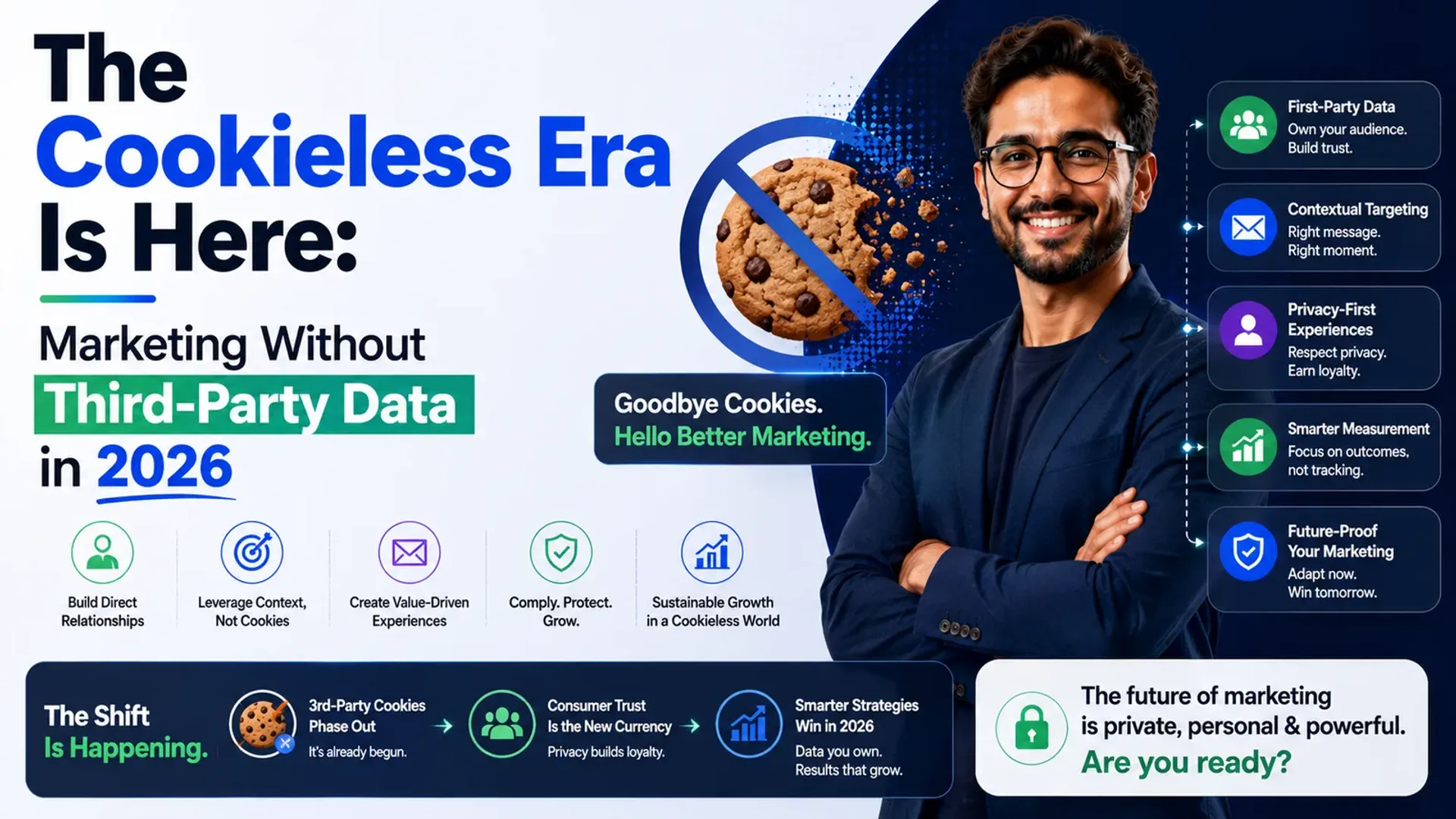
For two decades, digital marketing quietly ran on borrowed data. Third-party cookies let advertisers follow people around the web, build shadow profiles, and retarget them into oblivion, all without the customer really understanding what was happening. That era is ending. Browser privacy changes, regulation, and initiatives like Google's Privacy Sandbox have steadily dismantled the infrastructure that made cross-site tracking easy.
Plenty of marketers are treating this like a crisis. It isn't. It's a correction, and honestly a healthy one. The brands panicking are the ones who never owned their audience in the first place, who rented attention from ad platforms and called it a strategy. The brands thriving are the ones who invested in direct relationships with their customers.
In 2026, the game is clear: whoever owns the most first-party data, collected with genuine consent, wins. Here's how to build that advantage before your competitors do.
Why Third-Party Data Stopped Working
Third-party cookies were always a fragile foundation. They relied on tracking users across sites they didn't own, and that model was doomed the moment privacy became a mainstream expectation rather than a niche concern. Several forces converged.
- Browser restrictions: major browsers now block or heavily limit cross-site tracking by default.
- Regulation: privacy laws across regions require clear consent and give people real control over their data.
- Platform shifts: approaches like Google's Privacy Sandbox aim to enable advertising through privacy-preserving methods rather than individual-level tracking.
- Consumer expectation: people simply expect to be asked before being tracked, and they punish brands that feel creepy.
The result: the retargeting and audience-buying tactics that felt effortless are getting less accurate and more expensive. Leaning on them harder is not a strategy.
First-Party Data: The Asset You Actually Own
First-party data is information customers share with you directly, on channels you control, with their permission. It's the opposite of rented data. Nobody can deprecate it, no browser update can break it, and no competitor can buy the same thing. It's yours.
This is the single most important shift in modern marketing. Instead of chasing anonymous strangers across the web, you build a direct, consented relationship with the people who actually want to hear from you.
Third-party data was a rental you never owned. First-party data is an asset that compounds. The brands treating this shift as a threat are the ones who spent a decade renting.
What counts as first-party data
- Email subscribers who opted in for real value.
- WhatsApp and SMS lists built on explicit consent.
- Account and purchase history from your own site or app.
- Preferences, survey responses, and behavioral signals from your owned properties.
Tactics to Build and Own Your Audience
Knowing you need first-party data is easy. Building it takes deliberate work. Here are the moves that matter most in the cookieless era.
Build owned audiences relentlessly
Every touchpoint should invite people into a channel you control, your email list, a WhatsApp opt-in, an app account. Treat list growth as a core KPI, not an afterthought. These owned audiences become the engine for everything else, and pairing them with strong organic social media gives you reach that doesn't depend on tracking cookies.
Trade real value for data (the value exchange)
People will happily share their email or phone number, but only for something worth it. A genuinely useful guide, a tool, early access, a discount, exclusive content. The stronger your content and AI-powered experiences, the more people opt in willingly. This is consent that customers feel good about, not dark patterns.
Get your server-side tracking basics right
With browser-based tracking degrading, measurement is moving server-side. Instead of relying entirely on scripts in the user's browser, data is collected and sent from your own server, giving you more reliable, more resilient, and more privacy-respecting measurement. You don't need to become an engineer to understand the principle: own your data pipeline the same way you own your audience. A well-built website and data foundation makes this dramatically easier.
Invest in community
The ultimate owned audience is a community that wants to hear from you, a newsletter people actually read, a WhatsApp group, an engaged following. Community turns one-time buyers into a durable, zero-cost distribution channel that no privacy update can take away.
How to Future-Proof Your Measurement
Measurement is where teams feel the cookieless shift most acutely, because the tidy last-click attribution they leaned on is breaking. The fix is a healthier, more honest approach to understanding what works.
- Consolidate around first-party signals. Prioritize data from your own properties over fragile third-party pixels.
- Adopt server-side collection. It's more durable and gives you cleaner, consented data.
- Accept modeled and directional data. Perfect 1:1 tracking is over. Focus on trends, incrementality, and business outcomes, not vanity precision.
- Tie marketing to revenue, not just clicks. With owned audiences, you can measure what actually matters: customers, retention, and lifetime value.
If your current setup can't do this, it's worth auditing your foundation now rather than after your metrics quietly break. A quick website and marketing audit is a sensible first step, and our digital marketing team can help you build the data infrastructure to match.
The Bottom Line
The cookieless era isn't the end of effective marketing, it's the end of lazy marketing built on data you never owned. The winners in 2026 are the brands investing in direct, consented relationships: owned email and messaging lists, value-driven content, community, and measurement built on first-party signals. This shift rewards exactly what good marketing was always supposed to be, earning attention and trust rather than buying surveillance. Start building your owned audience today, and the disappearance of third-party cookies becomes your competitive advantage instead of your problem.
Frequently Asked Questions
Is third-party data completely gone?
Not entirely, but its reliability and reach are shrinking fast as browsers restrict cross-site tracking and privacy regulation tightens. Rather than trying to squeeze more out of a declining resource, the smart move is to shift investment toward first-party data you collect and own directly, which is durable and improves over time.
What is server-side tracking, in plain terms?
Traditional tracking runs scripts in the user's browser, which browsers increasingly block. Server-side tracking collects and sends data from your own server instead, making measurement more reliable, more resilient to browser changes, and easier to keep privacy-compliant. You don't need to be technical to adopt it, but you do need the right web and data foundation.
How do I start building first-party data today?
Make audience ownership a priority: add consent-based email and WhatsApp opt-ins across your site and social channels, offer genuine value in exchange for sign-ups, and invest in content and community people want. Then move measurement toward first-party and server-side signals. Reach out if you'd like help mapping it out.
Worried your marketing still leans on data that's disappearing? Let's future-proof your strategy around audiences you actually own.
Related reading: SEO for business owners · lead generation that works
Tap the button and Google will show you our new articles more often — in Search, Top Stories and AI Overviews.
Have a project in mind?
Let’s turn it into an intelligent product. Book a free 30-minute discovery call.
Start your project →