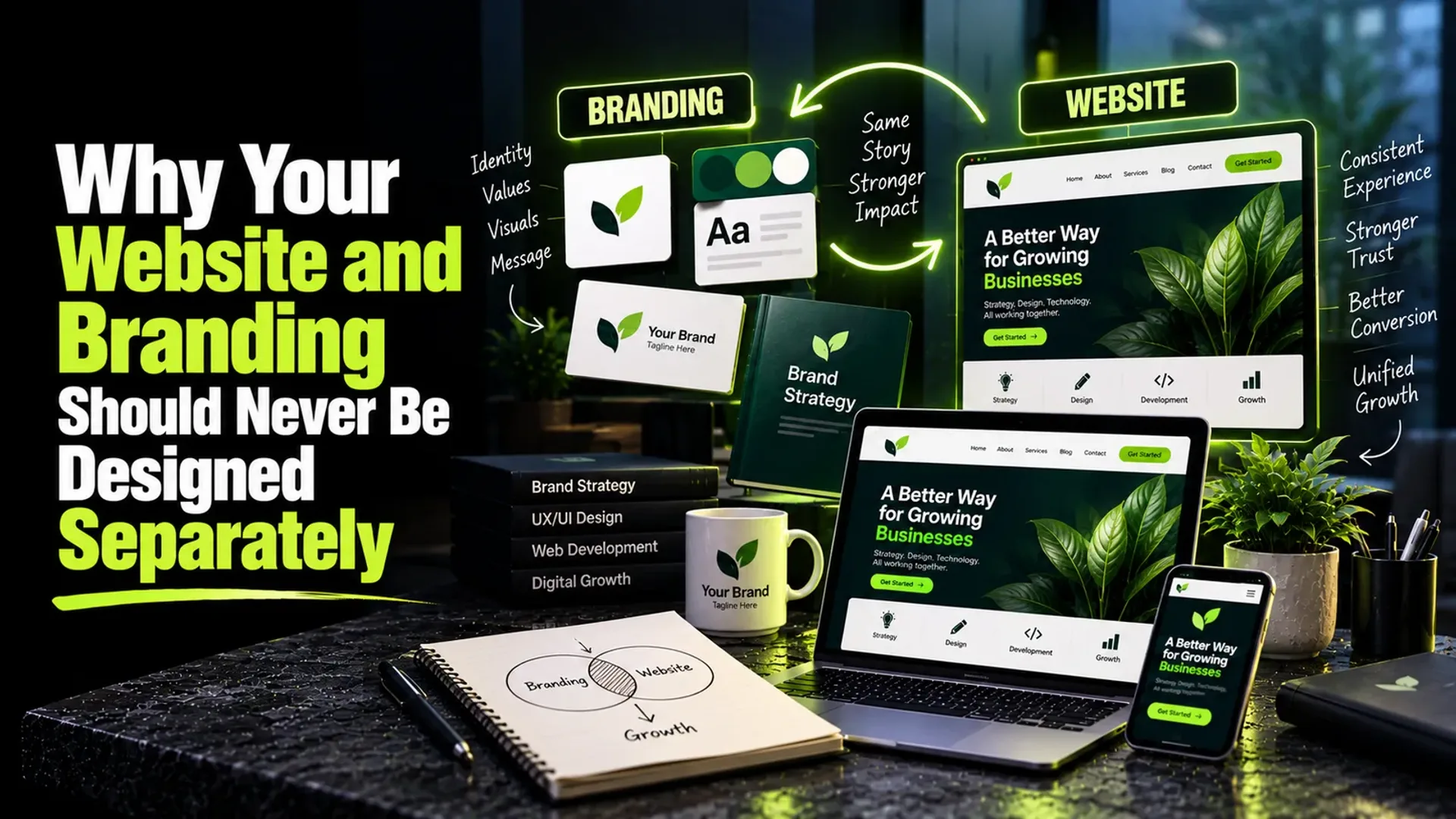
A business can have a great brand and a terrible website.
It can also have a beautiful website and a weak brand.
Both situations happen all the time.
The problem is that businesses often treat branding and website design as two completely separate projects.
First, someone creates the logo.
Then another team designs the website.
Then the marketing team creates social media posts.
Then someone else runs the ads.
Everyone does their own part.
The result?
The individual pieces may look good, but they do not always feel like they belong to the same business.
And customers notice that.
Your website is not just a place where you list your services.
It is one of the biggest places where people experience your brand.
That is why your branding and website should be planned together.
Your website is often the first serious interaction with your brand
Someone might discover your company through Google, LinkedIn, Instagram, an advertisement or a referral.
But at some point, there is a good chance they will visit your website.
That is when curiosity turns into evaluation.
They start asking:
Can I trust this company?
Do they understand what I need?
Do they look professional?
Have they worked with businesses like mine?
Is this company actually good at what it claims to do?
Your website needs to answer those questions quickly.
Google's own guidance encourages businesses to create websites and content that are useful, reliable and designed primarily for people. Its helpful content guidance is a useful reminder that a website should not be built simply to attract search traffic.
The website needs to work for the person who arrives on it.
And that includes the brand experience.
A logo sitting at the top of a website is not branding
This is an easy mistake to make.
A business creates a logo and then puts it in the top left corner of the website.
The colours are used somewhere.
The logo appears on the footer.
Done.
That is not really integrating branding into a website.
Your brand should influence much more than the logo.
It should influence:
The typography.
The colours.
The photography.
The layout.
The language.
The headlines.
The animations.
The icons.
The buttons.
The navigation.
The way information is organised.
Even the amount of information you show.
A premium brand may need a very different website experience from a playful consumer brand.
A healthcare company may need to communicate trust and clarity.
A technology startup may want to communicate innovation and speed.
The design should support the position of the business.
Imagine a premium brand with a cheap looking website
Let's say you run a premium consulting company.
You charge $20,000 for your services.
You work with senior executives.
Your team has years of experience.
Your clients include well known companies.
But your website looks like it was built ten years ago.
The fonts are outdated.
The pages are cluttered.
The images are generic.
The messaging is vague.
The mobile experience is poor.
The contact form looks like an afterthought.
What does the customer think?
They may never tell you.
They may simply leave.
This is one of the frustrating things about branding.
You can be excellent at what you do and still lose opportunities because your digital presentation does not communicate that quality.
Your website has to match the promise your brand makes
Imagine your brand says:
"We make complex technology simple."
Then someone visits your website and immediately sees technical jargon everywhere.
That is a mismatch.
Or your brand says:
"We help busy founders save time."
But your website forces visitors through six pages before they can understand what you actually offer.
Another mismatch.
Or you position yourself as a premium service provider, but your website is filled with low quality images and inconsistent design.
Again, a mismatch.
Your website should prove your positioning, not contradict it.
Branding gives the website a personality
Without a strong brand direction, many websites start looking the same.
Large headline.
Stock photograph.
Three feature cards.
Testimonials.
A services section.
A contact button.
There is nothing necessarily wrong with this structure.
But the problem is that thousands of businesses use it.
The brand is what gives the website personality.
Think about two companies offering the same service.
One may want to feel bold, modern and innovative.
The other may want to feel calm, reliable and established.
The basic website structure could be similar.
But the experience should feel completely different.
The visual language, copy, imagery, interaction and tone should reflect the brand.
Your messaging should come before your website design
Another common mistake is opening Figma before deciding what the website needs to say.
The designer starts creating beautiful sections.
Then the copywriter tries to fit words into those sections.
This often creates websites that look good but do not communicate well.
A better process starts with the customer.
What do they need to know?
What problem are they trying to solve?
What questions do they have?
What objections might they have?
What proof do they need?
What action do you want them to take?
Once those questions are answered, the design can support the content.
This is one reason good UX is not just about making things look nice.
It is about making information easier to understand and actions easier to take.
Your homepage has one big job
Your homepage does not need to explain everything about your business.
It needs to help the right visitor understand that they are in the right place.
Within a short amount of time, someone should have a basic idea of:
What you do.
Who you help.
What problem you solve.
Why they should care.
What they should do next.
You can then use the rest of the website to go deeper.
Services.
Case studies.
About.
Resources.
FAQs.
Contact.
The homepage is the starting point.
It should not be an information dump.
Design consistency builds trust
Imagine clicking from a LinkedIn advertisement to a website.
The advertisement has one visual style.
The landing page has another.
The logo looks slightly different.
The colours are different.
The language changes.
The visitor may not consciously notice every difference.
But the experience can still feel disconnected.
This is why consistency matters.
The same principle applies to your social media, email campaigns, presentations and sales material.
A customer should feel like they are interacting with one company.
Not several unrelated teams.
Research into brand consistency has repeatedly highlighted the difficulty businesses face when different teams create content without a shared brand system. The Lucidpress brand consistency research found that off-brand content was a common issue among organisations surveyed.
The exact impact will vary from company to company, but the underlying lesson is useful.
As your business creates more content, you need a system that keeps the brand connected.
Your website is also part of your sales process
A website should not simply tell people what you do.
It should help them decide what to do next.
For example:
Read a case study.
Book a call.
Request a quote.
Start a trial.
Buy a product.
Download something useful.
Contact the team.
That means your brand and conversion strategy need to work together.
The visual design should create confidence.
The messaging should create relevance.
The proof should reduce doubt.
The call to action should make the next step obvious.
When these pieces work together, the website becomes more than a brochure.
It becomes part of your sales team.
Good UX makes your brand easier to experience
Your brand can promise simplicity.
But if your website is difficult to navigate, that promise falls apart.
Your brand can promise premium service.
But if your booking process is frustrating, the customer experience says otherwise.
Your brand can promise speed.
But if the website takes forever to load, the experience contradicts the message.
This is why UX is part of branding.
It is not just about menus and buttons.
It is about whether the experience feels consistent with what the brand promises.
Mobile experience matters too
A website may look fantastic on a large desktop monitor and still be frustrating on a phone.
Text may be too small.
Buttons may be difficult to tap.
Images may load slowly.
Sections may be difficult to navigate.
Forms may be painful to complete.
That matters because your customers do not experience your brand only from a designer's laptop.
They experience it wherever they happen to be.
Google has also made mobile usability an important part of its search and website guidance over the years. Its Search Essentials provide a useful starting point for businesses that want to understand the fundamentals of building a search friendly website.
The goal should not simply be to satisfy search engines.
A good mobile experience is good business.
Your content needs to look like it belongs to your brand
Branding and website design also affect content.
Think about your blog.
Your case studies.
Your videos.
Your downloadable guides.
Your product pages.
Your FAQs.
If every piece of content uses a different style, the website starts feeling inconsistent.
Create a visual system for your content.
Decide how headlines work.
Decide how images are treated.
Decide how quotes and statistics appear.
Decide how case studies are structured.
Decide how calls to action look.
This makes content easier to produce and easier for customers to recognise.
Your case studies are part of your brand
Case studies are often treated as a portfolio section.
They should be more than that.
A good case study shows how you think.
It tells the customer:
Here was the problem.
Here is what we did.
Here is why we did it.
Here is what changed.
Here is the result.
This can be much more convincing than simply saying:
"We deliver excellent results."
If you want to position your business as an expert, your website should demonstrate expertise.
Not just claim it.
Do not let trends decide your website
Every year, there is a new web design trend.
Glassmorphism.
3D graphics.
Huge typography.
Micro animations.
Dark mode.
AI generated visuals.
Minimalist layouts.
Some of these can work brilliantly.
But a trend should never be the reason you redesign your website.
Start with the brand.
Start with the audience.
Start with the business goal.
Then decide what design direction makes sense.
A website should still make sense after the trend disappears.
What happens when branding and website design work together?
The customer experience becomes much more coherent.
The visual identity feels natural.
The messaging is clearer.
The website feels more distinctive.
The content feels connected.
The user journey makes more sense.
The business looks more credible.
And most importantly, the website starts feeling like an actual representation of the company.
Not a separate marketing project.
A simple test for your website
Open your website and remove the logo mentally.
Now look at the homepage.
Could someone still understand what kind of company this is?
Could they tell who it is for?
Could they understand what makes the business different?
Could they recognise the brand from the colours, typography, imagery and tone?
If the answer is no, your brand may not be integrated deeply enough into your website.
Now do another test.
Open your website next to your latest social media post, advertisement and sales presentation.
Do they look like they belong to the same business?
If they do, you are probably on the right track.
If they do not, there is work to do.
Branding and web design should start with the same question
That question is:
What do we want people to think and feel about this business?
Once you know that, everything becomes easier.
Your brand strategy gives the website direction.
Your website gives the brand a place to live.
Your content gives the brand a voice.
Your UX gives people an experience of the brand.
Your marketing gets that brand in front of more people.
These things should not operate in separate boxes.
Your website should feel like your brand, not just display it
A logo at the top of a website does not make the website branded.
A few brand colours do not make it branded.
Real brand integration happens when the strategy, messaging, design, content and user experience all support the same idea.
That is how a website becomes memorable.
At Alternate, we bring branding, UX/UI, website development, content and digital marketing together because businesses should not have to build each part of their digital presence in isolation.
Your website is one of the most important places where customers experience your brand.
So it should not just display your brand.
It should feel like it.
Tap the button and Google will show you our new articles more often — in Search, Top Stories and AI Overviews.
Have a project in mind?
Let’s turn it into an intelligent product. Book a free 30-minute discovery call.
Start your project →