Marcus ran a small plumbing business in Brisbane. Good reputation, decent reviews, twelve years in the game. But his pipeline of new customers looked like this: one week swamped, the next week quiet enough to make payroll uncomfortable. So he did what most owners do — tried everything at once. A Facebook ad here, a few blog posts there, a referral card he printed but never handed out. Six months and $4,000 later, he couldn't tell you which dollar had worked.
That story is almost universal. Not because those channels are broken — they're not — but because spreading yourself across seven at once means you're half-committed to all of them. What actually works is choosing one channel, learning it properly, and making it predictable. Then, once it runs on its own, you add the next.
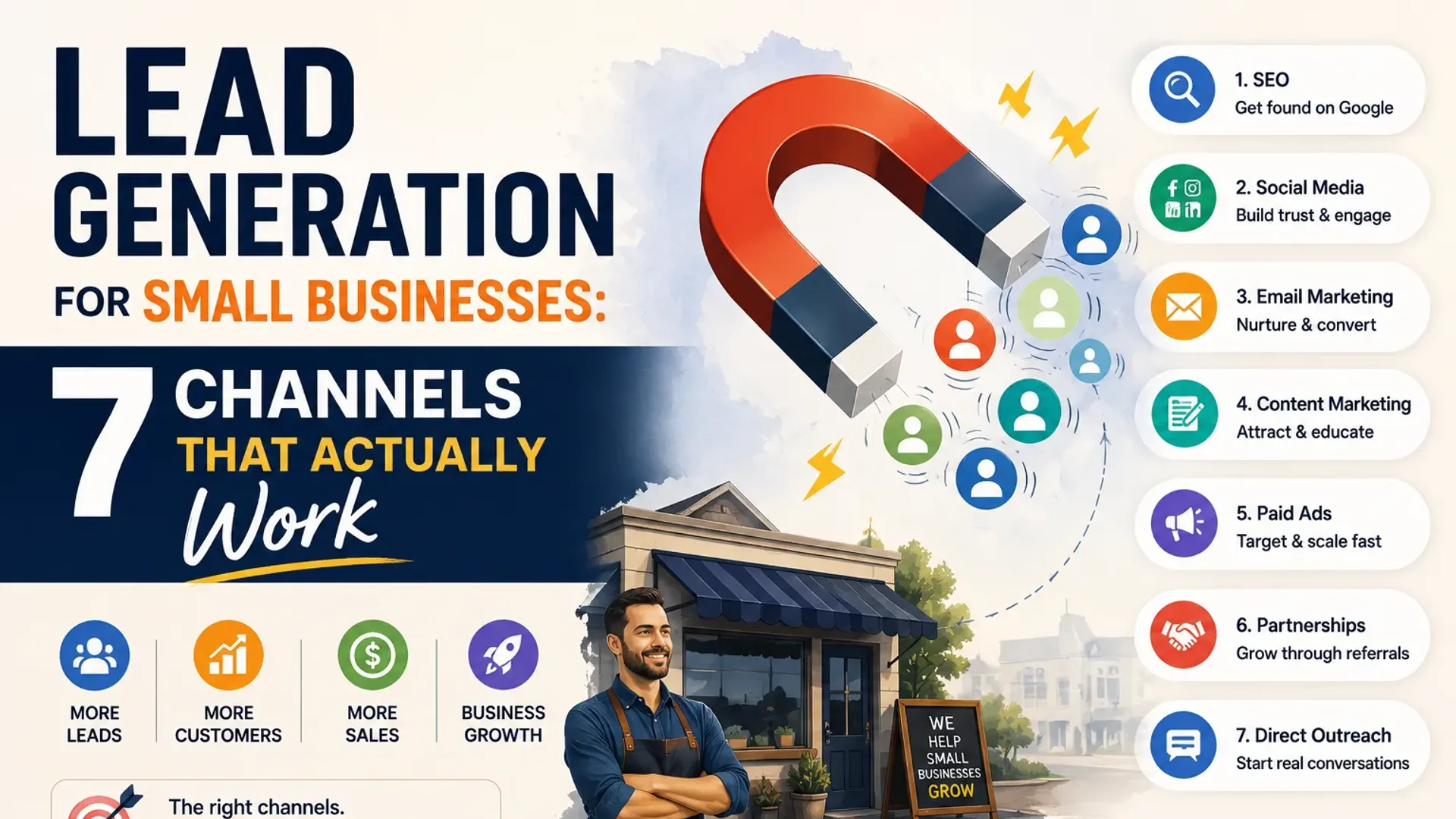
This guide covers seven real channels for lead generation for small business. Each one comes with an honest look at effort, cost, timeline, and fit. By the end, you'll have a clear way to pick your first channel.
Why "More Channels" Is Usually the Wrong Move
There's a consultancy myth that says you need an omnichannel presence. Technically true at scale. Practically useless if you're a business owner doing your own marketing between client calls.
Every channel has a learning curve. Google Ads rewards people who understand match types and negative keywords. SEO rewards consistency over months. Referral systems need a process or they stay random. Split your time across all of them and you never go deep enough into any one to make it work.
The goal isn't to be everywhere. The goal is to have at least one reliable source of new business that you understand and can repeat.
Once you have that — one channel that produces predictable enquiries — everything else becomes optional upside rather than desperate scrambling.
Channel 1: SEO and Content Marketing
What it is
You create pages and articles that rank on Google when potential customers search for what you offer. Someone in your city types "commercial electrician near me" or "accountant for small business Melbourne" — your website appears, they click, they enquire. The traffic is free and compounds over time.
Effort, cost, and timeline
High effort upfront, low ongoing cost once you're ranking. The honest timeline: most businesses see meaningful organic traffic at six to twelve months. Not a quick-win channel — but the businesses that start earliest get the biggest compounding advantage.
What actually moves the needle: a technically sound website (fast, mobile-friendly, properly indexed) and content that answers real questions your customers type into Google. We covered both in detail over at why your website isn't generating leads.
Best fit
Service businesses with evergreen demand — legal, accounting, trades, health, education, B2B services. Also strong for e-commerce and SaaS. Not ideal as a first channel if you need leads in the next 30 days.
Channel 2: Google Business Profile
What it is
The free listing that appears when someone searches for your business or category in Google Maps. That block of results showing star ratings, phone numbers, and "directions" — that's Google Business Profile (GBP). It's separate from your website ranking and often shows up above it.
Effort, cost, and timeline
Low effort, zero cost, and results can show in a few weeks once the profile is properly optimised. This is the most underused channel for local service businesses. Most owners either haven't claimed their listing or filled in half the fields and left it.
What "optimised" actually means: complete every section (hours, services, service areas, description), add real photos, and — critically — collect Google reviews consistently. Reviews are the single biggest factor in whether you appear in the top three local results. One business in the same suburb with 80 reviews will consistently outrank one with 12, even if the second has a better website.
Best fit
Any business with a physical location or a defined service area. Restaurants, trades, medical, legal, retail, personal services. If your customers are local and searching on Google, this channel deserves to be your first priority. It's the most efficient lead generation for small business owners with limited time and budget.
Channel 3: Referrals and Word of Mouth
What it is
Your existing customers tell other people about you. Sounds obvious — and most businesses say "we rely on referrals" — but there's a difference between referrals that happen by accident and referrals that happen by design.
Effort, cost, and timeline
Low cost, moderate effort, and results can come fast if you have an existing customer base. The catch is that random word of mouth is not a growth strategy — it keeps some businesses afloat, but you have no control over timing or volume.
A referral system needs three things: ask at the right moment (right after a positive outcome), make it easy (a link, a card, a message template), and give a reason (a small thank-you or discount). A trades business that added a simple "$50 off for you and your friend" program grew referrals by about 40% in three months. Nothing fancy — just making the ask explicit.
Best fit
High-trust service businesses: legal, financial, health, home services, B2B consulting. Anywhere the decision to buy relies heavily on social proof. Less effective where the product is transactional or where customers don't talk to their networks about that type of purchase.
Channel 4: Paid Advertising (Google Ads and Meta Ads)
What it is
You pay to appear in front of people who are either searching for what you offer (Google Ads) or who match a demographic and interest profile you define (Meta — Facebook and Instagram). Leads can come within days of launching.
Effort, cost, and timeline
High cost and fast results. The minimum viable budget for Google Ads in most Australian metro markets is $1,500–$2,500 per month, and you'll likely lose money for the first few weeks while you tune the campaign. Meta Ads can start smaller — $600–$1,000/month — but work better for businesses creating demand rather than capturing it.
The failure mode most businesses hit: ads go to a mediocre landing page, clicks come in but no enquiries, blame the platform, stop. The ads were probably fine. The page didn't convert. If you want paid ads to work, the landing page needs a clear offer, social proof, and one call to action. Our digital marketing team usually fixes the page before touching the ad account.
Best fit
Businesses with a healthy margin and enough volume to cover the cost of acquisition. Works well for lead generation where you can track a real value per enquiry. Not ideal if your average sale is small, margins are thin, or you don't have budget for at least a 90-day test.
Channel 5: Organic Social Media
What it is
Posting content on LinkedIn, Instagram, Facebook, or TikTok without paying to promote it. Building an audience over time through consistent, useful, or interesting content.
Effort, cost, and timeline
Low cost, very high time investment, and the slowest of all channels to produce reliable leads. Organic social can work — there are tradespeople with 50,000 Instagram followers booked three months out — but they've been posting consistently for years.
The key question: does your customer spend time on this platform in a way that leads to purchases? B2B consultancies getting clients from LinkedIn posts — yes, that's real. A local plumber from organic Instagram — much harder, much slower. Pick the platform your actual customers use.
Best fit
B2B businesses on LinkedIn. Consumer brands where visual storytelling works (food, interiors, fashion, fitness). Businesses where the owner themselves is the brand and wants to build a personal audience. Not a reliable primary channel for most local service businesses starting from zero.
Channel 6: Email Marketing
What it is
Building a list of people who've expressed interest — past customers, enquiries, website opt-ins — and communicating with them regularly. Value-first emails that keep you top of mind when someone is ready to buy.
Effort, cost, and timeline
Low cost (most tools are free up to a few thousand contacts), moderate setup effort, results depending heavily on list quality. A list of 500 warm past customers will produce more leads than 5,000 cold contacts you bought somewhere.
Email has the highest return on marketing investment of any channel — around $36 for every $1 spent, according to industry averages. But only for lists built with permission and maintained with genuinely useful content.
The practical play: set up a simple monthly newsletter, write something useful (a tip, a case study, a seasonal heads-up), and make a soft offer at the end. No elaborate automation needed at first. The goal is to stay in the mind of people who already know you.
Best fit
Any business with repeat customers or a longer sales cycle. Accountants, consultants, health practices, home service businesses, B2B service providers. Less immediately useful if you have no existing customer list and no website traffic to collect opt-ins from.
Channel 7: Partnerships and Referral Networks
What it is
Building relationships with complementary businesses who serve the same customers and refer work to each other. An architect who regularly recommends a specific builder. A financial adviser who refers clients to a mortgage broker. A digital agency (like Alternate) that sends SEO work to a copywriter and gets web projects sent back.
Effort, cost, and timeline
Low cost, moderate relationship effort, and results that can come quickly once the right partnerships are in place. This isn't passive — you need to identify who your customers buy from before and after buying from you, reach out to those businesses, and give value first.
One accountant added two partnerships with financial planners in her city. Within four months, those relationships sent her more new clients than her Google Ads campaign — at zero cost per lead. The difference: she picked up the phone and suggested a coffee.
Best fit
B2B services, professional services, high-value trades, any business where the customer makes multiple related purchases in a short window. Strong for businesses in tight local markets where personal relationships carry weight. For more ideas on how to combine channels intelligently, the piece on how AI agents generate leads around the clock covers some of the automation side that can support any channel.
How to Pick Your First Channel
Four questions will usually point you to the right channel.
- How quickly do you need leads? If you need enquiries in the next 30 days, paid ads or an activated referral ask are your only realistic options.
- What's your budget? Under $500/month? Focus on GBP, referrals, email, and partnerships. Over $2,000/month and willing to test? Paid ads and SEO become realistic.
- Are your customers local or national? Local: start with Google Business Profile. National or B2B: SEO and LinkedIn deserve early attention.
- Do you have existing customers? Yes: activate referrals and email first — near-zero cost, high conversion because trust already exists. No base yet: GBP or paid ads.
Most businesses here will land on GBP or referrals. Both are free, relatively fast, and don't require a marketing degree. Get one consistent before adding a second.
Actionable Takeaways
- Choose ONE channel to build this month — resist the urge to spread across three at once.
- If you have a local service area, claim and fully complete your Google Business Profile today. Add photos and ask your last five happy customers for a review.
- Write out your referral ask. Decide when you'll deliver it (right after a positive job completion) and what the incentive is, even if small.
- Audit your last six months of enquiries: where did they actually come from? Let the data guide your channel choice, not gut feel.
- If you run paid ads, check the page people land on. Does it have a clear headline, one call to action, and at least three credibility signals (reviews, logos, results)? If not, fix the page before spending more on clicks.
- For email: export your past customer list into a free tool like Mailchimp or Kit and send one genuinely useful email this week. That's the whole starting move.
- For partnerships: write down three businesses that serve the same customers you do. Reach out to one this week, no agenda, just to connect.
Frequently Asked Questions
What is the cheapest way to generate leads for a small business?
Google Business Profile and referrals are effectively free. GBP takes about an hour to set up properly, and a referral ask costs only the confidence to make it. Both can produce results within weeks if you're consistent about collecting reviews and asking happy customers to spread the word.
How long does it take to see results from lead generation?
Paid ads can produce enquiries in days. A well-optimised GBP listing can start generating calls within weeks. SEO and organic social both run on a months-long timeline — typically six to twelve before traffic is reliable. Set expectations based on the channel you choose, not an average.
How do small B2B businesses generate leads online?
LinkedIn (organic content or outreach), SEO targeting specific industry pain points, and strategic partnerships tend to work best. Email nurture for warm leads also converts well in B2B because buying decisions take longer and relationships matter more.
Should I do lead generation myself or hire someone?
Understand the channel yourself first, even if you eventually hire it out — you need enough knowledge to evaluate whether the work is being done well. DIY for the first 60–90 days, then bring in a specialist once you have baseline data.
How many leads should a small business aim to generate per month?
Work backwards from your revenue target. If you want two new clients per month and you close roughly one in three enquiries, you need six to eight leads. Start there before worrying about volume.
Is social media good for small business lead generation?
It can be, but it's rarely the most efficient starting point. Organic social is slow and reach is unpredictable. For most local service businesses, GBP and referrals will outperform social in the early stages.
The Only Strategy That Actually Works Long-Term
There's no secret channel. What separates businesses with consistent lead flow from those always chasing it is simpler than most want to admit: they picked one thing, stuck with it long enough to learn it, and made it reliable before moving on.
Lead generation for small business isn't about doing more — it's about doing less, better, for longer than feels comfortable. Pick the channel that fits your budget, timeline, and customer type. Execute for 90 days. Measure. Then add the next one.
If you're not sure where to start, or you've been running campaigns that aren't converting, book a free growth call with the Alternate team — a practical conversation about which channels fit your business specifically. Or if the website itself might be the problem, grab a free website audit and we'll show you exactly what's holding enquiries back.
Tap the button and Google will show you our new articles more often — in Search, Top Stories and AI Overviews.
Have a project in mind?
Let’s turn it into an intelligent product. Book a free 30-minute discovery call.
Start your project →