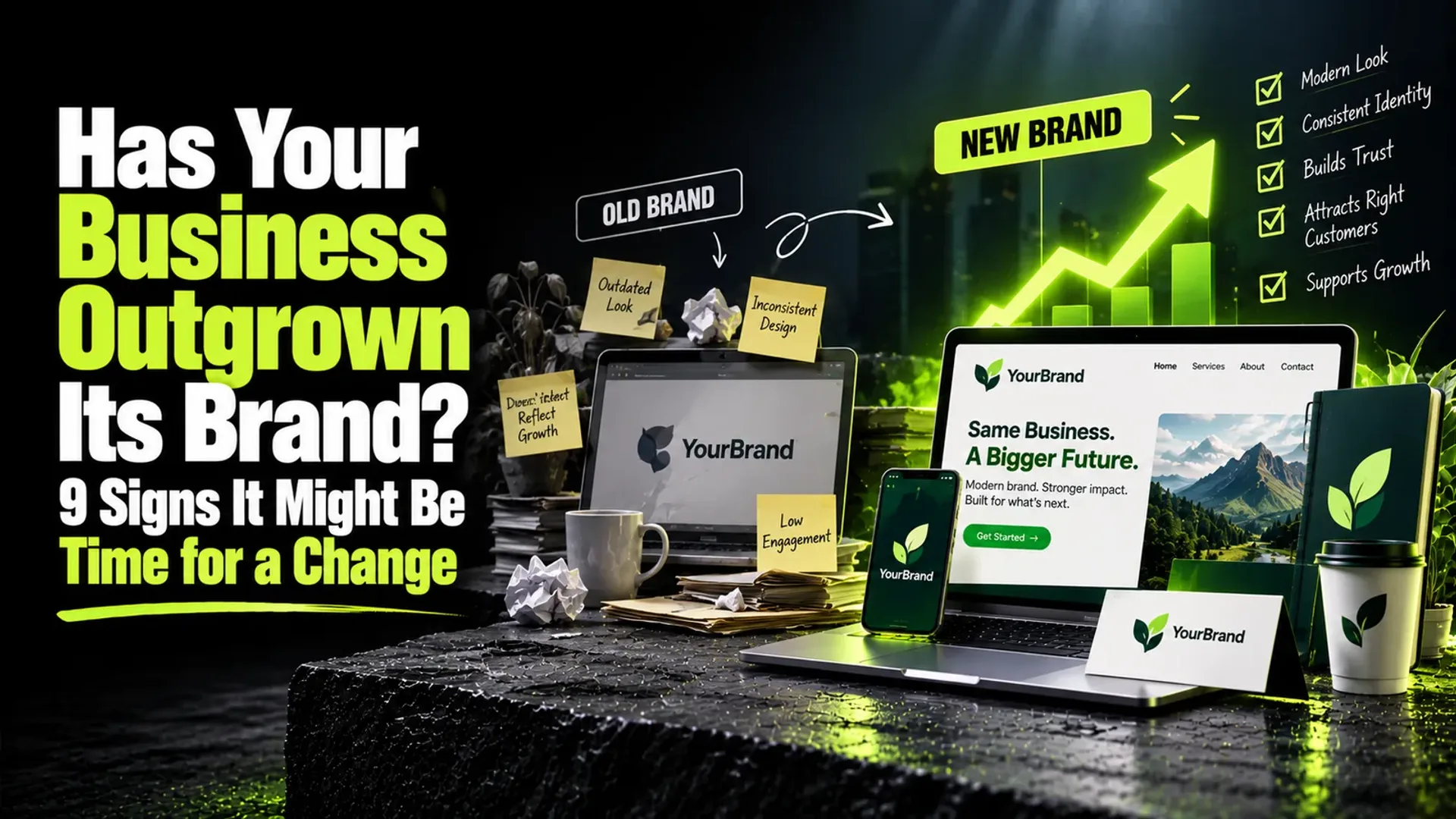
Your business has changed.
Your customers have changed.
Your services have changed.
Maybe even your team has changed.
But your branding still looks exactly the same as it did when you started.
That is more common than you might think.
A lot of businesses keep using the same logo, website, messaging and visual identity for years because, technically, nothing is "wrong" with them.
The logo still works.
The website still opens.
The colours still look fine.
So why change anything?
Because your business may have moved forward while your brand stayed behind.
And when that happens, your brand can start creating the wrong impression.
It may make a growing company look small.
It may make an experienced company look outdated.
It may make a premium service look cheap.
Or it may simply fail to explain what the business has become.
That is when it is worth looking at a brand refresh or, in some cases, a complete rebrand.
Your brand is supposed to represent where your business is going
When a company starts, branding is usually created around what the business is at that particular moment.
That is perfectly normal.
A startup might begin with three services, a small team and a very specific type of customer.
Five years later, the same company may have 50 employees, a much bigger customer base, new services and clients across multiple countries.
But its website still says:
"We are a small team helping local businesses..."
The business has moved on.
The brand has not.
Brand strategy is not something that should stay frozen forever. NielsenIQ describes brand positioning as an ongoing process that needs to adapt as organisations and customer needs change. NielsenIQ's guide to brand positioning also explains how positioning should connect a company's target audience, market, differentiation and value proposition.
That does not mean you should redesign your logo every year.
It means you should regularly ask whether your brand still represents the business you are building.
So how do you know if your brand has outgrown itself?
Here are nine signs to look for.
1. Your business does much more than your website says
This is one of the clearest signs.
Maybe you started as a web design company.
Over time, you added branding, UX, marketing, AI automation and software development.
But your website still presents you as a web design company.
That creates a gap between what you actually do and what people think you do.
And that gap can cost you opportunities.
A potential customer may visit your website, see that you build websites and leave.
They may never realise that you could also help them with branding, marketing or automation.
Your website does not need to list every single thing your team can do.
But it should clearly communicate what your business has become.
2. You are attracting the wrong customers
Your branding has a big influence on who approaches you.
Think about a luxury interior design company with a website that looks like it was created for budget home renovations.
The company might provide an excellent service.
But the branding is attracting the wrong audience.
The same thing happens with B2B companies.
If your branding looks like a small freelance operation, larger companies may hesitate to contact you.
If your messaging is too corporate, smaller businesses may assume you are too expensive.
Your brand sends signals before anyone speaks to your sales team.
If the signals are wrong, you may end up spending more time convincing the wrong customers.
3. Your competitors look more established
This one can be uncomfortable to admit.
Sometimes your competitors simply look better.
Their websites are clearer.
Their messaging is sharper.
Their visual identity feels more professional.
Their content looks consistent.
And when potential customers compare you side by side, they may assume the more polished company is more capable.
That assumption is not always correct.
But customers do make judgments based on presentation.
Your branding does not need to copy your competitors.
In fact, it should do the opposite.
It should make your difference easier to understand.
Strong brand positioning is about finding a distinctive place in the market and communicating it clearly, not simply trying to look better than everyone else. NielsenIQ's research on brand positioning explains why differentiation, target audience and value proposition need to work together.
4. Your customers cannot explain what makes you different
Ask a few customers:
"Why did you choose us?"
Listen carefully to the answers.
If they can clearly explain what makes your company different, that is a good sign.
If the answer is:
"Your service was good."
"You were recommended to us."
"You seemed professional."
"Your price was reasonable."
you may have a positioning problem.
Those things matter, but they are not necessarily a strong reason for choosing one brand over another.
Your brand should make your difference easier to understand.
Maybe you are faster.
Maybe you specialise in one industry.
Maybe you combine services that are usually handled by multiple agencies.
Maybe your technology is different.
Maybe your customer experience is better.
Whatever it is, your brand should help communicate it.
5. Your business has become more premium, but your brand has not
This happens all the time.
A company starts by serving small projects.
It builds experience.
The team grows.
The quality of work improves.
The company starts working with larger clients.
Prices increase.
But the website still looks exactly the same.
The old stock photos are still there.
The messaging still sounds basic.
The website has not been updated in years.
The social media is inconsistent.
The company may now be capable of delivering a much higher level of service, but the brand does not communicate that.
There is nothing wrong with keeping a simple identity.
But simple and outdated are two very different things.
6. Your brand has become difficult to manage
Here is another sign that often appears as companies grow.
Everyone has their own version of the brand.
One designer uses one shade of blue.
Another uses a slightly different blue.
The sales team has an old logo.
The marketing team uses a different font.
The social media team has its own templates.
Someone sends a presentation with a completely different colour palette.
Individually, these things may seem minor.
Together, they make the company look inconsistent.
This is often a sign that the business needs a proper brand system rather than simply a new logo.
A good brand strategy should give everyone a common framework for how the company looks, sounds and communicates. NielsenIQ describes brand strategy as a broader plan that informs branding decisions across an organisation rather than just individual marketing campaigns. Read NielsenIQ's overview of brand strategy.
7. Your website feels like it belongs to an older version of your company
Open your website and pretend you have never seen it before.
Now ask yourself:
Does this look like the company we are today?
Does it speak to the customers we want today?
Does it show our strongest work?
Does it explain our current services?
Does it communicate the level of experience we now have?
Does it look as good as the work we deliver?
If the answer to several of these questions is no, your website may be holding your brand back.
And sometimes the problem is bigger than design.
The entire story needs to change.
The homepage may need a different message.
The services may need to be reorganised.
The case studies may need to be stronger.
The navigation may need to change.
The visual identity may need to be updated.
A rebrand and website redesign often make sense together because the website is where customers experience a large part of the brand.
8. Your company has entered a new market
Expanding into a new market is another good reason to reconsider your positioning.
Maybe you started in India and are now selling in the US, UK and Australia.
Maybe you started with small businesses and are now targeting enterprise clients.
Maybe you started with one industry and now work across healthcare, fintech, real estate and ecommerce.
The old positioning may not work anymore.
This does not necessarily mean you need a completely new brand.
Sometimes you simply need to adjust your messaging.
Other times, the change is significant enough to require a broader repositioning.
The important thing is to understand the new audience before changing the visuals.
A new market may have different expectations, competitors and buying behaviour.
The branding should reflect that reality.
9. You are embarrassed to send people to your website
This one is simple.
If someone asks for your website and you hesitate before sending it, something is probably wrong.
You should not have to explain:
"The website is old, but our work is much better."
Or:
"Ignore the homepage. Let me send you our portfolio instead."
Your website does not have to be perfect.
But it should give potential customers confidence.
If your best salespeople are constantly compensating for your website, the website is probably doing the opposite of what it should.
But do you really need a rebrand?
Not necessarily.
This is where businesses often go too far.
A company notices that its website feels outdated and immediately decides to change everything.
New logo.
New colours.
New name.
New website.
New messaging.
New social media.
Sometimes that is the right decision.
Sometimes it is completely unnecessary.
There is a big difference between a brand refresh and a rebrand.
A brand refresh usually keeps the core identity while improving how it looks and communicates.
You might update the typography, colours, website, photography, messaging or design system.
A rebrand goes much deeper.
It can involve repositioning the company, changing the identity, redefining the audience, changing the brand story and rebuilding the overall experience.
The right choice depends on the problem you are trying to solve.
Do not change your brand just because you are bored with it
This is important.
You see your logo every day.
Your team sees it every day.
You have probably looked at the same website hundreds of times.
Eventually, you get tired of it.
That does not automatically mean your customers are tired of it.
Brand recognition has value.
People become familiar with brands through repeated exposure.
Changing a recognisable identity without a clear reason can create unnecessary confusion.
Harvard Business Review has discussed this exact risk in its work on rebranding. One HBR discussion with strategist Roger Martin points out that changing a familiar brand can disrupt the habits customers have built around it and force the company to rebuild recognition. Read the Harvard Business Review discussion on the risks of rebranding. So do not rebrand because the marketing team wants something "fresh."
Rebrand because the business has a real problem to solve.
Start with strategy, not design
This is probably the most important part.
Do not start with:
"What should our new logo look like?"
Start with:
"Where is our business going?"
Then ask:
Who are we trying to attract?
What do we want to be known for?
What has changed since our original brand was created?
Who are our strongest competitors now?
What do customers currently think about us?
What do we want them to think about us?
What makes us different?
What should stay?
What needs to change?
These questions give you a direction.
Only then should you start thinking about colours, fonts and logos.
A simple way to decide if you need a brand refresh
Try this exercise.
Take your current brand and score it from 1 to 5 on these areas:
Positioning: Is it clear what we do and who we serve?
Visual identity: Does the design represent the quality of our business?
Messaging: Does our website explain our value clearly?
Consistency: Does the brand look and sound the same across channels?
Audience: Does the brand attract the customers we actually want?
Website: Does the website represent the company we are today?
Differentiation: Can customers understand why they should choose us?
If most of your scores are 4 or 5, you probably do not need a complete rebrand.
You may simply need a few improvements.
If most scores are 1 or 2, there is probably a bigger problem.
That is when it makes sense to look at your brand more seriously.
Your brand should grow with your business
A good brand is not something you create once and forget about.
Your business changes.
Markets change.
Customers change.
Competitors change.
Technology changes.
Your brand needs enough flexibility to grow with those changes.
That does not mean constantly changing it.
It means knowing when the current version is no longer helping the business.
The goal is not to make your company look different.
The goal is to make your company look more like what it has become.
The best rebrand may not look like a completely new company
Sometimes the smartest rebrand is surprisingly subtle.
The logo stays recognisable.
The colours are refined.
The typography improves.
The messaging becomes clearer.
The website gets rebuilt.
The photography becomes more consistent.
The brand story finally reflects what the company actually does.
Customers still recognise you.
But the business feels sharper, more confident and more relevant.
That can be much more valuable than changing everything just for the sake of change.
Your brand should be helping your business move forward
If your business has grown but your brand still looks like it belongs to the early days, it is worth taking a step back.
Look at your website.
Look at your social media.
Look at your sales presentations.
Look at your advertisements.
Look at what your competitors are doing.
Then ask a simple question:
"Does our brand represent the business we are building today?"
If the answer is no, you may not need a completely new identity.
But you probably need to do something.
At Alternate, we approach branding from the business side first. We look at positioning, audience, messaging and visual identity before deciding what needs to change. From brand strategy and identity to website design, UX/UI and digital marketing, the goal is to make every part of the business tell the same story.
Because a good rebrand is not about looking new.
It is about making sure your brand finally matches the business behind it.
Tap the button and Google will show you our new articles more often — in Search, Top Stories and AI Overviews.
Have a project in mind?
Let’s turn it into an intelligent product. Book a free 30-minute discovery call.
Start your project →