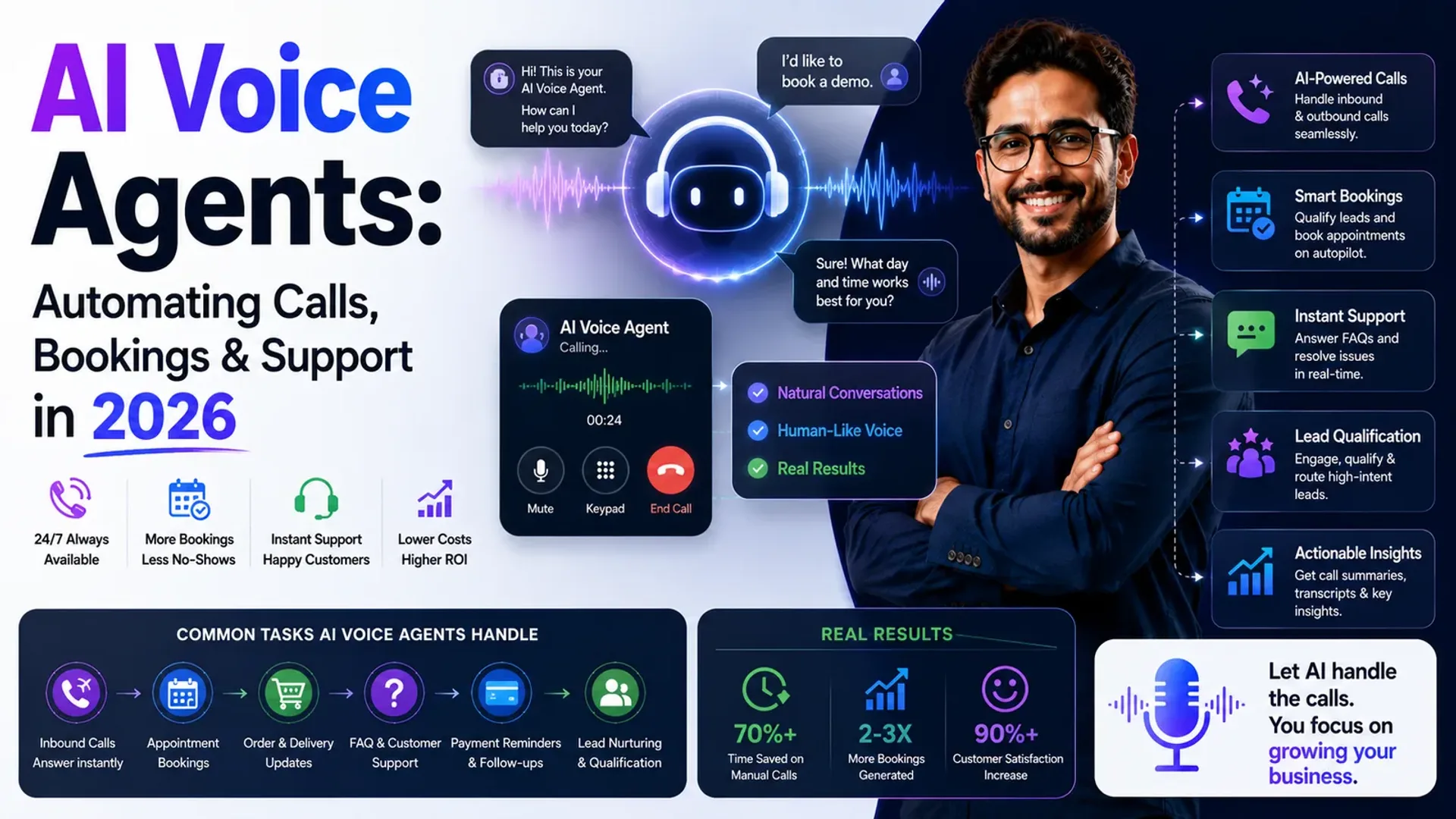
The phone never went away. For huge swathes of business, it is still where bookings get made, questions get answered and deals get closed. It is also where a lot of time and money quietly leaks: missed calls, hold queues, after-hours voicemails no one returns. AI voice agents are the technology aimed squarely at that leak, and in 2026 they have crossed the line from novelty to genuinely useful.
A modern AI voice agent can answer a call, understand a natural spoken request, respond in a lifelike voice, and complete a task like booking an appointment or checking an order status. The good ones are smooth enough that many callers do not immediately realize they are talking to software. That capability is powerful, and it carries real responsibilities around trust and compliance that no serious business should ignore.
Let us break down how these systems actually work, where they earn their keep, and how to pilot one without damaging the customer relationships you have spent years building.
How AI voice agents actually work
Under the hood, a voice agent is a pipeline of three core technologies working in near real time:
- Speech-to-text (STT): The caller's speech is transcribed into text as they talk.
- A language model (LLM): That text is interpreted, reasoned over against your business logic and connected systems, and a response is generated.
- Text-to-speech (TTS): The response is converted back into natural-sounding audio, using voice synthesis from tools like ElevenLabs and others.
The reason these agents feel so much better than the phone menus of the past is twofold. The language model understands intent rather than forcing callers down rigid keypad trees, and voice synthesis has become expressive enough to carry natural rhythm and tone. Wrapped around this core are integrations to your calendar, CRM or booking system, so the agent does not just talk. It acts.
Where voice agents actually deliver
Not every call is a good fit, but several categories are a strong match today.
Inbound reception and routing
Answering every call instantly, understanding why the person is calling, handling the simple requests, and routing the rest to the right human. No more missed calls going to voicemail purgatory.
Bookings and scheduling
Appointment-driven businesses such as clinics, salons, restaurants and service trades lose real revenue to unanswered calls. A voice agent can check live availability, book, reschedule and confirm around the clock.
Support and status queries
Order status, opening hours, account questions and other high-volume, low-complexity queries can be resolved instantly, freeing human agents for the conversations that genuinely need a person.
Outbound follow-ups
Appointment reminders, confirmations and simple check-ins can be handled at scale, provided you respect consent and calling rules, which we will come to.
A voice agent should make callers feel helped, not handled. The moment it feels like a wall between the customer and a human, it is doing more harm than good.
Voice agents are not text chatbots
It is worth being precise here, because the two get conflated. A voice agent operates in a live, real-time audio conversation where there is no scrolling back, no re-reading, and no patience for long pauses. That raises the bar considerably. Latency has to be low, interruptions have to be handled gracefully, and errors are less forgivable because the caller cannot see what went wrong.
Text-based assistants live on your website and in chat, where users tolerate slightly slower, more deliberate exchanges and can review the conversation. Both are valuable, and many businesses run them together, but they are different disciplines. If your priority is on-site and messaging conversations, that is the domain of our AI chatbot development work rather than voice.
The limits, trust and compliance
This is the part too many vendors gloss over, and it is the part that protects your brand. Honest guardrails are not optional.
- Disclosure: In many regions, callers have a right to know they are speaking with an automated system. Building clear disclosure in is both good ethics and, increasingly, a legal requirement.
- Consent and calling rules: Outbound calling is heavily regulated in many markets. Consent, calling hours and opt-out handling must be respected, and rules vary widely by country.
- Graceful handoff: There must always be a fast, obvious path to a human. An agent that traps frustrated callers is worse than no agent at all.
- Accuracy and edge cases: Accents, background noise, emotional callers and unusual requests still challenge these systems. Design for failure, not just the happy path.
- Data handling: Calls contain personal and sometimes sensitive information. How that data is stored, processed and secured needs to be deliberate.
Get these right and a voice agent extends your team. Get them wrong and it quietly erodes the trust your business runs on.
How to pilot a voice agent the smart way
The businesses that succeed with voice agents treat the rollout as an experiment, not a switch to flip. A sensible pilot looks like this:
- Pick one narrow, high-volume use case, such as after-hours booking or order-status calls. Do not try to automate everything at once.
- Define a clear handoff rule so anything outside the agent's competence reaches a human quickly.
- Script the disclosure and the escape hatch before you script anything else.
- Monitor real transcripts closely in the early weeks and refine based on where callers get stuck.
- Expand only once the numbers and the feedback justify it.
Because a voice agent touches your systems, your brand voice and your compliance posture at once, it benefits from being built by people who understand all three. This is where a team fluent in generative AI development and the surrounding AI tooling makes the difference between a demo and a dependable service. You can see the broader philosophy behind our builds across the blog.
The bottom line
AI voice agents in 2026 are a real, deployable tool for automating inbound calls, bookings, support queries and simple outbound follow-ups. They work by chaining speech-to-text, a language model and text-to-speech into a live conversation, and the best of them feel remarkably natural. But they demand honesty about limits, clear disclosure, respect for calling and consent rules, and an always-available human handoff. Pilot narrow, monitor closely, and expand only when the results earn it. Done that way, a voice agent stops being a gimmick and starts being one of the most reliable members of your team.
Will callers know they are talking to an AI?
They should. Clear disclosure is good practice and, in many regions, a legal requirement. The goal is not to fool people but to help them quickly, with an easy path to a human whenever they want one.
How is a voice agent different from a chatbot?
A voice agent handles live phone conversations in real time, which demands low latency and graceful handling of interruptions and noise. A chatbot handles text on your site or in messaging, where users can scroll and read at their own pace. Many businesses use both for different channels.
Where should we start with a pilot?
Choose one narrow, high-volume, low-complexity use case such as after-hours bookings or order-status queries. Nail disclosure and human handoff, watch real transcripts, and only expand once the pilot proves out.
Curious whether a voice agent fits your business, or where the line between voice and chat should sit? Reach out to our team and we will help you scope a sensible first step.
Related reading: how to build an AI chatbot · AI customer support
Tap the button and Google will show you our new articles more often — in Search, Top Stories and AI Overviews.
Have a project in mind?
Let’s turn it into an intelligent product. Book a free 30-minute discovery call.
Start your project →