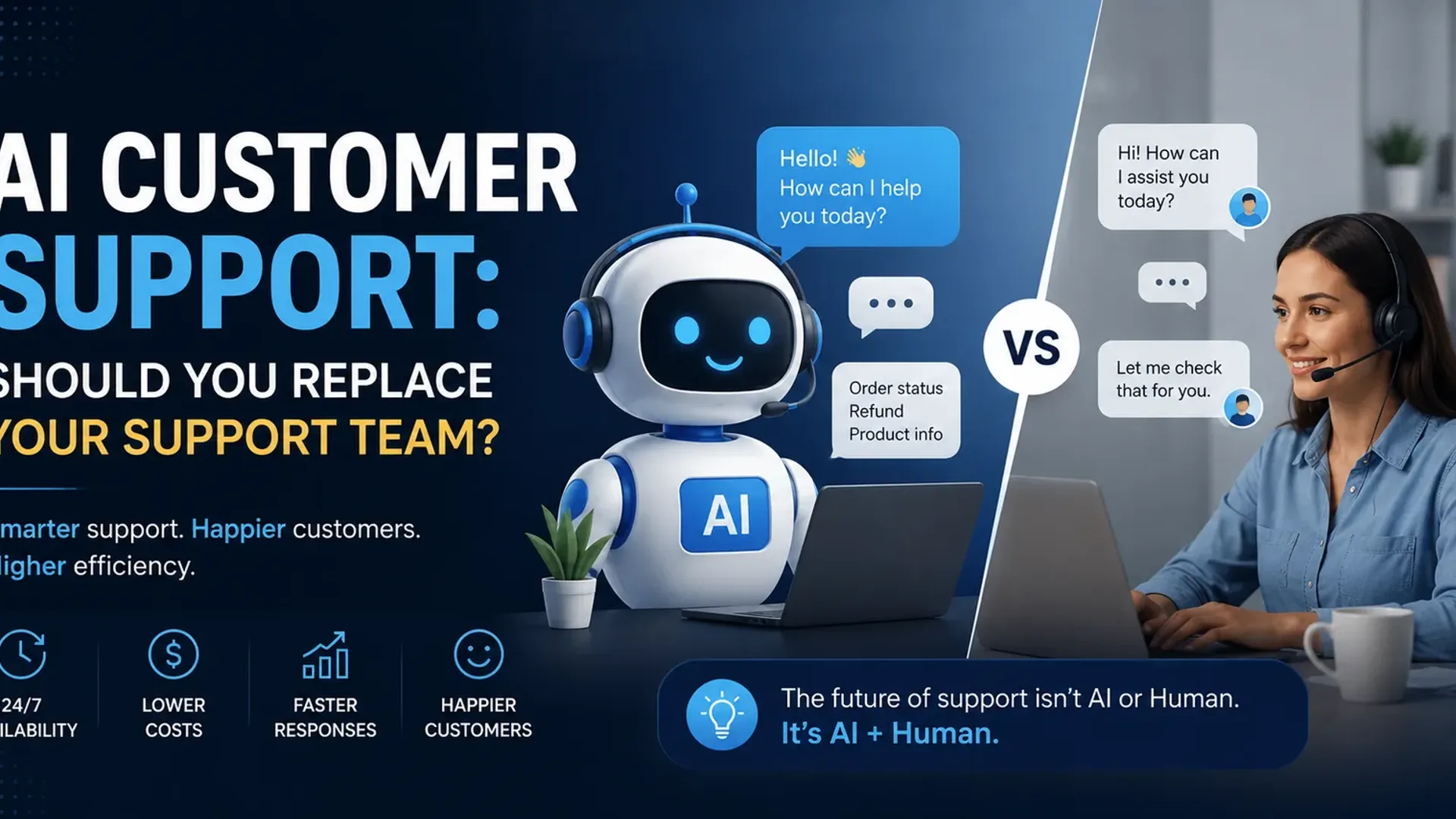
The question shows up in nearly every leadership meeting now. AI can answer tickets at 3 a.m., handle a thousand chats at once, and never asks for a raise. So the temptation is obvious: why keep paying a support team when a chatbot can do the work?
It's the wrong question. The businesses winning with AI customer support aren't the ones replacing their teams — they're the ones figuring out exactly which work belongs to machines and which still belongs to people. Get that line right, and you cut costs while customers actually feel better served. Get it wrong, and you save money for one quarter, then watch your reviews and retention quietly fall apart.
Here's how to draw that line.
What AI Customer Support Actually Does Well
Modern AI customer service automation has moved far past the clunky decision-tree bots of a few years ago. Today's systems understand natural language, pull from your knowledge base in real time, and resolve genuine issues without a human ever touching them. The trick is knowing where they shine.
High-volume, repetitive questions. "Where's my order?" "How do I reset my password?" "What are your hours?" These make up the bulk of most support queues, and they're nearly identical every time. An AI chatbot for business handles them instantly, around the clock, in any language, without a queue. Your customers get an answer in seconds instead of waiting on hold.
Instant first response, 24/7. Even when a query does need a human, AI can acknowledge it immediately, gather context, and set expectations. The customer never feels ignored — and your team starts the morning with tickets already triaged and summarized.
Routing and triage. Good AI doesn't just answer; it sorts. It can detect urgency, identify the topic, pull up the customer's history, and send the right ticket to the right person with all the context attached. That alone can shave minutes off every human interaction.
Self-service at scale. When AI is wired into your help center, customers solve their own problems through guided conversation rather than digging through articles. Deflection rates climb, and your cost per resolved ticket drops sharply.
The pattern across all of these: AI is excellent at volume, speed, and consistency for problems that have a known answer.
What Humans Should Still Handle
Now the other half — the work you should never hand to a bot, no matter how good the demo looks.
Emotionally charged situations. A customer who's angry, frightened, or grieving doesn't want efficient. They want to feel heard by someone who can actually empathize and bend the rules. AI can detect frustration; it can't genuinely reassure a person who's just lost data, money, or trust. This is where a human voice rebuilds a relationship that automation would shatter.
Complex, non-standard problems. The moment a query doesn't fit a pattern — a billing dispute with three moving parts, an edge case the documentation never anticipated — judgment matters more than speed. Humans connect dots, weigh trade-offs, and make exceptions. Bots loop.
High-stakes accounts and decisions. Enterprise renewals, escalations from key clients, anything involving real money or legal exposure: these deserve a person who can own the outcome. The cost of an AI getting it wrong here dwarfs any efficiency gain.
Relationship-building and retention. A save call, an upsell conversation, a check-in with a long-time customer — these are about trust and nuance, not information retrieval. They're often where your highest revenue lives.
The pattern here is the mirror image: humans are essential for judgment, empathy, and accountability on problems without a clean, known answer.
The Real Model: AI and Humans, Not AI vs. Humans
The strongest support operations treat AI as the front line and humans as the specialists behind it.
AI handles the first contact, resolves the routine majority, and escalates the rest — with full context — to a person. Your team stops drowning in password resets and starts spending its time on the conversations that actually move retention and revenue. Headcount doesn't necessarily shrink; the nature of the work improves. Agents handle fewer tickets, but each one matters more, and job satisfaction tends to rise alongside it.
The numbers tend to follow. You get faster response times, higher resolution rates, lower cost per ticket, and — critically — better customer satisfaction, because nobody's being forced through a bot when they needed a human.
So, should you replace your support team? No. You should redesign it. Automate the predictable, elevate the human, and connect the two seamlessly. That's the version of AI customer support that pays off well beyond the first quarter.
Where to Start
The hard part isn't the technology — it's mapping your specific ticket volume to the right automation, integrating it with your existing tools, and drawing that AI-versus-human line correctly for your business. Done poorly, automation frustrates customers. Done well, it becomes one of the highest-ROI investments your support operation will make.
That's exactly what we help businesses build: AI chatbot and automation systems designed around your real support workflows, not a generic template.
Ready to find out what you should automate — and what you shouldn't? Book an AI Automation Consultation and we'll map it out with you.
Tap the button and Google will show you our new articles more often — in Search, Top Stories and AI Overviews.
Have a project in mind?
Let’s turn it into an intelligent product. Book a free 30-minute discovery call.
Start your project →