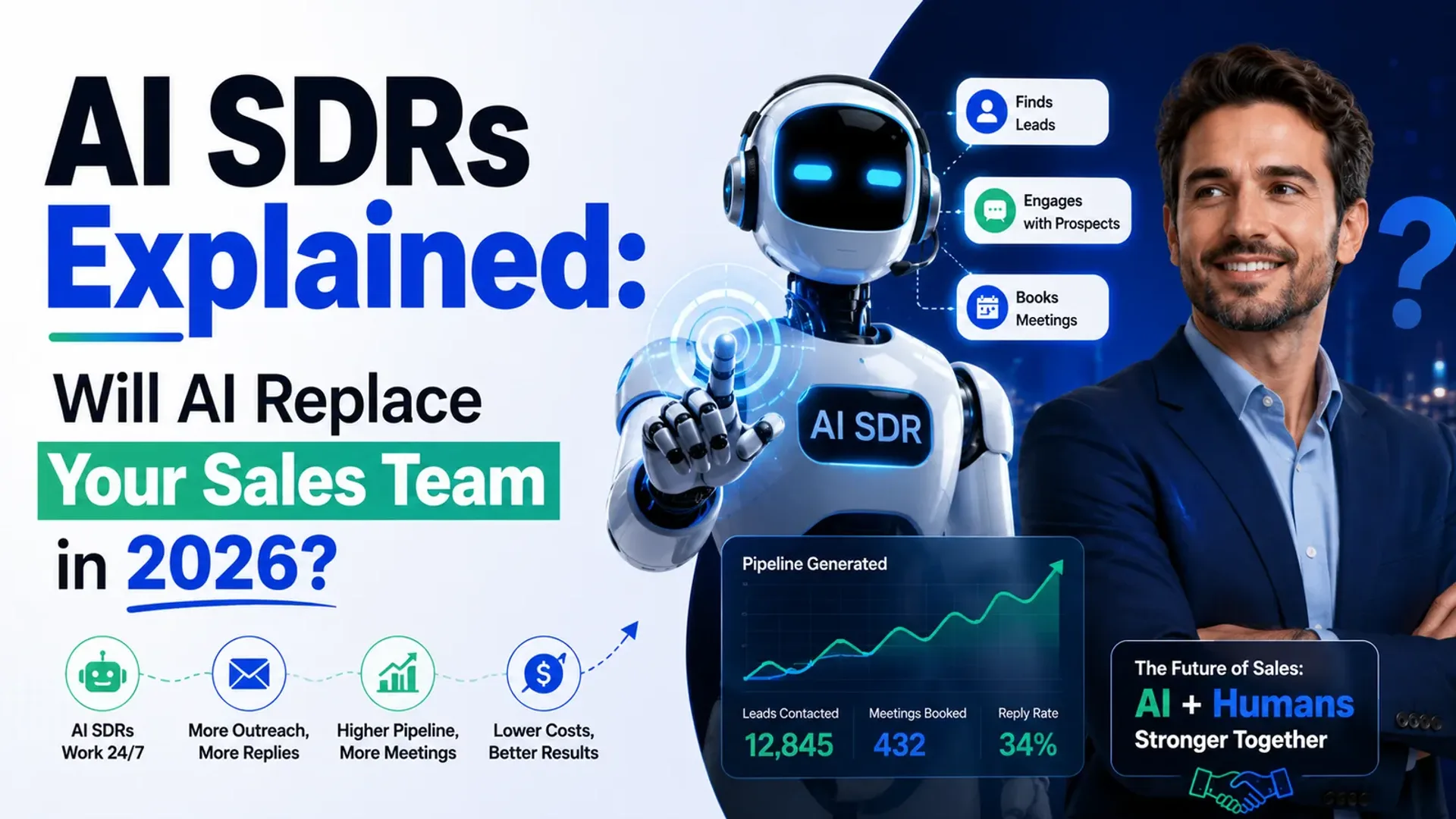
Ask any founder or sales leader what keeps their pipeline thin, and you'll hear the same thing: prospecting is slow, repetitive, and easy to deprioritize. Enter the AI SDR (Sales Development Representative) tools that promise to research accounts, write personalized emails, and book meetings while your reps sleep. The pitch is seductive, and in 2026 it's everywhere.
So the obvious question lands on every leadership meeting agenda: is this the moment AI finally replaces the sales team? The honest answer is more useful than the hype. AI SDRs are genuinely powerful at the top of the funnel and genuinely dangerous when deployed carelessly. Used well, they make your humans more effective. Used lazily, they torch your sender reputation and your brand in a single quarter.
Let's break down what these tools actually do, where they quietly fail, and how to deploy them without becoming the spam everyone deletes.
What an AI SDR Actually Does
An AI SDR isn't one tool. It's a category of software that automates the repetitive layers of outbound sales development. The strongest platforms chain several capabilities together into something that looks a lot like a junior rep who never gets tired.
- Account and contact research: pulling together signals about a company, its recent activity, tech stack, and likely pain points.
- Personalized outreach drafting: generating email and LinkedIn copy tailored to each prospect rather than a single blast template.
- Multi-step sequencing: sending follow-ups, adjusting timing, and pausing when a prospect replies.
- Qualification: asking discovery questions, scoring interest, and routing warm leads to a human.
Where this shines is volume plus consistency. A human rep can personalize maybe a few dozen quality emails a day before quality collapses. An AI SDR can research and draft at a scale no team can match, which is exactly why the category exploded. If your outbound has stalled because nobody has time to prospect, this is a real lever.
Where AI SDRs Quietly Fail
Here's what the demos don't show you. The failures are rarely dramatic. They're slow, compounding, and expensive.
Deliverability collapse
The moment you point an automated system at a large list, you're one bad campaign away from your domain landing in spam. Mailbox providers are aggressive about pattern detection. Send too much, too fast, to unengaged addresses, and your legitimate email including invoices and support replies starts disappearing into junk folders. This is the single most common way teams sabotage themselves.
"Personalization" that reads like a robot
AI can insert a prospect's company name and a recent headline. That isn't personalization; it's mail-merge with extra steps. Buyers have learned to spot it instantly, and a clumsy "I loved your recent post about..." that clearly nobody read does more damage than a plain cold email.
Brand and compliance risk
Every automated message goes out under your name. If the AI hallucinates a claim, misreads context, or emails someone who never should have been contacted, that's your reputation on the line, not the vendor's. Privacy regulations around consent and outreach vary across markets, and "the tool did it" is not a defense.
An AI SDR doesn't remove human judgment from sales. It removes the excuse for not doing the work, then punishes you brutally if you skip it anyway.
The Human + AI Hybrid Model That Actually Works
The teams winning with this technology aren't choosing between humans and machines. They're redrawing the line between them. The pattern is consistent: let AI handle breadth, let humans own depth and relationships.
- AI owns the grind: research, first-draft copy, list hygiene, sequencing, and surfacing which accounts show buying signals.
- Humans own the moments that matter: the reply, the discovery call, the objection, the negotiation, and any account that's strategically important.
- AI qualifies, humans close: let the system book and pre-qualify, but a person should be the one a serious buyer talks to before money changes hands.
This is the same logic behind well-built conversational AI and chatbot systems. The bot handles the first mile at scale; the human takes over the instant intent gets serious. Sales development is no different. If you're thinking about how these tools fit your stack, our team's approach to practical AI tools for business starts from workflow, not novelty.
How to Deploy AI SDRs Responsibly
If you're going to do this, do it in a way that protects the assets that take years to build, your domain reputation and your brand. A responsible rollout looks like this:
- Warm your infrastructure. Use dedicated sending domains, authenticate properly, and ramp volume gradually. Never fire a cold system at full throttle.
- Start narrow. Pick one tight, well-researched segment. Prove the messaging converts before you scale the volume.
- Keep a human in the loop. Review AI-drafted copy early and often. Approve, don't just automate.
- Respect consent and suppression. Honor opt-outs immediately, scrub bad data, and know the rules in each market you sell into.
- Measure reply quality, not just reply rate. Meetings booked with the wrong people are worse than no meetings at all.
Outbound is only one channel, and it works best inside a broader engine. Pairing AI-assisted outreach with strong demand generation and digital marketing means your reps are reaching people who already recognize your name, which changes everything about how those emails perform.
The Bottom Line
AI SDRs won't replace your sales team in 2026, and the vendors quietly know it. What they will do is replace the least valuable, most repetitive parts of the job and expose whether you actually understand your buyer. The technology is a multiplier: it amplifies good judgment and it amplifies laziness just as fast. Treat it as a co-pilot for your humans, protect your deliverability like the finite resource it is, and keep a person on every conversation that matters. Do that, and you get scale without becoming noise.
Frequently Asked Questions
Will an AI SDR completely replace human sales reps?
No. AI SDRs excel at high-volume research, drafting, and qualification, but they struggle with genuine rapport, nuanced discovery, objection handling, and closing. The most effective model is hybrid: AI handles breadth at the top of the funnel while humans own the relationships and decisions that actually drive revenue.
What's the biggest risk of using AI for sales outreach?
Deliverability and brand damage. Automated systems can flood inboxes and trigger spam filters, which can push even your legitimate email into junk folders. Because every message goes out under your name, poor targeting or inaccurate claims become your reputational risk. Careful ramp-up, human review, and strict consent practices are essential.
How do I get started without hurting my domain?
Use a dedicated sending domain, authenticate it properly, and increase volume slowly. Begin with one tightly defined, well-researched segment and keep a human reviewing the copy. Prove the messaging converts before scaling. If you'd rather build this correctly the first time, talk to our team about a responsible rollout.
Thinking about layering AI into your sales motion without burning trust? Let's map out what a responsible, human-led AI outreach system looks like for your business.
Related reading: automate your sales funnel with AI · a lead-gen system on autopilot
Tap the button and Google will show you our new articles more often — in Search, Top Stories and AI Overviews.
Have a project in mind?
Let’s turn it into an intelligent product. Book a free 30-minute discovery call.
Start your project →