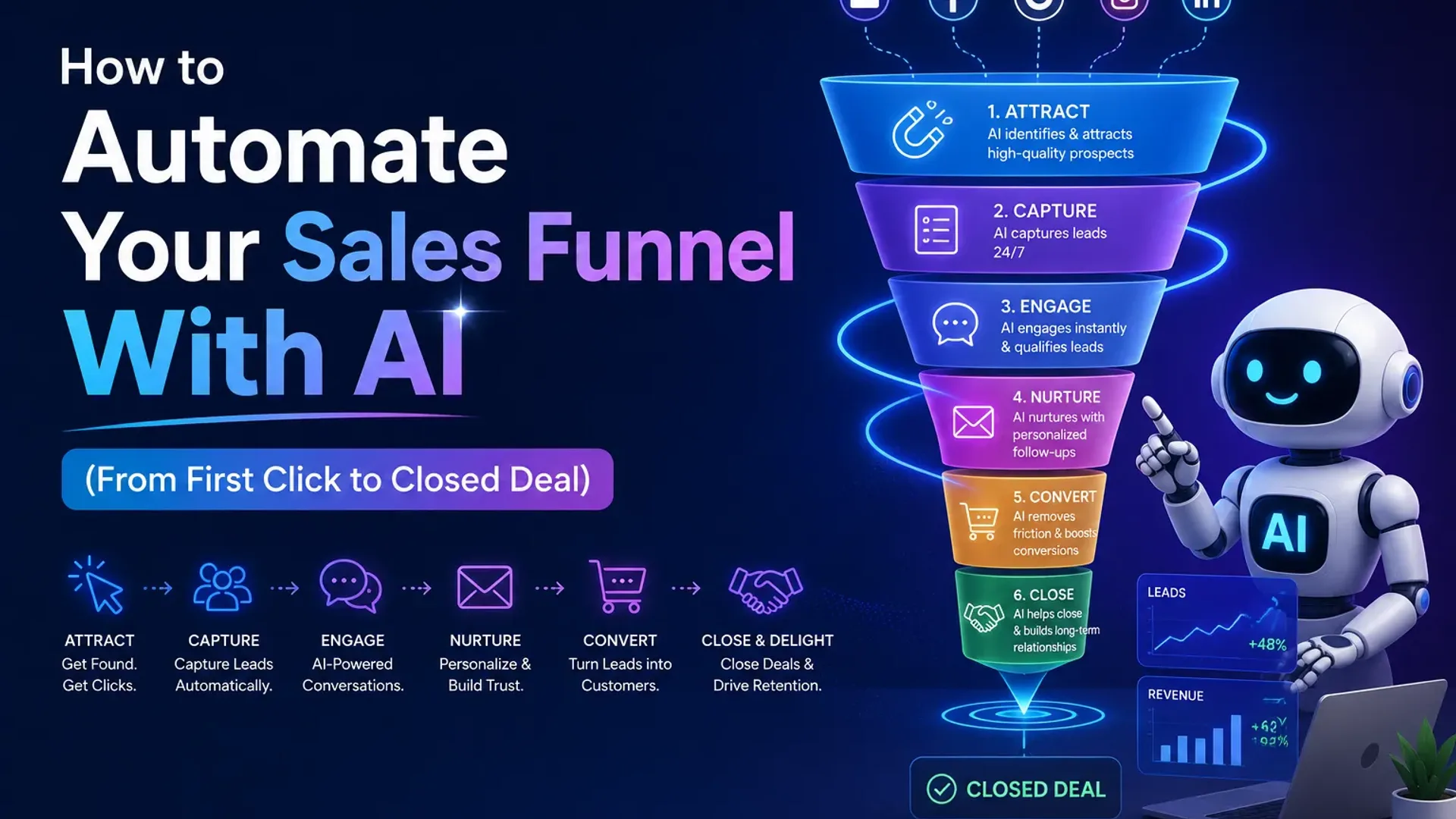
How to Automate Your Sales Funnel With AI (From First Click to Closed Deal)
Marcus runs a B2B software company. Last Tuesday, a prospect clicked one of his ads at 11:47 PM, browsed the pricing page for four minutes, and closed the tab. By the time Marcus's sales rep saw the lead the next morning, the prospect had already booked a demo with a competitor.
That gap — between the moment someone shows interest and the moment a human responds — is where deals go to die. It happens dozens of times a day in most businesses, quietly.
AI sales funnel automation closes that gap. Not the magic-button version vendors sell you — the real version: AI handling the repetitive first mile so that when a human steps in, the deal is warm, the prospect is informed, and the meeting is already booked. This post breaks down each stage, names where humans still need to show up, and follows one lead — Priya — from first click to signed contract.
Why Most Sales Funnels Leak (And Where AI Plugs the Holes)
A typical funnel has six stages: attract, capture, qualify, nurture, close, retain. Most businesses have some process at each stage. What they rarely have is speed and consistency across all six simultaneously.
A rep who's great at closing is terrible at following up with cold leads for 90 days. Nobody wants to manually score 300 inbound leads a week. That's not a people problem — it's a volume-and-consistency problem. Which is exactly where AI earns its keep.
AI doesn't replace the sales relationship. It eliminates the boring parts that were preventing the relationship from starting at all.
Stage 1: Attract — Getting the Right People Into the Funnel
AI-assisted content and paid ads
Priya runs a logistics company and is searching for warehouse management software. She types "best WMS for mid-sized warehouses" into Google. Your article ranks — not because you stuffed keywords in, but because an AI content workflow helped you identify exactly that query, cluster related topics, and build out an authoritative piece at a fraction of the time it used to take.
On the paid side, tools like Google's Performance Max and Meta's Advantage+ use machine learning to find audiences that look like your best customers, test creative variants automatically, and shift budget toward what converts. You give the AI your offer and assets — it handles the optimisation loop.
One caveat: AI-generated ad creative still needs a human eye for brand tone and accuracy. Let it draft, let it test, but sign off before anything goes live.
Stage 2: Capture — Smart Forms and Conversational Entry Points
Priya lands on your site. She's read enough to be curious, but she's not ready to talk to anyone yet. A static "fill in this form and we'll call you" is where curiosity goes to die.
AI chatbots that qualify, not just greet
A well-built AI chatbot doesn't just say "Hi, how can I help?" It asks Priya what size her warehouse is, what system she uses, and what her biggest headache is. It gives instant answers to questions she'd otherwise wait 48 hours to get from a rep. By the end of a five-minute chat, you know her use case, urgency, and budget — and she's given you her email because the conversation was useful.
Compare that to a contact form promising someone will "be in touch soon." One creates value upfront. The other asks for trust before giving any.
Dynamic forms
Tools like Typeform and HubSpot's smart forms can change what they ask based on earlier answers. If Priya says she has 50+ staff, it skips the small-business questions and goes straight to enterprise features. Fewer irrelevant fields, higher completion rates.
Stage 3: Qualify — AI Scoring and Instant Routing
Here's where most businesses waste enormous time. Priya submits her details. She goes into the CRM alongside 80 other leads from the past week. Someone — if they get to it — will manually review each one and decide who deserves a call.
This is a solved problem.
Lead scoring that runs itself
AI lead scoring looks at everything: company size, industry, pages visited, time on site, email opens, chat responses, even the email domain. It assigns each lead a score based on how closely they match your best historical customers. Priya — a 60-person logistics company asking specific questions about ERP integration — scores 87 out of 100. The freelancer who filled in a form by mistake scores 12.
The 87 gets routed to your senior rep within minutes, with a full summary. The 12 goes into a low-touch nurture sequence. No human decision required.
Why speed matters more than most people realise
Responding within five minutes versus five hours can improve conversion rates by 400% or more. AI scoring and routing makes that five-minute response structurally possible — not dependent on someone checking their inbox at the right moment. See how this fits into a broader automated lead generation system.
Stage 4: Nurture — Personalised AI Follow-Up at Scale
Most leads don't buy on first contact. Priya is interested but she's comparing three vendors. She's not ready to talk to a salesperson yet. What happens to her in the next 30 days determines whether you're still in the running when she is ready.
AI-personalised email sequences
Old-school nurture: everyone got the same five-email drip regardless of what they said. Modern AI lead nurturing is different. Priya mentioned her warehouse integration headache in the chat. Her follow-up emails reference that directly — a logistics case study, an integration walkthrough video, a switching-cost FAQ. Another lead who mentioned growth gets a completely different sequence.
This level of personalisation used to require a full marketing team. Now it requires a decent CRM, clear segmentation, and the upfront work to write content variants — after which the AI handles matching and sending.
Behavioural triggers
If Priya opens the case study twice then visits pricing, that's a signal. An AI-driven system catches it and notifies her rep: "Good time to reach out." The rep sends a short, personal email that day. The timing feels uncanny to Priya. To you, it was automated.
The goal isn't to fake a relationship — it's to ensure that when a real relationship moment arrives, you don't miss it because you were busy with something else.
Stage 5: Book and Close — Removing Friction at the Decision Point
Priya is ready. She clicks "book a call." Old process: she sees a "we'll be in touch to schedule" message, waits a day, plays email tag to find a time. New process: she lands on a live calendar, picks a slot that works for her, and gets an automated confirmation with a prep form asking what specific outcomes she wants from the call.
AI meeting prep
Before the call, your rep gets a one-page summary: everything Priya shared in the chat, her lead score, which content she engaged with, and the three questions she put in the prep form. The rep walks in knowing more than most salespeople learn in the first 20 minutes of a discovery call.
This is where the human handoff becomes decisive. AI has done everything up to this point. Now your rep's job is to listen, handle nuance, build rapport, and close. The AI can't do that. Shouldn't try to.
The one rule about AI and closing
Don't automate the close. A chatbot sending a contract link is fine for low-value, self-serve products. For anything complex — anything where the customer is making a real investment and taking a real risk — they need a human who can answer "what if this doesn't work?" with genuine accountability. AI that handles that conversation makes customers feel processed, not understood.
Stage 6: Retain — Onboarding, Check-ins, and Reviews on Autopilot
Priya signs. Now the funnel becomes a flywheel. The deals that don't churn — the ones that renew, expand, and refer — are what fund the next round of growth.
Automated onboarding and check-ins
The week after signing, Priya gets a structured sequence: introduction to her account manager, getting-started resources, a day-7 check-in, a day-30 survey. None of it required a human to schedule — it runs because it was set up once.
AI tools can also flag churn signals: if Priya's team hasn't logged in for two weeks, that triggers a personal email from her account manager. The AI spots the pattern; the human has the conversation.
Review requests at the right moment
90 days in, if usage is healthy and the last support ticket was resolved well, an automated sequence asks for a review. The timing is intentional — that's the difference between a 4.2 and a 4.8 on your public profile.
Priya's Journey: From First Click to Signed Deal
- Day 0, 11:47 PM: Priya clicks a Google ad, reads a blog post, visits pricing.
- Day 0, 11:53 PM: An AI chatbot asks the right questions. She explains her team size, setup, and integration problem. She leaves her email because the conversation was useful.
- Day 0, 11:58 PM: Lead scoring fires. Score: 84. Routed to the senior rep with a full summary.
- Day 1, 8:03 AM: The rep sends a personal email referencing exactly what Priya said — eight hours after her first visit, while competitors are still asleep.
- Days 3–18: Three targeted emails: a logistics case study, an integration video, a switching-cost FAQ. She opens all three.
- Day 19: Priya revisits pricing. Rep gets an alert. A short note lands that afternoon: "Saw you were back looking at pricing — happy to walk you through how we structure this."
- Day 21: She books via live calendar, fills the prep form. Rep reviews the AI brief beforehand.
- Day 22: Discovery call. Rep already knows her situation. 45 minutes, no wasted basics. Priya feels understood.
- Day 31: Contract signed.
Two real human touchpoints. Everything else — routing, timing, content matching, scheduling — was handled by systems. That's what sales funnel automation looks like when it's built properly.
The Over-Automation Warning Nobody Tells You About
There's a version of this that goes wrong. You automate everything — including the parts that need a human — and prospects feel like they're talking to a machine. Because they are. They disengage, opt out, and sign with whoever actually called.
The failure mode is optimising for efficiency at the expense of trust. Some touchpoints need to feel human because they ARE human. AI can organise, qualify, personalise, and prepare. But the moment a prospect has a real concern or is making a real financial decision, they need a person who can say "I'll make sure that gets sorted" and mean it.
Automate the process. Keep the relationship. You can explore how AI agents power lead generation without eroding the trust that closes deals.
Actionable Takeaways
- Audit your response time. Measure how long from lead submission to first human contact. That gap is your biggest opportunity.
- Add a qualifying chatbot to your highest-traffic page — not a greeter, a qualifier that captures intent and filters tyre-kickers.
- Set up lead scoring first. Route high-scorers to a human within 30 minutes before you tackle anything else.
- Build three email sequences, not one — one per audience segment or problem type. Generic drip has terrible engagement.
- Replace "we'll be in touch" with a live calendar on every call CTA. Measure the booking rate change over 30 days.
- Give every rep an AI-generated pre-call brief pulled from the CRM. 10 minutes of prep changes the discovery call completely.
- Write down your human handoff rule. Define the score or trigger at which AI stops and a person takes over. Stick to it.
- Automate post-sale touchpoints with specific timing logic — not "30 days after signing" but "30 days after signing AND last ticket resolved."
Frequently Asked Questions
What is AI sales funnel automation?
AI sales funnel automation means using artificial intelligence — chatbots, lead scoring algorithms, personalised email tools, and scheduling systems — to handle the repeatable, time-sensitive parts of your sales process automatically. The goal is faster response times, better lead qualification, and more personalised follow-up, without hiring a bigger team.
Can AI fully automate my sales process?
For low-value, high-volume, self-serve products, yes — many businesses run fully automated funnels. For complex B2B sales or high-ticket services, the honest answer is no. AI handles qualification, nurturing, and logistics extremely well. The actual close — where trust, nuance, and accountability matter — still needs a human. Trying to automate that part tends to backfire.
How much does it cost to set up an AI sales funnel?
A basic setup with HubSpot, Calendly, and an AI chatbot runs from a few hundred dollars a month. A custom-built system with proprietary scoring and integrations costs more but scales without proportional increases. The ROI question usually comes down to how many leads you're currently losing to slow response or poor qualification.
How do I make sure AI nurture emails don't feel robotic?
Write the copy yourself and segment properly so each email references something specific to that lead's situation. "You mentioned warehouse integration" feels personal even when triggered automatically. "We thought you'd find this useful" feels like a mass email regardless of the system behind it.
What tools should I use for AI sales automation?
The right stack depends on your CRM, volume, and budget. Common building blocks: HubSpot or Salesforce for CRM and scoring, Intercom or a custom chatbot for qualification, ActiveCampaign for email sequences, Calendly for scheduling. The tools matter less than the logic connecting them.
How long before I see results from sales funnel automation?
Quick wins — faster response times, fewer dropped leads, higher booking rates — show up within 30–60 days. Meaningful revenue impact from nurturing usually takes 90–120 days, since leads need to work through the full funnel. Businesses that quit at 45 days consistently miss the payoff.
The Honest Bottom Line
Most businesses don't have a lead quality problem — they have a lead handling problem. Good prospects are clicking, reading, and considering you. Then they fall through the gap between interest and first real conversation, and they end up signing with whoever responded first or stayed in touch longest.
A properly built ai sales funnel automation system closes that gap. It doesn't make your product better or your price more competitive. It makes sure that every person who's already interested actually gets a good experience, a timely response, and a reason to keep you in the running.
If you're ready to map out what that looks like for your specific business — your lead volume, your sales cycle, your existing tools — talk to the team at Alternate. We've built these systems for service businesses, SaaS companies, and agencies. The conversation is free, and we'll tell you honestly what's worth building and what's overkill for where you are now. If you want to start with the chatbot layer specifically, our AI chatbot development service is a good starting point.
Tap the button and Google will show you our new articles more often — in Search, Top Stories and AI Overviews.
Have a project in mind?
Let’s turn it into an intelligent product. Book a free 30-minute discovery call.
Start your project →