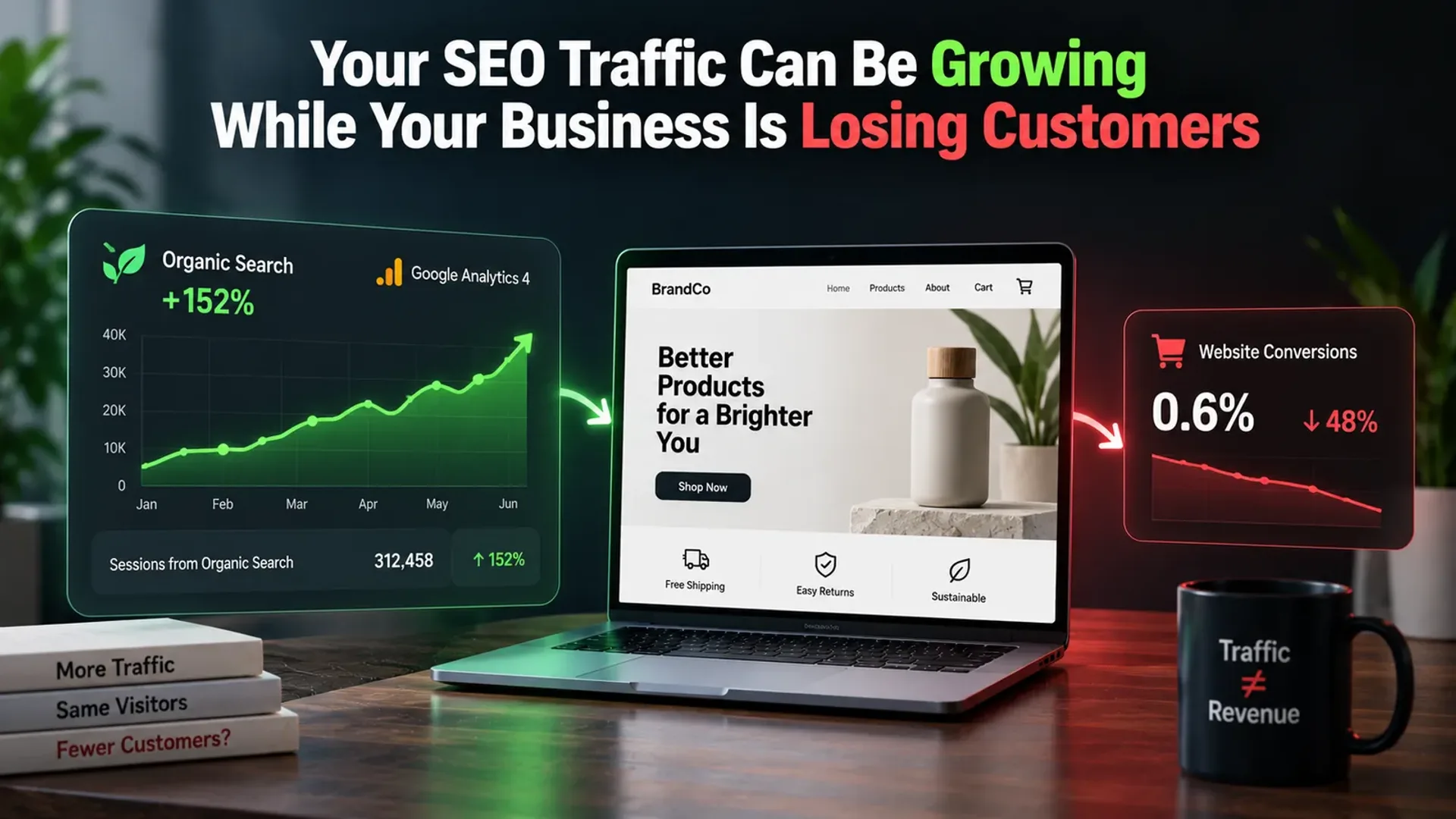
There is a dangerous number in SEO.
It is not zero.
It is not a 50% traffic drop.
It is the number that makes everyone in the monthly marketing meeting feel comfortable:
“Organic traffic is up 18%.”
Great. Everyone relaxes.
The SEO agency gets a green arrow.
The marketing team moves on to the next slide.
The CEO is told that search is working.
Except there may be a problem.
Your website could be getting more organic traffic while becoming less visible for the searches that actually generate customers.
A service page can lose rankings while an informational blog post gains thousands of visits. Your impressions can increase while clicks barely move. Google can keep changing which page it ranks for an important query. Your organic leads can fall while total organic sessions barely change.
By the time the traffic graph finally turns red, the damage may have been happening for months.
That is the warning behind a recent Search Engine Land analysis of the early signals that can appear before organic traffic falls. The article highlights several signals businesses should watch, including ranking URL changes, rising impressions without proportional click growth, commercial-page declines hidden by informational traffic, competitor improvements and falling leads despite relatively stable traffic.
And there is a bigger lesson here:
Your SEO report can look healthy while your SEO strategy is quietly going wrong.
The Biggest SEO Mistake Is Watching the Wrong Number
Let's say you run a U.S. B2B software company.
Your website generated 100,000 organic visits last year.
This year, you're at 125,000.
Sounds like a win.
But now break that traffic down.
Your blog posts generated 30,000 additional visits.
Your glossary generated another 10,000.
A few informational pages started ranking for broader searches.
Meanwhile, traffic to your product pages dropped by 15%.
Traffic to your pricing page dropped by 22%.
Clicks from searches containing terms such as “software,” “platform,” “pricing” and “demo” declined.
Your sales team is getting fewer organic leads.
Suddenly, that 25% traffic increase doesn't look quite as impressive.
This is why sitewide organic traffic is a terrible standalone SEO KPI.
It tells you how much traffic you received.
It doesn't tell you whether the right people found you.
And it definitely doesn't tell you whether that traffic helped the business make money.
Google Search Console itself gives marketers the ability to break performance down by queries, pages, countries, devices and other dimensions. Google also recommends looking at trends in impressions and clicks rather than relying on average position alone.
The data is there.
The problem is what businesses choose to look at.
Warning Sign #1: Your Traffic Is Up, But Your Commercial Pages Are Down
This is probably the most important signal businesses miss.
Not all organic traffic has equal value.
Someone searching:
“What is cloud accounting?”
is different from someone searching:
“Best cloud accounting software for small business.”
And that person is different again from someone searching:
“Cloud accounting software pricing.”
The searches become increasingly commercial.
If your website is gaining traffic from educational searches while losing visibility for product, service, pricing or comparison searches, your overall traffic graph can hide a serious business problem.
Search Engine Land highlights this exact type of situation, where informational content can increase overall organic traffic while commercially important pages lose visibility.
The solution isn't to stop creating informational content.
It is to stop pretending every visit is equally valuable.
For a lead-generation business, your SEO dashboard should tell you:
- Which service pages gained visibility?
- Which service pages lost visibility?
- Which commercial queries gained clicks?
- Which commercial queries lost clicks?
- Which pages generate leads?
- Which pages generate sales-qualified leads?
- Which pages generate traffic but almost no business value?
If your agency only reports total traffic, ask why.
Warning Sign #2: Impressions Are Increasing, But Clicks Aren't
This one can look like success.
Your Google Search Console report says:
Impressions +40%.
The marketing report says:
Organic visibility is growing.
But clicks are up only 4%.
That should trigger another question:
Where did those extra impressions come from?
Maybe your website is suddenly appearing for hundreds of low-intent searches.
Maybe your content is ranking on page two.
Maybe you're showing up for informational queries where people have little reason to click.
Maybe competitors have become more compelling in the search results.
Or maybe the search results themselves have changed.
Google defines impressions as the number of times your site or page appeared in Search, while clicks measure actual visits generated from those results. CTR connects the two.
So an impression is not a customer.
It isn't even a visitor.
It is simply an opportunity to be seen.
If impressions are rising dramatically while clicks barely move, don't celebrate automatically.
Investigate.
Warning Sign #3: Google Keeps Ranking the Wrong Page
This is one of the most overlooked SEO problems.
Imagine you have two pages:
Page A: “R&D Tax Credit Services”
Page B: “Complete Guide to R&D Tax Credits”
You want Page A to rank when someone searches for a service.
Page B is educational.
But Google keeps switching between them.
One week, Page A ranks.
The next week, Page B appears.
Then Page A comes back.
Then the guide replaces it again.
Your average ranking may still look perfectly normal.
But Google is effectively telling you:
“I'm not completely sure which page on your website is the best answer.”
Search Engine Land specifically identifies ranking URL changes as a warning signal worth investigating, particularly when the position itself looks relatively stable.
There may be too much overlap between the pages.
Internal linking may not make their purposes clear enough.
The service page may have fallen behind competing results.
Or the search intent may have changed.
There is also a commercial issue.
Someone arriving on a service page designed to generate an inquiry has a very different journey from someone landing on an old educational guide.
For important searches, watch the URL as closely as the ranking.
Warning Sign #4: Your Competitor's Page Is Becoming More Useful
SEO teams often run competitor reports like this:
Competitor A has 8,000 keywords.
We have 5,500.
Competitor A has 400 referring domains.
We have 280.
Therefore, we need more keywords and more backlinks.
Sometimes that is useful.
But it doesn't answer the most important question:
Why does Google have a reason to rank their page above ours?
Imagine two companies selling warehouse flooring.
Both have service pages.
Both talk about durability.
Both mention different flooring systems.
Both have a quote form.
But one page answers the questions a warehouse manager actually needs to know:
How long does installation take?
Can the warehouse remain operational?
How quickly can forklifts use the floor?
What happens if the existing concrete is damaged?
Which flooring system works for heavy traffic?
It also shows previous installations and explains what was involved.
Now the competitive difference becomes obvious.
The competitor isn't necessarily winning because they used the keyword 14 more times.
They're winning because their page helps the customer make a decision.
That is a much more useful SEO insight.
When a competitor starts gaining ground, don't just export another keyword gap report.
Open the page.
Read it.
Study the structure.
Look at the evidence.
Look at the examples.
Look at the questions it answers.
Then ask:
What does this page help the customer understand, verify or decide that ours doesn't?
Warning Sign #5: Your Best Pages Haven't Been Updated in Years
This is where businesses get stuck.
A page ranks in the top three.
It generates leads.
Nobody wants to touch it.
Fair enough.
But leaving it untouched doesn't mean the competitive environment has stayed the same.
Your page may be exactly as good as it was three years ago.
The problem is that your competitors may have improved.
They added case studies.
They added pricing information.
They answered customer questions.
They added original research.
They improved their visuals.
They published new examples.
They built stronger authority around the topic.
Your page didn't necessarily become bad.
The market simply became better.
Search Engine Land makes the same point: a successful page can become relatively weaker even when nothing on the page itself has changed.
This is why successful SEO isn't just about fixing broken pages.
It is about protecting pages that already make money.
Look at your highest-value pages every quarter and ask:
“If I were the customer today, is this still one of the best pages I could find?”
If the answer is no, don't wait for the ranking to disappear.
Warning Sign #6: Your Rankings Look Stable, But Your Leads Are Falling
This is where SEO reporting can become dangerously misleading.
Suppose your average organic position hasn't changed much.
Traffic is roughly flat.
Impressions are slightly higher.
But organic leads have fallen 25%.
The easy conclusion is:
“We have a conversion problem.”
Maybe.
But investigate the traffic before deciding that.
Perhaps your site lost visibility for a handful of high-intent searches.
A keyword moving from position two to position six might barely move your average ranking across thousands of keywords.
But if that keyword generates expensive B2B leads, the commercial impact could be significant.
Perhaps your traffic mix has changed.
Perhaps you're attracting more students, researchers, job seekers or early-stage visitors while losing people actively looking for your service.
Perhaps Google is sending traffic to a different page.
Perhaps one location or service line has lost visibility.
Google itself notes that average position is a complex metric and recommends focusing on trends in impressions and clicks rather than position alone.
This is why average position is not a business metric.
Neither is traffic by itself.
The real question is:
Are we becoming more visible to people who are likely to buy?
Warning Sign #7: Your SEO Numbers Stop Agreeing With Each Other
This may be the biggest warning sign of all.
Your rankings say one thing.
Your traffic says another.
Your leads say something else.
That disagreement is where the real story usually starts.
For example:
Impressions: +35%
Clicks: +6%
Organic traffic: +4%
Service page traffic: -17%
Organic leads: -21%
A basic SEO report might headline the first three numbers.
A good analysis would investigate the last two.
Or consider:
Average position: Stable
Important commercial keywords: Down
Overall traffic: Stable
Blog traffic: Up
Service page traffic: Down
Again, the overall number isn't necessarily telling the truth about the health of the business.
The numbers aren't wrong.
The interpretation is incomplete.
The SEO Traffic You're Losing May Be Hidden by the Traffic You're Gaining
This is the part businesses need to understand.
SEO is an aggregate.
Your website can gain 10,000 visits and lose 2,000 valuable ones.
The dashboard still says:
+8,000 visits.
But those 2,000 visitors may have been worth more than the 10,000 you gained.
That is why modern SEO reporting needs to separate traffic by intent.
At a minimum, consider dividing organic performance into:
Informational
People looking to learn.
Commercial investigation
People comparing options.
Transactional
People ready to buy, contact, book or request a quote.
Branded
People already looking specifically for your business.
Then look at what each group is doing.
Which one is growing?
Which one is shrinking?
Which one produces leads?
Which one produces revenue?
That gives you a much more realistic picture of SEO health.
And Then There Is AI Search
There is another reason businesses should stop treating organic traffic as the complete picture of search visibility.
People are increasingly using AI tools to research products, services and businesses.
That means a brand can lose traditional organic clicks without necessarily disappearing from the customer's research journey.
Someone might ask an AI system for the best agencies for a particular service.
They might compare companies inside an AI conversation.
They might then visit a brand directly later.
They might search the brand on Google.
They might never click the original organic result that introduced them to the company.
This doesn't make traditional SEO irrelevant.
It makes visibility more complicated.
Your business now needs to understand not only:
“Where do we rank?”
but also:
“Where are customers discovering and evaluating us?”
That includes Google, AI search, social platforms, directories, communities and other sources that influence purchase decisions.
For an agency, this changes what SEO should mean.
SEO isn't simply getting more clicks.
It is building discoverability around the moments that matter.
Stop Asking, “Did Traffic Go Up?”
Ask Better Questions.
The next time someone presents your SEO report, don't start with traffic.
Start with these questions:
Which commercial queries gained visibility?
Which commercial queries lost visibility?
Which pages are gaining traffic?
Which pages are losing traffic?
Did Google change the page it ranks for important searches?
Are impressions growing faster than clicks?
Are our competitors creating more useful pages?
Are our best-performing pages still competitive?
Are organic leads growing at the same rate as traffic?
Has lead quality changed?
Are we visible in AI-driven search experiences as well as traditional search?
Those questions turn SEO reporting into business analysis.
And that is what companies actually need.
What Your SEO Team Should Be Doing Every Month
A strong SEO process shouldn't wait for a traffic crash.
It should have an early-warning system.
1. Track commercial keywords separately
Create a dedicated keyword set for your products, services, pricing, locations and high-intent searches.
Don't bury them inside thousands of informational queries.
2. Monitor landing pages
Track organic traffic and conversions at the page level.
If a service page loses 20% of its organic traffic, you should know even if the website overall is growing.
3. Watch ranking URLs
For your most important queries, track which URL Google is ranking.
A change can reveal intent confusion, cannibalization or a competitive shift.
Google Search Console lets you filter and analyze performance by query and page, making this kind of investigation possible.
4. Compare impressions and clicks
If impressions rise but clicks don't follow, investigate the queries responsible for the increase.
5. Review competitors manually
Don't rely entirely on keyword-gap tools.
Open the competing pages.
Read them.
Ask what they explain better.
6. Talk to sales
SEO data doesn't know everything.
Your sales team does.
Ask which leads are arriving, what prospects are asking and which competitors are being mentioned.
7. Connect SEO to revenue
Track the journey from organic search to lead to opportunity to customer wherever your analytics and CRM setup allows.
Traffic is a useful indicator.
Revenue is the business outcome.
The Best Time to Fix an SEO Problem Is Before It Becomes a Traffic Problem
A traffic collapse gets everyone's attention.
That is exactly why it is a terrible time to start investigating.
By then, you may be dealing with lost rankings, weaker content, stronger competitors, changing search intent, technical issues or months of declining commercial visibility.
The better approach is proactive.
Watch the small changes.
A service page slipping from position two to four.
A competitor appearing for searches they didn't rank for six months ago.
Impressions climbing without clicks.
An informational article absorbing traffic from a service page.
A successful page becoming outdated.
Leads declining even though traffic looks stable.
None of these necessarily means your SEO is failing.
But each one deserves a question.
Because the goal of SEO isn't to produce a beautiful traffic graph.
The goal is to make your business easier to find when people are looking for what you sell.
Your SEO Report Should Tell You Where You're Losing Money
At Alternate, we don't believe SEO should end with a ranking report and a traffic graph.
We look at the entire search journey.
Which searches matter to your business?
Which pages are winning them?
Where are competitors taking visibility?
Where is your content becoming outdated?
Which organic visitors actually become leads?
And where is your brand becoming invisible across Google, AI search and other discovery channels?
Our approach brings SEO, GEO, content, creative, web development, analytics and performance marketing together so search visibility is connected to the rest of your growth strategy.
Because getting 100,000 visitors is meaningless if the people who could actually buy from you can't find you.
Don't wait for your organic traffic to fall. Find out what your SEO is trying to tell you before it does.
Explore Alternate Creative Agency
Tap the button and Google will show you our new articles more often — in Search, Top Stories and AI Overviews.
Have a project in mind?
Let’s turn it into an intelligent product. Book a free 30-minute discovery call.
Start your project →