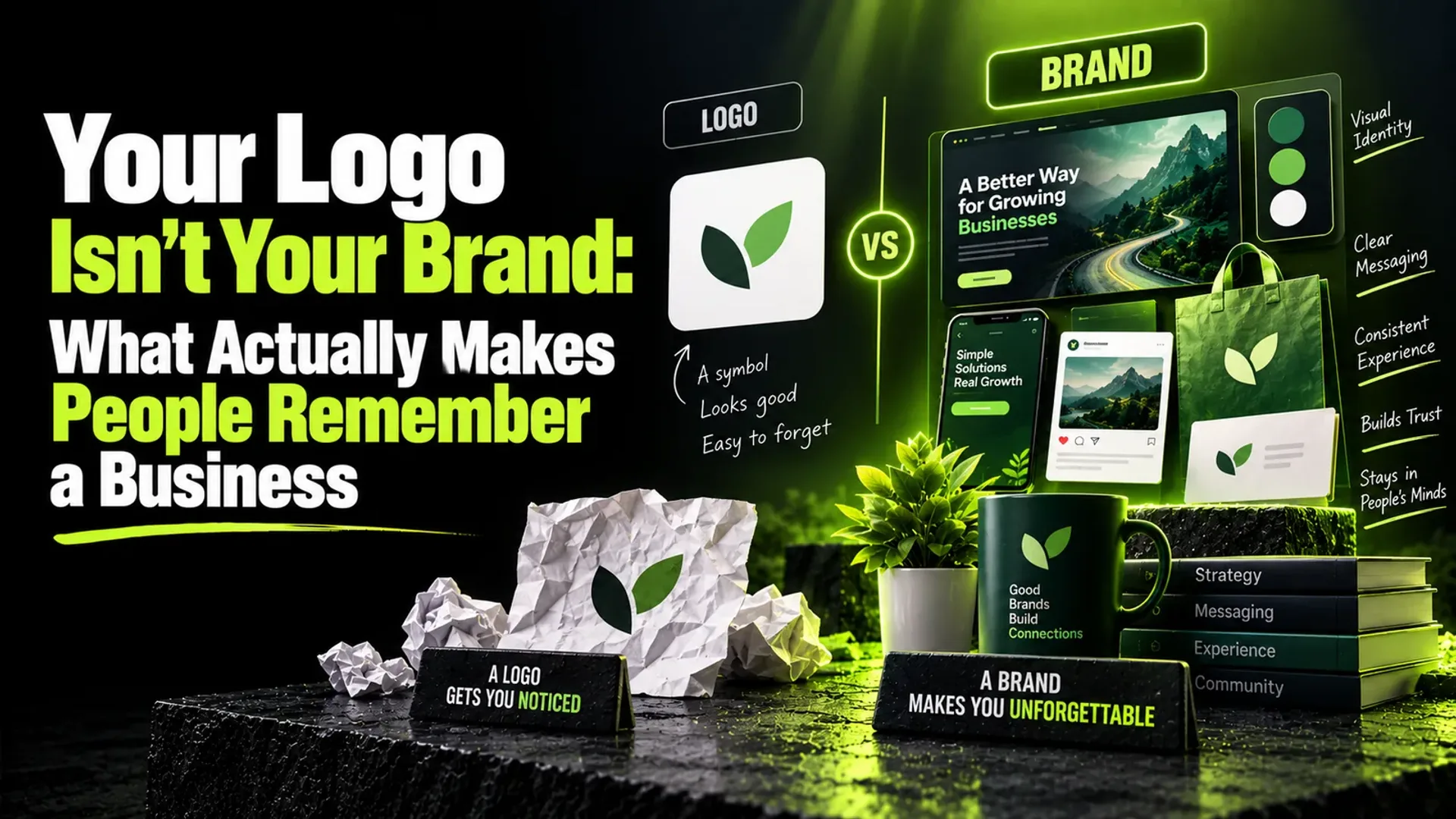
Ask most business owners what their brand is and there is a good chance they will show you their logo.
And that makes sense.
The logo is usually the first thing people create when they start a business. It goes on the website, Instagram page, business card, packaging, invoices, presentations and pretty much everything else.
But here is the problem.
Your logo is not your brand.
It is only one part of it.
You can have a beautiful logo and still have a forgettable brand. You can also have a fairly simple logo and build a business that people recognise instantly.
Think about some of the companies you know well.
You probably recognise them from their colours, the way they communicate, their packaging, their advertisements, their website, the type of images they use and even the way their employees talk to customers.
The logo is just one piece of that experience.
A strong brand is the feeling people get when they come across your business.
And that feeling is built over time.
So, what actually is a brand?
A brand is the overall impression people have of your business.
It is what they think about when they hear your name.
It includes your visual identity, but it goes much further than that.
Your brand includes:
• What your business stands for
• Who you are trying to serve
• How you position yourself
• How you speak to customers
• How your website looks and feels
• How your social media looks
• The kind of content you publish
• Your packaging and marketing materials
• Your customer experience
• The promises you make
• Whether you actually deliver on those promises
This is why branding is not just a design project.
You can change a logo in a few days.
Changing the way people see a business takes much longer.
A good logo cannot fix unclear positioning
This is one of the biggest mistakes businesses make.
They spend weeks choosing a logo, colours and fonts while barely thinking about what the brand actually stands for.
Imagine you run a software company.
Your logo looks modern.
Your website looks expensive.
Your colours are perfect.
Your social media posts look professional.
But when someone visits your website, they still cannot understand what you actually do.
That is not a logo problem.
That is a positioning problem.
A visitor should be able to understand fairly quickly:
What do you offer?
Who is it for?
What problem do you solve?
Why should someone choose you?
If those answers are unclear, changing the logo will not solve the problem.
Your brand needs a point of view
Look at businesses that people remember.
They usually stand for something.
They have a clear personality.
They do not try to sound like everyone else.
This does not mean you need to be controversial or completely different from your competitors.
It simply means you need to know what makes your business different.
For example, saying:
"We provide high-quality digital solutions for businesses."
does not tell anyone much.
Thousands of companies could say exactly the same thing.
Now compare that with:
"We help growing businesses build their brand, website and digital systems without managing five different agencies."
You immediately have a better idea of what the company does and why its approach is different.
That is positioning.
And positioning should come before visual design.
Your colours are saying something too
Colours are not just decoration.
They influence how a business feels.
A financial company may want to communicate trust and stability.
A children's brand may want to feel playful.
A luxury brand may prefer restraint and simplicity.
A technology company may want to look modern and innovative.
There is no single colour that automatically makes a brand premium or trustworthy.
What matters is how the entire visual system works together.
Your colours.
Your typography.
Your photography.
Your illustrations.
Your layouts.
Your icons.
Your website.
Your social media.
All of these things should feel like they belong to the same company.
This is where many businesses struggle.
Their website looks one way.
Their Instagram looks completely different.
Their presentations use another set of colours.
Their sales team sends proposals using an old logo.
Their advertisements look like they were created by a completely different company.
Individually, none of these things may look terrible.
Together, they create a confusing brand.
Consistency makes a brand easier to remember
Think about seeing the same person several times.
The first time, you may not remember them.
The second time, they look familiar.
After seeing them regularly, you recognise them almost instantly.
Branding works in a similar way.
When customers repeatedly see the same visual language and messaging, the brand becomes familiar.
That is why consistency matters.
It does not mean every social media post needs to look identical.
It means there should be a clear connection between everything the company puts out.
Your website should feel like your brand.
Your social media should feel like your brand.
Your advertisements should feel like your brand.
Your emails should feel like your brand.
Your sales presentation should feel like your brand.
The customer should not have to wonder whether they are dealing with the same company.
Your website is part of your brand
This is especially important today.
For many businesses, the website is where people form their first serious opinion about the company.
Someone may see your advertisement first.
Then they visit your website.
And within a few seconds, they are making assumptions.
Is this company professional?
Does it understand what I need?
Does it look trustworthy?
Does this business understand its customers?
Is this worth my time?
A good website therefore needs to do more than look attractive.
It needs to communicate the brand clearly.
The messaging, design, navigation, images, typography and user experience all contribute to that impression.
This is why branding and web design should not be treated as two completely separate projects.
Your website is one of the biggest places where your brand comes to life.
Your brand voice matters more than you think
There is another part of branding that businesses often ignore.
How do you talk?
A brand can look premium and still sound completely generic.
For example:
"We are committed to delivering innovative solutions that empower businesses to achieve their goals."
There is nothing technically wrong with that sentence.
But it could belong to almost any company.
Now imagine a company saying:
"We build the brand, website and digital systems your business needs to grow, without making you coordinate five different teams."
It feels more direct.
More human.
More specific.
Your brand voice should sound like an actual company with an opinion, not a collection of corporate phrases.
Decide whether your brand should sound:
Professional or casual?
Friendly or authoritative?
Playful or serious?
Simple or technical?
Bold or understated?
Once you decide, keep that personality consistent.
Your customers are part of your brand too
Here is something many branding discussions miss.
Your customers experience your brand through interactions.
Imagine a company with a fantastic logo and beautiful website.
Then you contact them.
Nobody replies for three days.
You finally get a response and have to explain your problem to three different people.
The website may look premium.
The experience does not.
And customers remember experiences.
This is why branding cannot stop at the marketing department.
Sales, customer support, product, delivery and even small details such as email communication can influence how people perceive the company.
A brand promise means very little if the actual experience does not support it.
Premium branding is not about making everything expensive
There is also a common misunderstanding about premium branding.
Some businesses believe that premium means:
Black background.
Gold text.
Minimalist logo.
Expensive photographs.
That can work for some brands.
But simply using these visual elements does not make a business premium.
Premium is often about clarity and attention to detail.
The message is clear.
The design has purpose.
The website is easy to use.
The content is thoughtful.
The customer experience feels considered.
The brand knows who it is for.
There is confidence in what the business says and, just as importantly, what it chooses not to say.
That is much harder to fake.
So when should you think about your branding?
You do not necessarily need a complete rebrand every few years.
Sometimes the business has simply outgrown the way it presents itself.
You may want to look at your branding if:
• Your business has changed significantly
• Your target customers have changed
• You are moving into a new market
• Your services have expanded
• Your current website no longer represents the quality of your work
• Your visual identity feels inconsistent
• Your competitors look much more established
• Customers struggle to understand what makes you different
• Your brand attracts the wrong type of customers
• Your company has grown but still looks like a small startup
Sometimes you need a complete rebrand.
Sometimes you only need to clean things up.
And sometimes the biggest problem is not your visual identity at all.
It is your positioning or messaging.
That is why a good branding project should start with questions, not Photoshop.
Before you redesign your logo, ask these questions
Before spending money on a new identity, sit down with your team and answer:
Who are we trying to attract?
Be specific.
"Businesses" is not an audience.
What problem do we solve?
Try to explain it without using complicated industry language.
Why should someone choose us instead of another company?
If the answer is "because we provide quality service", keep going.
Your competitors probably say the same thing.
What should people feel when they interact with us?
Trust?
Excitement?
Confidence?
Comfort?
Curiosity?
What do we want to be known for?
This is perhaps the most important question.
Because if you cannot answer it, your customers probably cannot either.
A brand is built through repetition
There is no single moment when a brand suddenly becomes strong.
It happens through repetition.
The same message.
The same visual language.
The same values.
The same quality of experience.
Again and again.
Someone sees your Instagram post.
Then they visit your website.
A few weeks later, they see your advertisement.
Later, they receive an email from your company.
Eventually, they hear your name from someone else.
All of those interactions add up.
That is how familiarity is built.
And familiarity can become trust.
The logo is the beginning, not the destination
A logo matters.
Good design matters.
Colours matter.
Typography matters.
But they work best when they are part of something bigger.
Your brand should tell people who you are, who you are for and why you deserve their attention.
That is why at Alternate, we look at branding as more than creating a logo.
The identity has to work across the website, social media, marketing, content and the wider customer experience. Alternate brings brand strategy, identity, web, UX/UI and marketing together so the different pieces work as one system.
Because at the end of the day, people may notice your logo.
But they remember how your business made them feel.
And that is where a real brand begins.
Tap the button and Google will show you our new articles more often — in Search, Top Stories and AI Overviews.
Have a project in mind?
Let’s turn it into an intelligent product. Book a free 30-minute discovery call.
Start your project →