Your Google Analytics 4 Says “Direct.” Your Customers May Have Found You on ChatGPT.
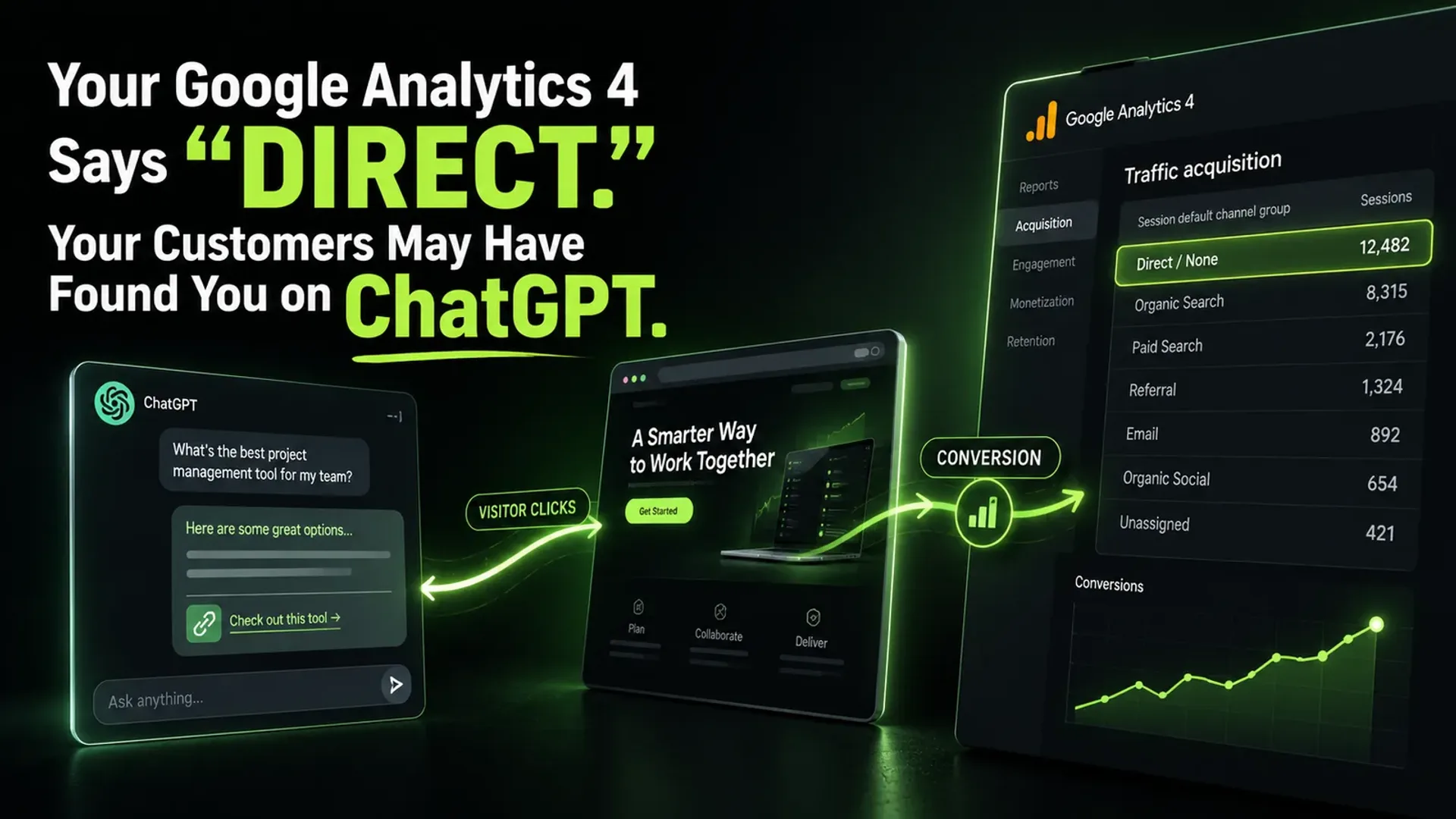
Your Google Analytics dashboard says your direct traffic is growing.
Your organic traffic is up.
Your paid traffic looks healthy.
Everything seems normal.
But there is a problem.
You may not actually know where some of your customers discovered you.
A customer could have asked ChatGPT for recommendations, seen your company, clicked through to your website and later returned directly.
Another customer might have discovered you through Google, checked Reddit, asked an AI tool about your company and then searched your brand name before contacting you.
Another may have seen your content on LinkedIn, searched for you on Google and eventually converted through a branded search.
By the time that person becomes a customer, your analytics dashboard may simply tell you:
Direct.
That's not necessarily wrong.
But it may be incomplete.
And as AI becomes part of how people discover businesses, products and information, this creates a bigger problem for marketers:
Are you measuring where your customers actually come from, or just where analytics managed to give them credit?
A recent Search Engine Land analysis of U.S. website traffic shows why this question is becoming increasingly important. Using Semrush Traffic Analytics data, the analysis found that ChatGPT.com reached approximately 1.09 billion monthly U.S. visits in July 2026, up 48.38% year over year, while Google remained the largest site with around 25.3 billion monthly visits.
Google isn't disappearing.
AI isn't replacing the entire web overnight.
Something more complicated is happening.
People are using more ways to discover information, and the customer journey is becoming harder to see inside a traditional analytics report.
The old customer journey was easier to understand
For years, marketers could explain the journey fairly simply.
Someone searches Google.
They see your website.
They click.
They visit a landing page.
They fill out a form.
The analytics platform records the source.
The marketing team reports:
Organic search generated 1,500 leads.
Simple.
Then social media became a bigger discovery channel.
Then YouTube.
Then Reddit.
Then influencers.
Then review platforms.
Then AI.
The journey started looking more like:
Google → Reddit → YouTube → Website → Direct → Conversion
Or:
LinkedIn → Google → Website → Sales Call
Or:
ChatGPT → Website → Return Visit → Google Brand Search → Conversion
The customer doesn't think in marketing channels.
They simply move around the internet until they trust something enough to buy.
Your analytics system has to try to reconstruct that journey from incomplete signals.
That's where things get messy.
Google is still enormous. That's the first thing businesses need to understand.
There is a tendency to turn every AI search story into:
“Google is dying.”
The data doesn't support that conclusion.
Search Engine Land's September 2026 analysis found that Google remained the #1 U.S. website, with approximately 25.3 billion monthly visits, and its traffic was actually up 10.72% year over year. YouTube was #2 with around 10.3 billion visits, up 36.6%.
So if someone tells your marketing team to stop investing in SEO because “everyone is using AI now,” don't take that advice seriously without looking at your own data.
Google still matters enormously.
But there is another number worth paying attention to.
ChatGPT.com reached 1.09 billion monthly U.S. visits in the same dataset.
That put it at #9 among U.S. websites, ahead of Bing and DuckDuckGo.
That is the more important shift.
The question isn't whether Google or ChatGPT wins.
The question is:
Why should your business depend on only one discovery system?
AI has become part of the discovery journey
People aren't only using AI to write emails or generate images anymore.
They're asking questions.
Which CRM is best for a 50-person sales team?
What are the best accounting firms in New York for startups?
Which agency can help a D2C brand scale paid acquisition?
What should I look for when choosing a cybersecurity company?
Which software is better for a growing B2B business?
These are commercial questions.
And commercial questions are valuable because they happen close to a buying decision.
The person asking isn't necessarily looking for a blog post.
They are looking for an answer.
If your company is relevant to that answer, you want to be visible.
That's where AI visibility, GEO and brand authority start becoming important.
But here's the part marketers are missing
Being mentioned by an AI system is not the same as getting measurable website traffic from that system.
A person might ask ChatGPT about your industry.
Your company might appear in the answer.
The person remembers your name.
They don't click.
Three days later, they search your company on Google.
Then they visit your website.
Then they contact sales.
What gets credit?
Google.
But Google wasn't necessarily where the journey started.
AI influenced the decision before the branded search happened.
Your analytics may never make that obvious.
This is why the future of marketing measurement can't be based entirely on last-click attribution.
The last click is often not the first impression
This isn't a new problem.
Marketers have struggled with attribution for years.
But AI adds another layer.
Imagine a customer journey like this:
Day 1: Sees your LinkedIn post.
Day 3: Searches your company on Google.
Day 5: Reads a Reddit discussion.
Day 7: Asks ChatGPT to compare you with two competitors.
Day 8: Visits your website directly.
Day 10: Books a sales call.
Your CRM might record:
Source: Direct
Your Google Analytics might record:
Direct
Your sales team might say:
“They found us through Google.”
But the real journey was much bigger.
This doesn't mean attribution is useless.
It means we need to become more comfortable with the fact that no single analytics platform can perfectly reconstruct every customer decision.
Search Engine Land's traffic data tells an important story
The recent Search Engine Land analysis compared U.S. website traffic in July 2026 with the same period a year earlier using Semrush Traffic Analytics.
Some of the numbers are striking.
Google: 25.3 billion monthly visits, up 10.72%.
YouTube: 10.3 billion, up 36.6%.
ChatGPT: 1.09 billion, up 48.38%.
LinkedIn: 473.7 million, up 15.48%.
At the same time:
Bing: down 50.43%.
DuckDuckGo: down 15.83%.
Amazon: down 15.31%.
Yahoo: down 13.82%.
The lesson isn't simply that AI is winning and everything else is losing.
It's that attention is moving differently across the digital ecosystem.
And businesses need to understand where their particular customers are moving.
The web isn't becoming less concentrated
This is another interesting part of the data.
You might assume that the rise of AI and social platforms means attention is becoming increasingly fragmented.
But Search Engine Land found that the top 10 U.S. websites still accounted for 68.6% of traffic among the top 150 sites, almost unchanged from 68.8% a year earlier.
In other words, a relatively small number of platforms still control an enormous amount of online attention.
Google.
YouTube.
Reddit.
ChatGPT.
Facebook.
Amazon.
Instagram.
LinkedIn.
TikTok.
These platforms are becoming increasingly important parts of the discovery ecosystem.
For businesses, this creates a new question:
Are we visible where our customers actually spend their attention?
Your website is no longer the entire digital presence of your brand
This is a major mindset shift.
Ten years ago, businesses often thought:
“Our website is our digital presence.”
Today, your digital presence is much bigger.
Your website.
Google results.
Google Business Profile.
YouTube.
Reddit.
LinkedIn.
Instagram.
Reviews.
Industry publications.
Directories.
Forums.
AI-generated answers.
Customer discussions.
Third-party articles.
Case studies.
Podcasts.
News coverage.
Your customers build an impression of your company from all of these places.
AI systems do too.
Your brand needs to exist outside your own website
Imagine someone asks:
“Is this company trustworthy?”
Your website will obviously say yes.
That's not enough.
The customer may look for reviews.
They may search Reddit.
They may check LinkedIn.
They may look at case studies.
They may search your founders.
They may ask an AI system what other people say about you.
That's why brand authority is becoming more important.
You don't just want to publish information about yourself.
You want other credible sources to talk about you.
AI needs information to understand your business
Here's another important point.
If your website says:
“We provide innovative solutions for businesses.”
what exactly does an AI system learn from that?
Not much.
Now compare:
“We help US D2C brands reduce customer acquisition costs through performance marketing, creative testing and conversion-focused ecommerce experiences.”
That's much clearer.
It tells the system:
Who you help.
Where you operate.
What you do.
What problem you address.
What makes your service relevant.
This is one reason positioning and GEO are connected.
The clearer your business is, the easier it is for both humans and machines to understand where you belong.
Your content needs to become more useful
AI can generate generic content at incredible speed.
That's going to make generic content less valuable.
Think about how much content already exists around:
“10 Benefits of Digital Marketing.”
Now imagine thousands of businesses generating similar articles with AI.
More volume doesn't necessarily create more authority.
What becomes more valuable is information based on actual experience.
For example:
“We analysed 300 paid campaigns for US ecommerce brands. Here's what happened when we changed the creative testing strategy.”
That's different.
It contains experience.
It contains data.
It contains an original point of view.
It gives people something they can learn from.
And it gives AI systems more useful information to understand your expertise.
Case studies are becoming more important
A case study isn't just a sales asset anymore.
It can become part of your search visibility strategy.
Instead of:
“We helped a client grow.”
explain:
The situation
What was happening before?
The problem
What wasn't working?
The strategy
What did you change?
The execution
What did you actually do?
The result
What happened?
The learning
What did you discover?
This creates content that demonstrates expertise rather than simply claiming it.
That's useful for customers.
It's useful for sales.
It's useful for SEO.
And it gives AI systems better context about what your business actually does.
Reviews matter more when people are asking AI for recommendations
Imagine someone asks:
“What's the best marketing agency for a B2B SaaS company?”
An AI system needs information to make that recommendation.
Your own website is one source.
But what other people say about you can matter too.
Reviews.
Customer stories.
Industry publications.
Third-party mentions.
Awards.
Interviews.
Community discussions.
The stronger your overall digital footprint, the easier it becomes to understand your brand beyond your own marketing claims.
This is why modern SEO increasingly overlaps with reputation, PR, content and brand building.
Your agency shouldn't only report traffic anymore
This is where the role of an agency needs to change.
A traditional monthly report might say:
Organic traffic: +18%
Paid traffic: +12%
CTR: +9%
Leads: +14%
Looks good.
But what does it actually mean?
Where did the new customers come from?
Which channels influenced them?
Which pages were involved?
What questions are customers asking?
Are competitors becoming more visible?
Are AI systems mentioning your company?
Are customers discovering you through Reddit or YouTube?
Are branded searches increasing?
Are leads becoming more qualified?
The modern agency needs to answer bigger questions.
Not just:
“How much traffic did we generate?”
But:
“How is your market discovering and evaluating you?”
Traffic is becoming less useful without context
Imagine two businesses.
Company A receives 100,000 website visits.
Company B receives 20,000.
At first glance, Company A looks better.
But Company A generates 50 customers.
Company B generates 200.
Which business has the better marketing?
Obviously, B.
Now add AI visibility.
Company C might generate only a small amount of direct referral traffic from AI platforms but be repeatedly recommended in high-intent conversations.
Its influence may be much larger than its referral numbers suggest.
This is why businesses need to stop treating traffic as the final score.
Traffic is an input.
Revenue is the outcome.
GA4 still matters. Just don't expect it to tell you everything.
This is an important distinction.
You should absolutely continue using analytics.
You need to understand:
Traffic.
Conversions.
Landing pages.
Engagement.
Campaign performance.
User behaviour.
Revenue.
But analytics is measurement infrastructure, not a perfect recording of human decision-making.
Search Engine Land's analysis highlighted this issue through a niche publisher's GA4 data, where direct traffic had grown sharply and represented more than 78% of total traffic, making it difficult to understand exactly where all those users originated.
That doesn't mean the analytics data is useless.
It means you should ask:
What might be happening outside the attribution model?
AI referral tracking is improving
There is also some good news.
AI discovery doesn't have to be completely invisible.
OpenAI says publishers that allow OAI-SearchBot to access their content can track referral traffic from ChatGPT using analytics platforms such as Google Analytics. ChatGPT search referral URLs include the UTM parameter utm_source=chatgpt.com, which can help identify that traffic.
So businesses should make sure their analytics setup can identify AI referrals where possible.
But referral tracking only captures part of the story.
It can tell you when someone clicks from ChatGPT.
It cannot necessarily tell you how many people saw your company mentioned in an AI answer, remembered your name and later searched for you elsewhere.
That's the bigger challenge.
Don't chase AI visibility just because it's fashionable
This is where marketers need some discipline.
The answer isn't to suddenly abandon everything and create 500 articles because someone on LinkedIn said GEO is the future.
Don't do that.
Start with your customers.
What questions are they asking?
What problems are they trying to solve?
What comparisons are they making?
What information do they need before buying?
Then build useful resources around those questions.
If AI systems eventually use that information, great.
If Google ranks it, great.
If a customer reads it and becomes a lead, even better.
Build assets that have value regardless of which algorithm is currently popular.
SEO isn't dead. It just isn't the whole game anymore.
Google is still the largest website in the U.S.
Its traffic grew year over year in the latest Semrush data analysed by Search Engine Land.
So SEO remains extremely important.
But search is expanding.
People now have more ways to ask questions.
That means a modern search strategy should include:
Technical SEO
Content
Brand authority
Digital PR
Reviews
Social discovery
Community presence
AI visibility
Original research
Case studies
Strong website content
These aren't separate worlds anymore.
They're different parts of digital visibility.
Your competitors may already be showing up where you're invisible
This is the part that should concern businesses.
Imagine someone asks:
“What are the best agencies for ecommerce growth?”
Your competitor gets mentioned.
You don't.
That customer may never visit Google.
They may never see your paid ad.
They may never encounter your website.
You've lost the opportunity before traditional search even enters the conversation.
That's why businesses need to start asking:
Where are our competitors visible that we're not?
Not only on Google.
Across the entire discovery ecosystem.
The new SEO question isn't “Where do we rank?”
It is:
“Where do we appear when our customers ask for help?”
That's a much bigger question.
Google rankings are still part of the answer.
But so are:
AI recommendations.
Reddit discussions.
YouTube results.
LinkedIn conversations.
Industry publications.
Reviews.
Maps.
Social platforms.
Brand searches.
Your website.
The customer doesn't care about your marketing department's channel structure.
They care about finding a credible answer.
This changes what a good agency should deliver
A modern agency should be able to look at your business and understand:
How are people finding us?
What are they searching for?
What are they asking AI?
Which competitors are being recommended?
What does our brand look like across the web?
What content do we own?
What third-party sources mention us?
Which channels influence qualified leads?
What can we actually attribute?
Where are the measurement gaps?
That's a much more useful strategic conversation than another 40-page monthly report.
Build a digital footprint, not just a website
Your website is still your home base.
But it shouldn't be your only asset.
Build useful content.
Publish original research.
Create case studies.
Earn credible mentions.
Collect genuine customer reviews.
Develop your brand on relevant social platforms.
Participate in industry conversations.
Make your expertise visible.
Answer customer questions.
Keep your business information consistent.
Make your website technically accessible to search systems.
OpenAI, for example, says public websites can appear in ChatGPT Search and recommends allowing OAI-SearchBot to crawl relevant content if you want that content to be discoverable and cited.
The goal isn't to “hack ChatGPT.”
The goal is to make your business genuinely understandable and discoverable across the web.
What should businesses do right now?
Don't panic.
Don't abandon SEO.
Don't move your entire marketing budget into AI.
Instead, take a more balanced approach.
1. Keep investing in SEO.
Google remains enormous and continues to send significant traffic.
2. Audit your AI visibility.
Search for your brand, category and key customer questions across major AI platforms.
3. Look at your competitors.
Find out who gets recommended when you're not.
4. Improve your positioning.
Make it immediately clear who you help and what you are known for.
5. Publish original information.
Use your experience, data and expertise.
6. Build better case studies.
Show what you actually achieved.
7. Strengthen your third-party presence.
Reviews, publications, communities and credible mentions matter.
8. Improve technical accessibility.
Make sure search engines and relevant AI crawlers can access important content.
9. Improve analytics.
Track AI referral traffic and use UTM parameters where possible.
10. Stop measuring marketing only by traffic.
Connect marketing activity to qualified leads, customers and revenue.
That's a much more durable strategy.
The future isn't Google vs ChatGPT
This is probably the biggest misconception.
Businesses keep asking:
“Who is going to win, Google or ChatGPT?”
That's the wrong question.
Your customers aren't waiting for a winner.
They're already using both.
They may use Google for one thing.
ChatGPT for another.
Reddit for opinions.
YouTube for demonstrations.
LinkedIn for professional recommendations.
Instagram for discovery.
A business that is visible across the relevant parts of that journey has an advantage.
A business that depends entirely on one platform has a risk.
The biggest opportunity is becoming the brand people ask for
This is where SEO, GEO and brand strategy eventually meet.
You don't just want to rank for:
“best performance marketing agency.”
You want customers to know your company.
You want them to search your brand.
You want other people to recommend you.
You want industry websites to mention you.
You want AI systems to understand what you do.
You want your case studies to prove it.
You want your website to confirm it.
You want your sales team to reinforce it.
That's how a digital brand becomes strong.
Not because one algorithm decided to rank you.
Because the entire web has enough evidence to support your position.
Your analytics dashboard isn't your customer's memory
This is the point marketers need to remember.
Your analytics platform records clicks.
Your customer experiences a journey.
Those aren't always the same thing.
A customer might discover you in an AI answer.
Remember your name.
See your LinkedIn content.
Search you on Google.
Read a case study.
Visit your website.
Talk to a salesperson.
Then buy six weeks later.
No single channel deserves all the credit.
The customer made the decision because multiple signals came together.
That's why the future of marketing isn't just about getting more traffic.
It's about building enough visibility, trust and relevance that customers can find you wherever they start looking.
The businesses that win will be visible everywhere that matters
Google isn't going away.
AI isn't going away.
Social isn't going away.
Communities aren't going away.
Reviews aren't going away.
Customers will continue moving between them.
The businesses that adapt will stop asking:
“How do we get more website traffic?”
and start asking:
“How do we become more visible, credible and useful throughout the customer's discovery journey?”
That's a much bigger opportunity.
And it changes the role of your marketing agency too.
The agency shouldn't just tell you how many people visited your website.
It should help you understand why they came, what influenced them, what convinced them and what ultimately turned them into customers.
Because the future of digital marketing isn't about owning one traffic source.
It's about becoming impossible to ignore wherever your customers go looking for an answer.
Ready to Understand Where Your Customers Are Really Finding You?
At Alternate, we look beyond individual marketing channels.
We bring together SEO, GEO, content, brand strategy, creative, performance marketing, website development, analytics and AI to help businesses build a stronger digital presence across the entire customer journey.
Because your next customer may find you on Google.
They may discover you through LinkedIn.
They may read a Reddit discussion.
They may watch your video.
Or they may simply ask an AI:
“Who should I choose?”
The question is whether your brand will be visible when they do.
Don't just optimise for traffic. Build a brand worth discovering, trusting and recommending.
If you're ready to understand where your customers are discovering your business and where you're currently invisible, let's talk.
Tap the button and Google will show you our new articles more often — in Search, Top Stories and AI Overviews.
Have a project in mind?
Let’s turn it into an intelligent product. Book a free 30-minute discovery call.
Start your project →