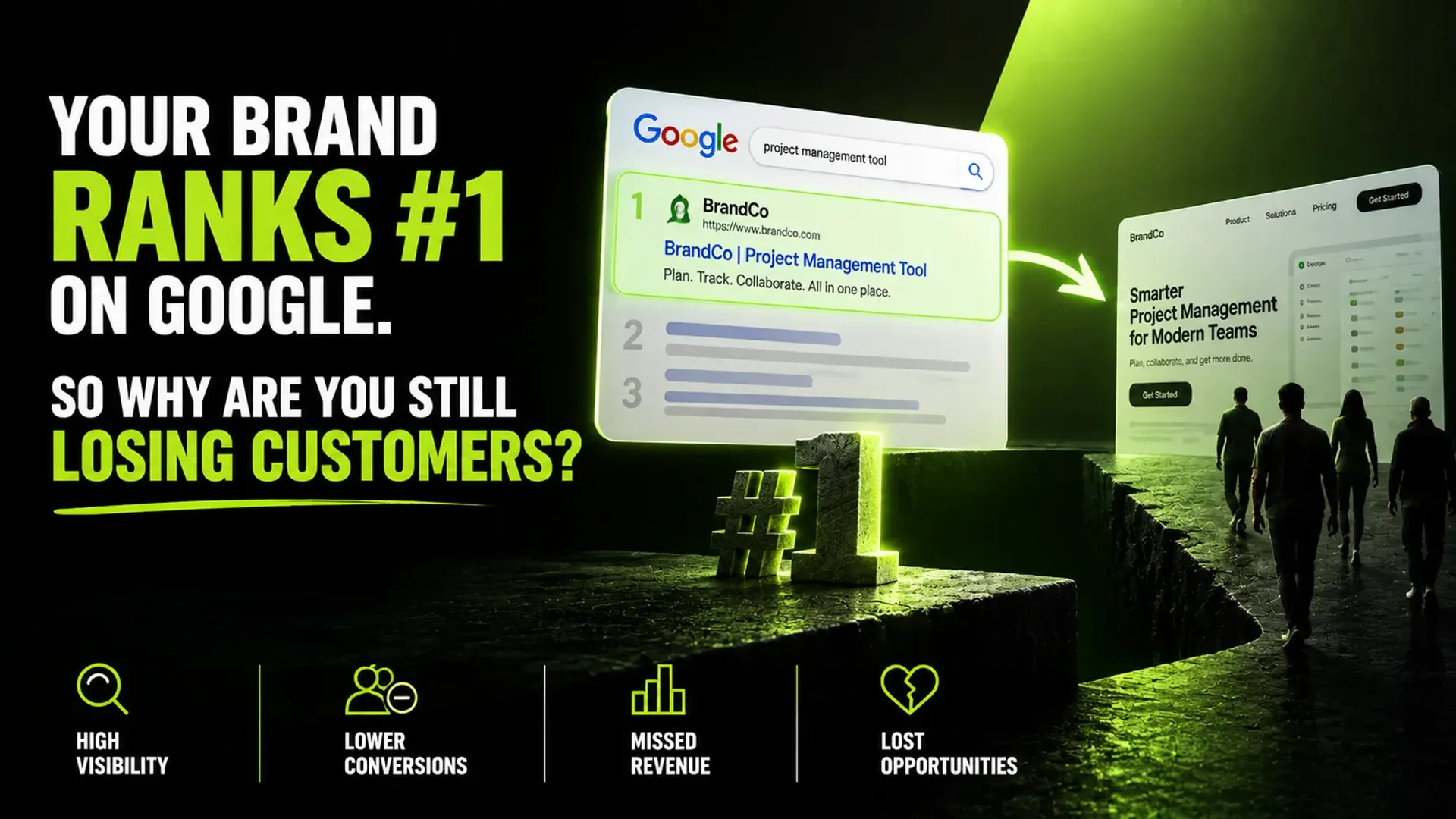
You search your company name on Google.
Your website is sitting at #1.
Everything looks fine.
So you close the browser and move on.
That could be a mistake.
Because ranking #1 for your own brand name does not mean you control your branded search results.
A potential customer searching for your company might see your website first, but they could also see a competitor's ad, a negative Reddit discussion, a review site, a YouTube video, an affiliate page, a news article, a comparison website or an AI-generated answer.
And that changes the customer's perception before they ever reach your website.
This is the problem highlighted in a recent Search Engine Land article about four risks hiding inside branded search results. The article points out that branded search results can change in ways that affect visibility, reputation and conversion, especially as Google and AI-powered search surfaces increasingly mix owned and third-party content.
The uncomfortable truth is simple:
Your brand may rank #1 and still be losing the search battle.
Your Brand Name Is One of the Most Valuable Searches You Own
Think about the difference between these two searches:
“Best CRM software for small business”
and
“Salesforce alternatives”
and
“Salesforce pricing”
and
“Salesforce reviews”
and
“Salesforce”
These searches represent very different stages of the buying journey.
But the branded searches are particularly valuable because the person already knows the company.
They may have seen an advertisement.
Someone may have recommended the company.
They may have visited the website before.
They may have seen the brand on social media.
They may be comparing the company against competitors.
They may already be close to making a purchase.
That makes branded search incredibly valuable.
And it also makes it dangerous to ignore.
When someone searches your company name, the search results become part of your sales process.
The First Risk: You're Depending on Too Few Positive Results
Let's say someone searches for your company.
The first three results are:
- Your homepage
- Your LinkedIn page
- Your product page
Looks good.
But what happens if the fourth result is a major negative review?
Or a Reddit thread criticizing your product?
Or an article questioning your company?
Or a competitor's comparison page?
Your brand reputation is suddenly depending on three or four positive assets.
That is fragile.
Search Engine Land's analysis makes this exact point: brands can become overly dependent on a small number of positive results, particularly when third-party results occupy more of the search landscape.
The answer isn't to fill Google with artificial positive content.
That rarely works for long.
The better strategy is to build a broad ecosystem of legitimate, authoritative brand signals.
Your website.
Industry publications.
Customer reviews.
LinkedIn.
YouTube.
Case studies.
Podcasts.
Press coverage.
Partner websites.
Industry directories.
Expert contributions.
Independent reviews.
Relevant third-party platforms.
The more credible sources that understand and mention your brand, the less dependent you become on one or two URLs.
The Second Risk: Negative Content Can Suddenly Become More Visible
This is where branded search becomes a reputation issue.
Imagine your company has had a negative Reddit post sitting on page two for six months.
Nobody inside the company cares.
Then the post gains engagement.
People start commenting.
Other websites reference it.
Google's results change.
Suddenly that discussion moves onto page one.
The company didn't publish anything new.
Its website didn't change.
But the perception surrounding the brand did.
Search Engine Land points out that negative content can become more prominent in branded search, including content from Reddit, YouTube and blogs. The article also highlights the growing importance of monitoring how these results appear across AI-powered search experiences.
This is why reputation management cannot simply mean:
“Let's check Google once every few months.”
Search results move.
Content gains authority.
New pages appear.
Old pages disappear.
Search features change.
AI systems surface different sources.
Your brand needs ongoing monitoring.
Your Customers Don't See Your Analytics Dashboard
This sounds obvious.
But marketing teams sometimes forget it.
You might have:
90% positive reviews.
A great Net Promoter Score.
A strong retention rate.
Thousands of happy customers.
Excellent case studies.
But your potential customer doesn't see any of that automatically.
They see what appears when they search.
And that creates a gap between what your business is and what your search presence communicates about your business.
That gap can cost you customers.
Imagine you're about to spend $20,000 with a software company.
You search the company name.
You find the homepage.
Then you see three Reddit threads complaining about customer support.
You find a comparison article saying another platform is better.
You see an old YouTube video criticizing the product.
You may still buy.
But now you have doubts.
And doubts are expensive.
Especially when your competitor is one click away.
The Third Risk: Google Has More Than Blue Links
A branded search audit that only checks the traditional organic listings is incomplete.
Google search results contain far more than ten blue links.
Depending on the query, customers may encounter:
Images.
Videos.
People Also Ask.
News results.
Maps.
Reviews.
Featured snippets.
Knowledge panels.
Shopping results.
Autocomplete suggestions.
AI Overviews.
Other search features.
Search Engine Land specifically recommends looking beyond traditional organic listings and monitoring additional search features such as images, People Also Ask, autocomplete, news results, Google Discover, Google Trends and Top Stories.
Why does this matter?
Because customers don't experience Google the way your SEO report does.
Your SEO report might say:
“We rank #1 for our brand.”
The customer sees:
A competitor ad
Your website
A review site
A Reddit thread
A YouTube video
An AI-generated summary
A People Also Ask result
That's a completely different experience.
The Fourth Risk: Your Positive Search Results Aren't Diverse Enough
This is one of the biggest mistakes brands make.
They publish more content on their own website.
More blog posts.
More landing pages.
More company announcements.
More press releases.
Then they expect Google to show a stronger brand presence.
But if almost everything positive about your company comes from your own website, the search ecosystem can still look weak.
People trust independent sources differently.
A customer may give more weight to a review from another customer than a testimonial written on your website.
They may trust a respected publication more than a company blog.
They may believe an industry expert more than a brand's own marketing copy.
This is why third-party authority matters.
Search Engine Land recommends diversifying positive brand mentions through trusted media organizations and other authoritative third-party properties.
The objective isn't to manufacture praise.
It is to make sure your brand exists outside your own domain.
Your Competitors Can Enter Your Branded Search
Here's another scenario businesses often underestimate.
Someone searches:
“[Your Brand] alternatives.”
Your competitor is ready.
They have a comparison page.
They are bidding on the keyword.
They have content explaining why customers should consider them.
You may rank #1 organically.
But your competitor can still appear above you through paid search.
The customer is now comparing you with someone else before they've even reached your website.
This is why branded search isn't only an SEO problem.
It is a PPC problem too.
Your SEO team might say:
“We're ranking #1.”
Your PPC team might say:
“Our brand campaign is performing normally.”
Meanwhile, the customer is seeing an entirely different competitive landscape.
A recent Search Engine Land analysis of branded search explains how paid ads, competitor ads, organic listings, affiliates, review platforms and aggregators can all compete within the same SERP.
The customer doesn't care which department owns each result.
They just see the page.
Branded Search Is Where SEO, PPC and Reputation Collide
This is why branded search is so interesting.
It sits directly between multiple marketing disciplines.
SEO controls your organic visibility.
PPC can defend important brand terms.
Content builds your authority.
PR creates third-party mentions.
Social media creates brand signals.
Customer experience creates reviews.
Reputation management monitors negative content.
GEO helps you understand how your brand appears in AI-generated answers.
All of these influence the same thing:
What happens when someone searches for your company?
Yet most companies manage them separately.
SEO looks at rankings.
PPC looks at CPC.
PR looks at media mentions.
Social looks at engagement.
Reputation teams look at reviews.
Nobody looks at the entire branded search experience.
That's the problem.
AI Search Makes This Even More Important
Branded search used to mean:
“What does Google show when someone searches our name?”
Now there is another question:
“What does AI say when someone asks about our company?”
That distinction is becoming important.
A customer might ask:
“Is [Company] a good agency?”
Or:
“What are the best alternatives to [Company]?”
Or:
“What do customers say about [Company]?”
Or:
“Should I choose [Company] or [Competitor]?”
The answer may not look anything like Google's traditional results page.
AI systems can draw from websites, reviews, discussions, publications and other sources when forming an answer.
That means your reputation can increasingly be shaped by information that your marketing team doesn't control directly.
Search Engine Land specifically connects the growth of AI-powered search with the need to monitor negative brand results beyond traditional Google rankings.
This is where SEO and GEO start overlapping with reputation management.
The New Brand Battle Isn't Just About Ranking
For years, marketers asked:
“Can we rank #1?”
That question is still important.
But it isn't enough anymore.
The better questions are:
What appears above our website?
What appears below it?
Which competitors are visible?
Which review sites appear?
Which Reddit conversations appear?
Which videos appear?
What does Google suggest when someone types our name?
What does People Also Ask show?
What does AI say about us?
Are the results positive, neutral or negative?
How much of the page do we actually control?
That is a much more sophisticated definition of brand visibility.
Your Brand Search Results Are a Reputation Dashboard
Here's a useful way to think about it.
Your branded search results are a public snapshot of how the internet understands your business.
If your search results contain:
Strong reviews.
Useful product pages.
Trusted media mentions.
Independent case studies.
Expert interviews.
Helpful videos.
Customer stories.
Authoritative third-party references.
That's a strong brand ecosystem.
If they contain:
Old complaints.
Competitor comparisons.
Unanswered Reddit threads.
Negative reviews.
Thin company content.
Outdated pages.
Low-quality directories.
Little third-party validation.
That's a warning.
Your branded SERP is telling you something.
You just have to pay attention.
How to Run a Branded Search Risk Audit
You don't need a complicated system to start.
You need consistency.
1. Search Your Brand Like a Customer
Don't just search the exact company name.
Search variations such as:
[Brand]
[Brand] reviews
[Brand] pricing
[Brand] alternatives
[Brand] complaints
[Brand] vs [Competitor]
[Brand] product
[Brand] services
[Brand] founder
[Brand] customer service
These searches reveal different parts of your reputation.
2. Record What Appears
Take a snapshot of the first page.
Record:
Owned results.
Third-party results.
Competitor results.
Reviews.
Reddit.
YouTube.
News.
Search features.
AI results where applicable.
Don't rely on memory.
Search results change.
3. Classify Every Result
Put every important result into one of four categories:
Positive
Neutral
Negative
Competitive
Then separate owned assets from third-party assets.
You will quickly see where your vulnerabilities are.
4. Watch Movement
A negative result on page three isn't the same risk as a negative result moving onto page one.
A new competitor ad isn't the same as a competitor appearing for the first time.
A growing Reddit discussion isn't the same as an old inactive thread.
Track movement.
5. Identify Your Weakest Areas
Maybe your website dominates traditional search but you have almost no third-party authority.
Maybe reviews are strong but YouTube results are negative.
Maybe your brand performs well on Google but poorly in AI search.
Maybe competitors dominate “brand + alternative” searches.
Different problems require different solutions.
6. Build More Independent Authority
Don't just publish another company blog.
Earn mentions.
Get customers to review you.
Publish original research.
Participate in industry discussions.
Appear in relevant publications.
Create useful expert content.
Build relationships with credible third-party sources.
The goal is to create a brand presence that doesn't collapse if one URL disappears.
Don't Try to Bury Negative Content With More SEO Content
This deserves attention.
When companies discover a negative search result, their first instinct is often:
“Let's publish 50 positive articles.”
That's rarely the best answer.
If the negative result is legitimate, address the underlying issue.
If a customer is complaining about support, improve support.
If customers are unhappy with a product, fix the product.
If misinformation is spreading, publish credible evidence that corrects it.
If the problem is an outdated article, provide current information.
SEO can help improve visibility.
It cannot replace reputation.
The strongest defense against negative search results is a business customers have good reasons to trust.
Branded Search Can Also Reveal Problems Inside Your Marketing
This is where the data becomes particularly useful.
Suppose your branded searches are growing rapidly.
That could mean your advertising is working.
Google's current Branded Searches measurement is designed to help advertisers measure searches for their brand after exposure to eligible campaigns such as YouTube and Demand Gen.
But now imagine those searches are increasing while branded CTR is falling.
That tells you something else.
More people know you.
But fewer are clicking through.
Maybe competitors are appearing more often.
Maybe review sites are taking clicks.
Maybe search features are taking up more space.
Maybe your brand messaging is unclear.
Maybe the customer is researching rather than ready to convert.
Branded search should therefore be treated as both a demand signal and a reputation signal.
The Brands That Win Will Own More Than Their Website
Your website is still the center of your digital presence.
But it cannot be the entire presence.
Customers will research you everywhere.
They will read reviews.
Watch videos.
Ask communities.
Compare competitors.
Search your company.
Ask AI tools.
Talk to other customers.
Look at social profiles.
Check third-party publications.
Your brand exists across all of those places.
That means your marketing strategy needs to extend beyond publishing content on your own domain.
You need to build an ecosystem of credible information around your business.
Not fake praise.
Not manufactured reviews.
Not hundreds of low-quality guest posts.
Real authority.
Real customers.
Real expertise.
Real proof.
Your #1 Ranking Doesn't Mean You Own the Conversation
This is the mistake brands need to stop making.
Ranking first for your own name is good.
It is not the finish line.
A strong branded search presence should give customers confidence.
It should answer their questions.
It should provide independent validation.
It should make competitors less distracting.
It should make negative content less dominant.
And increasingly, it should create consistency between what people find on Google and what AI systems understand about your company.
Because when someone searches your brand, they're not just looking for your homepage.
They're deciding whether they should trust you.
Is Your Brand Actually Controlling Its Search Presence?
At Alternate, we look beyond traditional rankings.
We analyze how your brand appears across SEO, paid search, third-party websites, social platforms and AI-driven discovery.
We look at the questions customers ask, the pages they see, the competitors appearing alongside you and the reputation signals influencing their decision.
Then we connect those insights to SEO, GEO, content, creative, web development, paid media and brand strategy.
Because your brand doesn't stop at your homepage.
It exists everywhere your customers look for proof.
And if you're not managing that presence, someone else is helping shape it.
Search your brand today. You might be surprised by what your customers see.
Explore Alternate Creative Agency
Tap the button and Google will show you our new articles more often — in Search, Top Stories and AI Overviews.
Have a project in mind?
Let’s turn it into an intelligent product. Book a free 30-minute discovery call.
Start your project →