Your Ads Aren’t Broken. Your Creative Is. Here’s Why Performance Marketing Is Becoming a Creative Game
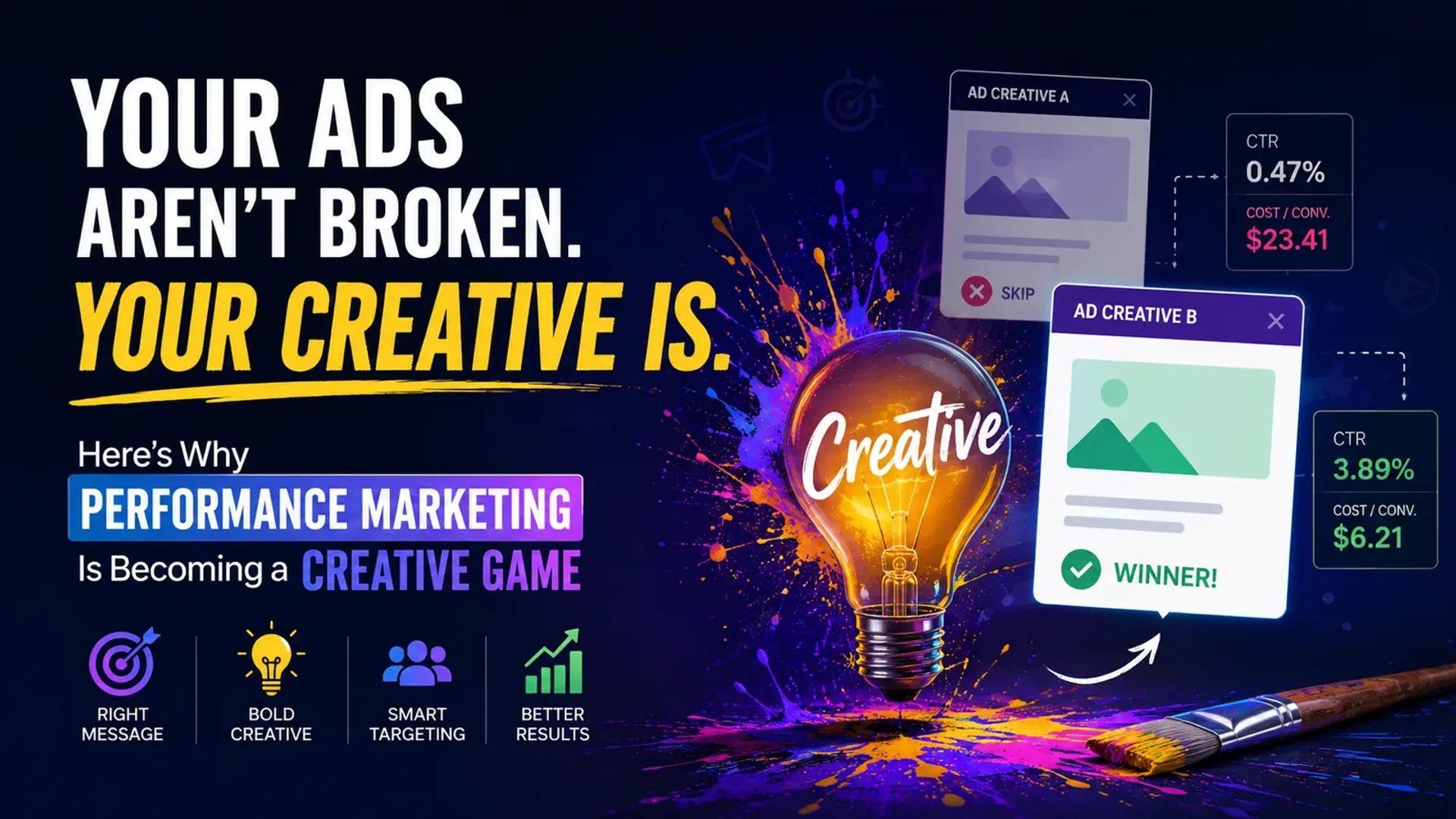
For years, performance marketing was sold as a numbers game.
Find the right audience.
Set the right bid.
Optimize the funnel.
Lower the CPC.
Improve the ROAS.
And, for a while, that worked pretty well.
But something has changed.
You can have a perfectly optimized Meta campaign, a carefully defined audience, a healthy budget and a dashboard full of green numbers and still watch your results fall apart.
The usual reaction is predictable.
“Maybe we need a new audience.”
“Let's change the targeting.”
“Maybe the algorithm isn't working.”
“Let's increase the budget.”
Sometimes those things help.
But increasingly, the problem is sitting somewhere much more obvious:
The ad itself isn't giving people a good enough reason to care.
And this is why performance marketing is quietly becoming a creative game.
Not because data suddenly stopped mattering. Quite the opposite. Data is more important than ever.
The difference is that platforms now have much more sophisticated systems for deciding who sees an ad, when they see it and how much the advertiser pays for that opportunity.
What marketers can control and what increasingly separates one campaign from another is the quality, relevance and diversity of the creative.
The targeting advantage is getting smaller
There was a time when a good performance marketer could build a significant advantage through targeting.
You could identify a specific audience, layer interests, build lookalikes, exclude certain groups and spend hours fine-tuning the campaign structure.
Today, platforms such as Meta and Google are increasingly using AI to handle large parts of that process.
Meta's advertising systems use AI to help determine which ads are most relevant to different people. In 2026, Meta said it had doubled the GPUs used to train its latest ad-ranking model, called GEM, as it works to improve how its systems understand engagement and select ads.
Google's Performance Max is doing something similar from another direction. Its systems evaluate creative assets based on signals such as impressions, clicks, conversions and conversion value over cost, helping advertisers understand which assets are actually contributing to performance.
In other words, the platforms are getting better at finding people.
That changes the marketer's job.
If the machine is getting better at finding the audience, the creative has to get better at convincing that audience.
And that's a very different skill set.
The ad is no longer just an ad
Think about the last time you opened Instagram.
You probably didn't open it thinking:
“I'm now going to evaluate five advertising campaigns.”
You opened it to watch a Reel, check a message, look at something a friend posted or simply kill five minutes.
Then an ad appeared.
You have perhaps one or two seconds to decide whether it's worth paying attention to.
That's the environment marketers are competing in.
And suddenly, things that used to sound like “creative department stuff” become performance variables.
The opening frame.
The first sentence.
The person delivering the message.
The visual style.
The problem being presented.
The emotional angle.
The offer.
The proof.
The reason to believe.
The call to action.
All of it matters.
Meta itself is now explicitly teaching advertisers about creative diversification using different formats, visuals and messages so its systems can match different creative to different people. Meta's 2026 Blueprint training describes creative diversification as a way to help the ad delivery system find interested audiences more effectively.
That's a pretty significant shift.
Creative isn't simply the packaging around the strategy anymore.
Creative is part of the strategy.
More ads doesn't mean more creative
Here's where many brands get it wrong.
They hear that they need more creative, so they produce 20 versions of the same advertisement.
Same video.
Same hook.
Same offer.
Same message.
Maybe a different background.
Maybe the logo moves.
Maybe the headline changes from “Save 20%” to “Get 20% Off.”
Technically, they have 20 ads.
Strategically, they may have one.
Real creative diversification means giving the algorithm genuinely different ideas to work with.
For example, imagine you're marketing a productivity app.
Instead of making ten versions of:
“Save 10 hours every week with our productivity app.”
You could build completely different creative angles.
One ad focuses on saving time.
Another focuses on reducing stress.
Another shows a founder drowning in administrative work.
Another uses a customer story.
Another demonstrates the product in 15 seconds.
Another attacks the old way of doing things.
Another compares the product with hiring another employee.
Another focuses purely on the financial benefit.
Same product.
Completely different reasons to care.
That distinction matters.
Meta's own training on creative diversification recommends varying creative by concepts and formats rather than simply producing more versions of the same idea.
And Meta has reported that visually distinct creatives can outperform similar creatives. One 2026 Meta Blueprint session cites large-scale testing showing up to a 32 percent performance improvement from visually distinct creative.
The lesson isn't “make 50 ads.”
The lesson is:
Give the system more meaningful ways to sell the same thing.
Creative is now carrying more of the performance burden
Google makes an even more interesting observation.
In its current guidance on AI-powered creative performance, Google cites research from NCS suggesting that creative accounts for 49 percent of the total sales impact of advertising.
That's a huge number.
And it explains something many performance marketers have experienced firsthand.
You can spend weeks fixing campaign settings and barely move the needle.
Then someone comes along with a genuinely better creative concept and suddenly the numbers change.
CTR improves.
More people watch the video.
More people click.
The landing page receives better-qualified traffic.
Conversion rate improves.
CPA comes down.
ROAS goes up.
The campaign didn't suddenly discover a magical audience.
People simply responded better to the message.
That's the power of creative.
But creative doesn't mean “make it pretty”
This is another important distinction.
A beautiful advertisement isn't necessarily a good performance advertisement.
In fact, some of the highest-performing ads on social media look almost embarrassingly simple.
A person talking to camera.
A screenshot.
A product demonstration.
A customer testimonial.
A badly lit but authentic-looking phone video.
A founder explaining a problem.
Why?
Because performance creative isn't primarily trying to win a design award.
It's trying to answer a much simpler question:
“Why should I stop scrolling?”
And then:
“Why should I believe you?”
And finally:
“Why should I act now?”
That's why creative strategy matters more than decoration.
The best performance creative often combines three things:
Attention + Relevance + Action.
Attention gets the person to stop.
Relevance makes them think, “This is for me.”
Action gives them a reason to continue.
Remove any one of those, and the ad becomes weaker.
The landing page can still ruin everything
Of course, there's another uncomfortable truth.
Sometimes the ad isn't the problem.
The journey after the click is.
Imagine this:
Your ad says:
“Get a Virtual Assistant for $10/hour.”
The person clicks.
And lands on a generic homepage with ten different services, three menus, five competing messages and no obvious connection to the ad they just saw.
That's not a traffic problem.
That's a message problem.
Google itself emphasizes that landing pages are critical to conversions from Google Ads and recommends regularly evaluating mobile experience and landing page performance. Google also notes that, in retail, a one second delay on mobile can impact conversions by up to 20 percent.
This is why performance marketing cannot exist in a silo anymore.
The ad, landing page, offer, website, brand and conversion experience all need to tell the same story.
If the ad makes one promise and the landing page tells another story, you're paying for the confusion.
The best performance teams are becoming hybrid teams
This is where things get interesting for agencies.
The old model looked something like this:
Client → Media Buyer → Ad Platform
The newer model looks much more like:
Strategy → Creative → Media → Landing Page → Data → Creative → Media → Conversion
It's a loop.
The media team tells the creative team what is happening.
The creative team develops new hypotheses.
The campaigns test those hypotheses.
The data shows which messages resonate.
Those insights go back into the next round of creative.
And the process repeats.
The result is not just “better ads.”
It's a marketing system that learns.
Google's Performance Max reporting already reflects this direction. Advertisers can evaluate individual creative assets using metrics such as conversions, impressions, clicks and conversion value over cost, then use those insights to decide what creative to build next.
That means the creative team shouldn't be sitting somewhere at the beginning of the campaign waiting for a brief.
They should be part of the performance feedback loop.
So, what does a modern performance creative process look like?
It starts with research.
Before opening After Effects, Photoshop or an AI image generator, understand the customer.
What are they struggling with?
What have they already tried?
What objections do they have?
What words do they use to describe the problem?
What does your competitor promise?
What makes your product different?
Then build creative hypotheses.
Not just concepts.
Hypotheses.
For example:
“Customers don't care about saving money as much as they care about avoiding the hassle.”
That's a hypothesis.
Create an ad around it.
Test it.
Maybe it wins.
Maybe it completely fails.
Either result is useful.
Then you build the next hypothesis.
This is where performance marketing becomes much closer to scientific experimentation.
You're not asking:
“Do you like this ad?”
You're asking:
“Does this message produce a better business outcome?”
That is a much more useful question.
Stop asking which ad looks best
This is probably one of the biggest mindset changes brands need to make.
The creative team may love Ad A.
The founder may love Ad B.
The agency may think Ad C is the strongest.
The audience might completely disagree.
And that's okay.
Performance marketing gives you something traditional advertising often couldn't:
feedback at scale.
Google's systems allow advertisers to evaluate creative assets against actual performance signals, while Meta is increasingly encouraging advertisers to diversify creative so its systems have more meaningful inputs to work with.
So instead of debating whether an ad is “good,” ask:
Does it get attention?
Does it communicate the value proposition?
Does it attract the right people?
Does it generate qualified traffic?
Does that traffic convert?
Does it produce profitable customers?
That's the scorecard.
Not whether the marketing team likes the font.
And this is where AI gets interesting
AI is going to make producing creative dramatically easier.
That's already happening.
You can generate images, write scripts, create variations, resize assets, generate voiceovers, produce video concepts and adapt content for multiple placements much faster than before.
Meta is actively developing AI-powered creative tools for advertisers, including capabilities around image expansion, text generation and background generation.
But here's the catch.
When everyone can produce 100 ads, 100 ads no longer give you an advantage.
The advantage moves upstream.
Who has the better idea?
Who understands the customer better?
Who can identify a new angle?
Who knows which message deserves another 50,000 dollars of media spend?
Who can look at the data and understand why something worked?
AI can help you produce more.
It doesn't automatically tell you what is worth producing.
That's still strategy.
The future belongs to creative-performance teams
The old argument between “creative people” and “performance people” is becoming increasingly irrelevant.
You need both.
A brilliant creative with no understanding of performance can make beautiful ads that don't sell.
A brilliant media buyer with weak creative can optimize a mediocre message incredibly efficiently.
Neither is enough.
The real advantage comes from bringing the two together.
Creative gives performance marketing something worth distributing.
Performance data tells creative what deserves to be made next.
And when those two teams actually work together, advertising stops being a guessing game.
It becomes a learning system.
That's the direction performance marketing is heading.
Not fewer numbers.
Not less data.
Not the death of targeting.
Something much more interesting:
A world where the quality of the idea can determine how effectively the algorithm finds the person who needs to hear it.
Your campaign might not need a new audience.
It might not need a bigger budget.
It might not need another dashboard.
It might just need a better idea.
And sometimes, the best place to find that idea isn't inside Ads Manager.
It's inside the creative room.
Tap the button and Google will show you our new articles more often — in Search, Top Stories and AI Overviews.
Have a project in mind?
Let’s turn it into an intelligent product. Book a free 30-minute discovery call.
Start your project →