There comes a point in almost every growing business when the owner looks at the brand and thinks:
“This doesn't really represent us anymore.”
The business has changed.
The customers have changed.
The services have changed.
The team has grown.
The prices have gone up.
The quality of the work has improved.
But the branding is still the same as it was five or ten years ago.
The old logo is still there.
The same website is still running.
The tagline still talks about something the business stopped focusing on years ago.
And the company is still describing itself in exactly the same way it did when it was much smaller.
This is where rebranding becomes more than a design exercise.
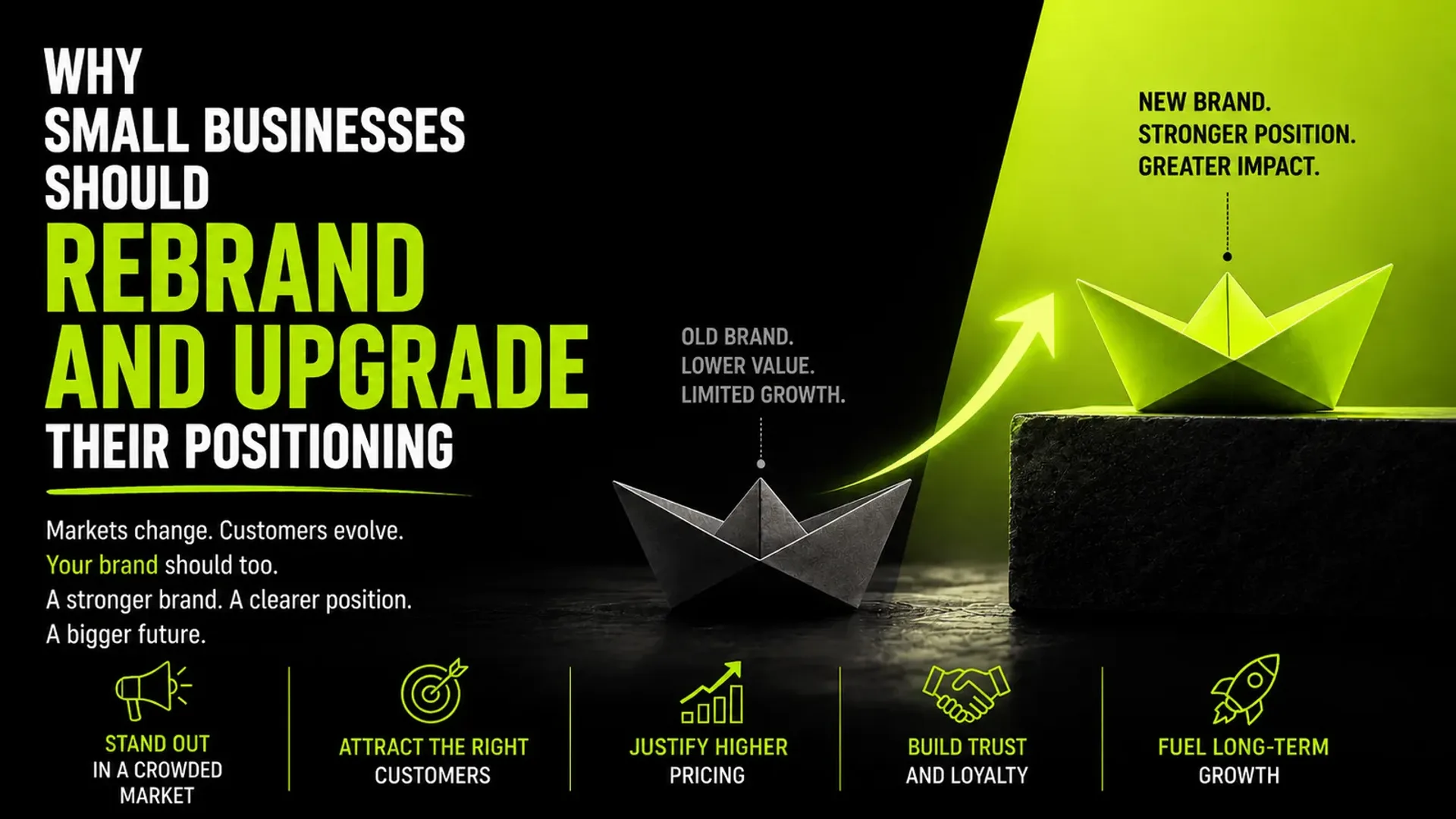
For a small business, a well-planned rebrand can be an opportunity to change how the market sees the company, attract better customers and position the business for its next stage of growth.
But there is an important distinction.
Rebranding is not simply changing your logo.
And positioning is not simply writing a new tagline.
The real question is:
Does the way your business presents itself match the business you are trying to become?
Your business may have outgrown its brand
Think about how most small businesses start.
The owner has an idea.
They create a name.
Someone designs a logo.
They make a basic website.
They create social media pages.
They start selling.
At that stage, speed matters more than perfection.
And that's completely fine.
You don't need a perfect brand on day one.
But five years later, the same business may look very different.
It may have:
• More employees
• Bigger clients
• Better products
• More experience
• Higher prices
• New services
• A stronger reputation
• A larger market
Yet the brand still looks like a business that started in someone's spare bedroom.
That's when the gap starts to become a problem.
The business has grown, but the perception hasn't.
People judge businesses before they speak to them
Fair or not, people make assumptions about a business based on how it presents itself.
Your website.
Your logo.
Your social media.
Your photography.
Your packaging.
Your advertisements.
Your proposal.
Your emails.
Even the way your sales team introduces the company.
All of these things contribute to perception.
Imagine two companies offering the same service.
Company A has an outdated website, inconsistent social media and a logo that looks like it was created in 2012.
Company B has a clear message, modern visual identity, strong case studies and a website that immediately explains what it does.
Which company feels more trustworthy?
The actual quality of their work could be identical.
But customers don't get to experience your quality before they buy.
They use signals.
Branding is one of those signals.
Rebranding is not about making the logo prettier
This is probably the biggest misunderstanding about rebranding.
A company changes its logo and announces:
“We have rebranded.”
But nothing else changes.
The same audience.
The same offer.
The same positioning.
The same messaging.
The same website structure.
The same customer experience.
That's not really a strategic rebrand.
That's a visual refresh.
A proper rebrand starts with a more difficult question:
What should this business be known for?
Once you answer that, the visual identity has a reason to exist.
Positioning comes before design
Before changing colours, fonts or logos, you need to understand your position in the market.
Ask:
Who are we trying to attract?
What problem do we solve?
Who are our best customers?
Why do they choose us?
What do competitors say?
What makes us different?
What do we want to be known for?
What are we better at than our competitors?
These questions can be uncomfortable.
They force a business to stop saying:
“We do everything.” and start saying: “We are particularly good at this.” That clarity is valuable.
Small businesses often try to appeal to everyone
This is understandable.
When you're growing, you don't want to reject customers.
So your website says:
“We provide complete solutions for businesses of all sizes.”
Your social media says:
“We help everyone achieve their goals.”
Your sales presentation lists 15 services.
Your homepage has five different audiences.
Your ads talk about everything.
The result?
Nobody knows exactly what you're known for.
Trying to appeal to everyone can make your brand less relevant to anyone.
A stronger position might be:
“We build ecommerce websites for growing D2C brands.”
Now the right customer immediately knows:
“This company is for businesses like mine.”
That's positioning.
Better positioning can help you attract better customers
Not every customer is equally valuable.
Some customers negotiate over every invoice.
Some understand the value of your work.
Some require constant hand-holding.
Some become long-term partners.
Some refer other customers.
Some buy one service.
Others eventually buy five.
Rebranding won't magically make difficult customers disappear.
But stronger positioning can influence who is attracted to your business in the first place.
If you position yourself as:
“Affordable website development for everyone,”
you are likely to attract customers looking for affordable websites.
If you position yourself as:
“Conversion-focused ecommerce development for brands doing ₹5 crore+ in annual revenue,”
you're sending a very different signal.
The second position is narrower.
That's the point.
Narrow positioning doesn't always mean a smaller market
This sounds counterintuitive.
Business owners often worry:
“If we target a specific audience, we'll lose customers.” Sometimes you will. But you may also become much more relevant to the customers you actually want. Imagine a restaurant saying: “We serve everyone.” Now imagine: “We make authentic sourdough pizzas for people who care about slow fermentation and quality ingredients.” The second business isn't necessarily trying to appeal to everyone. It is trying to become the obvious choice for a particular group. Small businesses can benefit from this enormously because they usually can't outspend larger competitors. They need to out-position them.
Your competitors may be changing while your brand stays still
Markets don't stay still.
New companies appear.
Old companies change.
Customer expectations evolve.
Technology changes.
Prices change.
New business models emerge.
Your competitors may have modernized their positioning while you're still describing your business the same way you did five years ago.
That creates a perception gap.
The customer sees:
Competitor: modern, focused, specialist.
You: generalist, outdated, unclear.
Even if your actual service is better.
That is a dangerous place to be.
Rebranding can help you move upmarket
This is one of the biggest reasons established small businesses consider a rebrand.
They want better customers.
Bigger projects.
Higher-value contracts.
More credibility.
But there is a problem.
Their brand still looks like a company competing on price.
You can't simply increase your prices and expect the market to immediately accept them.
Your entire presentation needs to support the new position.
That includes:
Brand identity
Website
Messaging
Portfolio
Case studies
Sales presentation
Photography
Content
Advertising
Customer experience
If you want to be perceived as premium, the entire customer journey needs to feel premium.
A new logo alone won't do it.
Your website is often the first place the positioning problem becomes obvious
Take a look at your homepage.
Can someone understand these three things within a few seconds?
What do you do?
Who do you do it for?
Why should they choose you?
If the answer is no, your positioning may not be clear enough.
A lot of small business websites start with:
“Welcome to XYZ Enterprises.”
Then:
“We are a leading provider of innovative solutions.”
Then:
“Our mission is to empower businesses.”
None of these statements tell the visitor much.
A stronger approach might be:
“We help Indian D2C brands turn slow ecommerce stores into high-converting shopping experiences.”
Now the visitor understands:
What you do.
Who you help.
What outcome you focus on.
That's much stronger.
A rebrand can force you to fix what has been unclear for years
This is one of the hidden benefits of a rebrand.
It forces conversations that businesses often avoid.
Who exactly are we?
What do we actually sell?
Which services make us money?
Which customers do we want more of?
Which customers are not a good fit?
What makes us different?
Why should someone choose us instead of a competitor?
What do we want to be known for three years from now?
These questions are uncomfortable.
But they're useful.
And sometimes the biggest value of a rebrand isn't the new identity.
It's the clarity the business gains while building it.
Don't rebrand just because you're bored
This is important.
Not every business needs a rebrand.
Sometimes the logo is perfectly fine.
Sometimes the website needs a few improvements.
Sometimes the problem is the product.
Sometimes sales are weak because the offer is weak.
Sometimes customers don't understand the business because the messaging is poor.
Changing the logo won't solve those problems.
A rebrand should have a business reason.
For example:
You're entering a new market.
Your target customer has changed.
You've moved upmarket.
You've added new services.
Your old positioning no longer reflects the business.
You merged with another company.
The brand has become outdated.
You are competing in a much more crowded category.
Your current identity is limiting growth.
These are much stronger reasons than:
“We just feel like changing it.”
There is a difference between a refresh and a rebrand
These terms are often used interchangeably.
They shouldn't be.
Brand refresh
A refresh usually keeps the core identity but improves it.
Maybe:
• Updated colours
• Improved typography
• Better photography
• Refined logo
• New templates
• Updated website
• More consistent social media
The business and positioning remain mostly the same.
Rebrand
A rebrand can involve deeper changes.
• New positioning
• New target audience
• New messaging
• New value proposition
• New visual identity
• New tone of voice
• New website
• New customer experience
A rebrand changes more than how the business looks.
It changes how the business presents itself to the market.
Your brand should reflect where you're going
One common mistake is designing a brand around where the business is today.
A better approach is to consider where you want it to be.
Imagine your company currently works with small local businesses.
But your five-year goal is to work with national and international brands.
Should your identity look like a local freelancer?
Probably not.
Your brand needs to be credible for the market you want to enter.
This doesn't mean pretending to be something you're not.
It means building an identity that supports your ambition.
But don't become something you're not
This is where rebranding can go wrong.
A small business suddenly decides it wants to look like a global corporation.
The website becomes overly formal.
The language becomes complicated.
The brand loses its personality.
The company starts sounding like every other corporate business.
That's not necessarily an upgrade.
Your brand should become more mature without becoming less authentic.
If you're a founder-led business, your personality can be an advantage.
If you're known for personal service, don't hide it behind corporate language.
If you're a creative company, don't make the brand look like a bank just because “professional” sounds safer.
Professional and personality can exist together.
Your existing customers matter too
Rebranding isn't just about attracting new customers.
You also need to think about the people who already trust you.
A dramatic change without explanation can confuse them.
That's why communication matters.
Tell them:
Why the business has changed.
What remains the same.
What the new identity represents.
What customers can expect.
A good rebrand should feel like an evolution, not a betrayal.
Your employees need to understand it too
Your team is part of the brand.
If your new website says:
“We are premium strategic partners.”
but your employees still describe the business as:
“We basically do whatever the client asks,”
there's a disconnect.
Your team needs to understand the new positioning.
What do we stand for?
Who are we trying to serve?
What kind of work do we want?
How should we communicate?
What should we say no to?
A strong position should influence internal decisions as well as external marketing.
Rebranding should change more than your Instagram profile
A common mistake is launching the new logo on social media and calling it done.
If you're serious about a rebrand, look across the entire customer journey.
Website
Social media
Google Business profile
Advertising
Sales decks
Proposals
Email signatures
Packaging
Invoices
Business cards
Office signage
Presentations
Case studies
Customer communication
Consistency matters.
If the new brand appears in one place and the old brand is still everywhere else, customers get mixed signals.
Your messaging matters as much as your visuals
You can have a beautiful new identity and still have weak positioning.
The new website might look fantastic.
But if the headline still says:
“Quality solutions for all your business needs,”
you haven't really solved the problem.
A strong rebrand should answer:
Who are you?
Who do you help?
What do you help them achieve?
Why should they believe you?
Why should they choose you?
These answers should appear consistently across your marketing.
Use proof to support your new position
If you want to move upmarket, show evidence that you deserve to be there.
Case studies.
Results.
Client testimonials.
Industry experience.
Awards.
Certifications where relevant.
Before-and-after examples.
Customer numbers.
Specific outcomes.
Don't simply say:
“We deliver exceptional results.”
Show them.
Instead of:
“We build high-performing websites.”
say:
“Our redesign helped Company X increase qualified enquiries by 42%.”
Specific proof is much more convincing than generic claims.
A stronger brand can improve your marketing efficiency
Brand and performance marketing are often treated as separate activities.
They shouldn't be.
A clear brand can make advertising easier.
When people recognize your company, understand what you stand for and trust the category you operate in, your marketing doesn't have to explain everything from scratch every time.
The same positioning can appear in:
Your Meta ads.
Your Google campaigns.
Your website.
Your social content.
Your sales deck.
Your email campaigns.
That consistency creates familiarity.
And familiarity can make future marketing more efficient.
Rebranding is not a one-day launch
There is often a lot of excitement around launch day.
New logo.
New website.
New social media post.
Press release.
Done.
But the real work begins after launch.
Your team needs to use the new messaging.
Your ads need to reflect the new positioning.
Your sales team needs to communicate the same value proposition.
Your website needs to keep evolving.
Your content needs to reinforce what you want to be known for.
A brand becomes strong through repetition.
Not one announcement.
How do you know if your rebrand is working?
Don't measure it only by likes on the launch post.
Look at business signals.
Are you attracting the right customers?
Are more qualified leads coming in?
Are people understanding your offer faster?
Are sales conversations becoming easier?
Can you charge more confidently?
Are customers referring you for the thing you want to be known for?
Are competitors describing you differently?
Are people recognizing the brand more easily?
Some of these things take time.
But they are much more useful than counting how many people liked the new logo.
A practical rebranding checklist for small businesses
Before starting, answer these questions:
1. Why are we rebranding?
Write down the actual business reason.
2. What has changed?
Your customers, products, services, market or ambitions?
3. Who do we want more of?
Be specific.
4. Who are our competitors?
Look at their positioning, messaging and visual identity.
5. What do we want to be known for?
Try to reduce this to one clear idea.
6. What makes us different?
Not features. Something customers actually value.
7. What proof do we have?
Collect the evidence.
8. What should stay?
Don't throw away useful brand equity just because you're changing things.
9. What needs to change?
Positioning, messaging, identity, website or all of them?
10. How will we measure success?
Decide before the launch.
The best rebrands make the business clearer
A successful rebrand doesn't simply make a company look newer.
It makes the company easier to understand.
The customer knows who it's for.
The team knows what it stands for.
The sales team knows what to say.
The marketing team knows what to promote.
The website knows what to communicate.
And the business knows what opportunities to pursue.
That is much more valuable than a new colour palette.
Small businesses don't need to look bigger. They need to look more relevant.
This is probably the biggest takeaway.
A rebrand isn't about pretending to be a much larger company.
It isn't about adding unnecessary corporate language.
It isn't about making everything look expensive.
It is about making sure your brand reflects the value you actually provide and the market you want to compete in.
If your business has improved but your brand hasn't, there is a gap.
If your services have changed but your positioning hasn't, there is a gap.
If your customers have changed but your messaging hasn't, there is a gap.
And if your ambition has changed but your brand still communicates the old version of your business, there is definitely a gap.
A thoughtful rebrand can close it.
Because sometimes the business doesn't need to become something completely new.
It simply needs to start looking, sounding and positioning itself like the business it has already become.
Tap the button and Google will show you our new articles more often — in Search, Top Stories and AI Overviews.
Have a project in mind?
Let’s turn it into an intelligent product. Book a free 30-minute discovery call.
Start your project →