Why Every Business Should Choose an Agency That Provides Everything Under One Umbrella
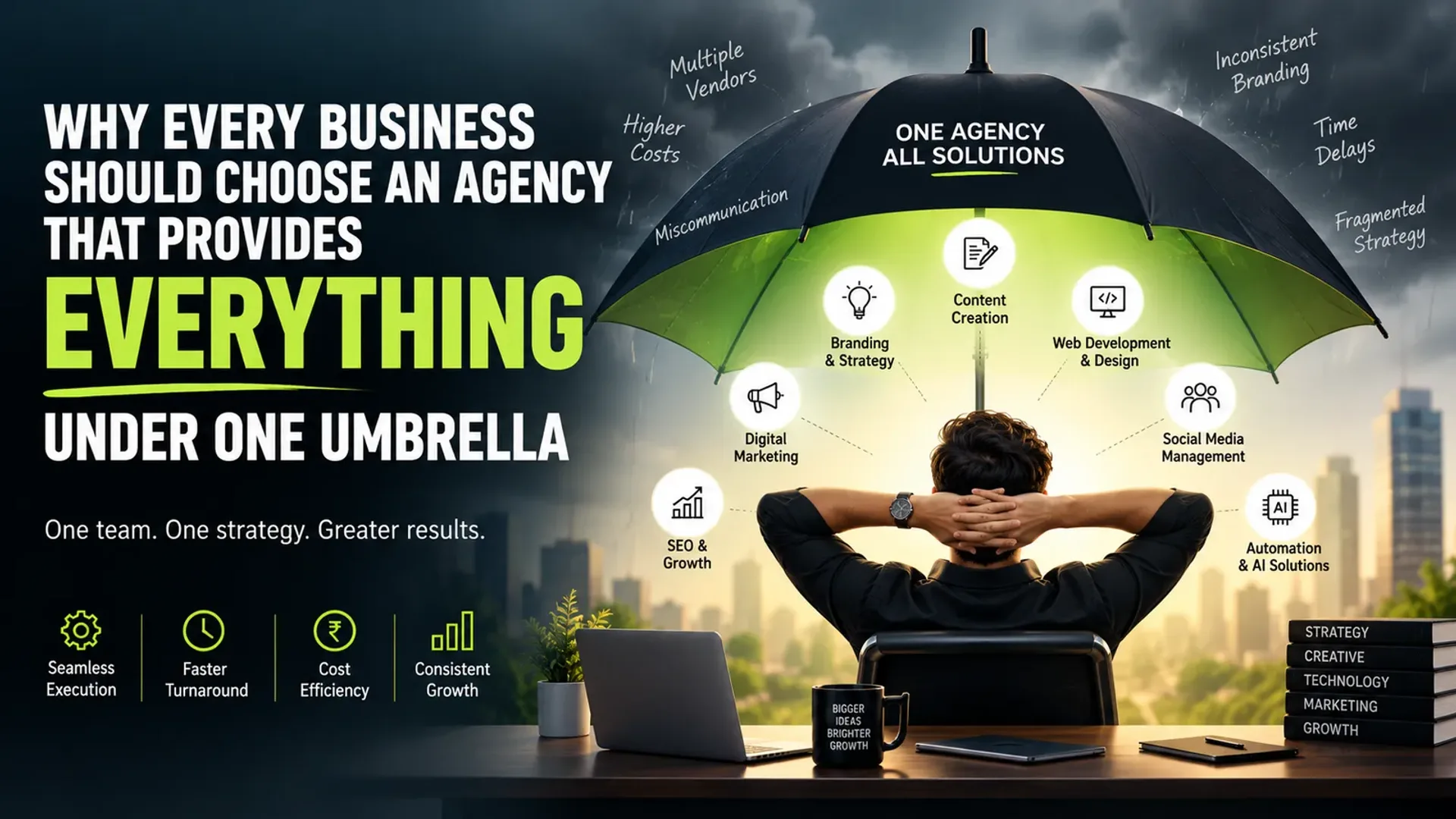
There is a common way businesses build their marketing team.
They hire one agency for branding.
Another for website development.
A separate agency for SEO.
Someone else for paid advertising.
A social media agency handles content.
A freelancer manages video.
Then another vendor gets involved when something needs to be automated.
At first, this sounds like specialization.
Everyone is an expert at one thing.
But eventually, someone has to make all these people work together.
And that's usually where the problems start.
The brand team wants one thing.
The performance agency wants another.
The web agency changes the landing page without telling the paid media team.
The SEO team publishes content that doesn't match the brand.
The social team creates content that has nothing to do with the campaign.
And the business owner ends up sitting in the middle of five different companies trying to make sure everyone is moving in the same direction.
This is why the one-agency, full-service model is becoming increasingly attractive for businesses in the US.
Not because one agency should blindly do everything.
But because modern marketing works better when the important pieces are connected.
Your brand, website, content, advertising, technology and customer experience are not separate parts of the business.
Your customer experiences them as one brand.
Your agency should understand that too.
The customer doesn't see your agencies. They see your business.
This is the simplest reason to think about an all-in-one agency.
Your customer doesn't care which agency manages your Google Ads.
They don't know which freelancer designed your Instagram post.
They don't care who developed your website.
They aren't thinking about which company wrote your email campaign.
They see one thing:
Your brand.
If your website looks premium but your social media looks outdated, that's your brand.
If your advertising promises one thing but your landing page says something completely different, that's your brand.
If your logo says premium but your website feels cheap, that's your brand.
The customer experiences the gaps between your vendors, even though they don't know those vendors exist.
Marketing has become too connected to work in silos
A modern growth campaign might involve:
Brand strategy
Creative
Website
Landing pages
SEO
Paid search
Paid social
Content
Email
Analytics
CRM
AI and automation
Each of these areas has its own expertise.
But they also affect each other.
Change your positioning and your ads may need to change.
Change your offer and your landing page needs to change.
Change your landing page and your conversion rate may change.
Change your conversion rate and your paid media economics change.
Change your customer acquisition strategy and your CRM workflow may need to change.
The pieces are connected whether you manage them together or not.
So why create unnecessary walls between them?
One strategy is easier than five different strategies
Imagine a US ecommerce company launching a new product.
The branding agency positions it as a premium product.
The social agency focuses on affordability.
The performance agency runs ads around a discount.
The SEO agency targets bargain-related searches.
The website agency builds a premium-looking site with no mention of the discount.
Technically, every agency has done its job.
But collectively, the strategy is a mess.
Now imagine one agency owns the broader strategy.
The positioning is clear.
The creative reflects it.
The website supports it.
The paid ads communicate it.
SEO content reinforces it.
Email continues the conversation.
Analytics tells the team what is working.
Suddenly, every marketing activity starts pulling in the same direction.
That's the real value of the umbrella model.
You don't need more meetings. You need fewer handoffs.
This is one of the biggest advantages for business owners.
Every additional vendor creates another handoff.
And every handoff creates the possibility of:
Miscommunication.
Delays.
Lost context.
Conflicting priorities.
Repeated meetings.
Repeated explanations.
Approval problems.
Version-control issues.
Responsibility gaps.
A simple campaign can become:
Client → Brand Agency → Client → Web Agency → Client → Paid Media Agency → Client → SEO Agency → Client.
By the time everything is approved, the market opportunity may already be gone.
A full-service agency reduces the number of handoffs.
Instead of coordinating five companies, the business has one strategic partner responsible for connecting the work.
That's a very different operating model.
One agency also means one source of truth
This matters more than most companies realise.
Marketing decisions depend on context.
What is the campaign trying to achieve?
Who is the target customer?
What is the offer?
What has worked before?
What has failed?
What does the sales team know?
What is the customer saying?
What does the data show?
When five vendors work separately, that information is often fragmented.
One agency may know why a campaign failed.
Another may not.
The SEO team may not know that the business changed its target audience.
The web team may not know which paid ad is converting best.
The creative team may not know which customer objections are hurting sales.
A unified agency can build institutional knowledge around the business.
Every campaign adds context for the next one.
That creates a compounding advantage.
Better creative comes from better business context
Creative work is often treated as a standalone function.
Give the designer a brief.
Get the design.
Done.
But the best creative usually comes from understanding the business.
Who buys the product?
Why do they buy?
Why don't they buy?
What alternatives are they considering?
What makes the company different?
What objections come up during sales?
What does the data show?
What does customer support hear every day?
An agency working across your brand, website and performance marketing has access to more of that context.
That can produce better creative.
Instead of creating an attractive ad, the team can create an ad around a real customer insight.
That is a much bigger difference.
Your website and advertising should work together
This is one of the most common problems businesses face.
An ad says:
“Get a free consultation.”
The landing page says:
“Explore our full range of business solutions.”
The customer clicked expecting one thing and arrived somewhere completely different.
That disconnect can hurt conversion.
Google itself describes landing pages as a critical part of the conversion process and recommends making sure the landing page is closely related to the ad and the keywords being used. Google Ads: Landing page experience
When the same team controls the advertising and landing page experience, it becomes much easier to maintain that connection.
The ad makes the promise.
The landing page continues the promise.
The conversion experience completes it.
Paid media performance isn't only about the ads
Businesses sometimes blame the media buyer when campaigns don't perform.
But the problem could be somewhere else.
Maybe the offer isn't compelling.
Maybe the landing page is slow.
Maybe the messaging is unclear.
Maybe the creative doesn't explain the product.
Maybe the checkout process is complicated.
Maybe the audience is wrong.
Maybe the product page doesn't build enough trust.
A performance marketer can identify some of these issues.
But if the same agency also controls creative, web development, UX and conversion optimisation, it can actually fix them.
That's a major advantage.
You don't need to send a report to another vendor and wait for the next meeting.
The team can act.
SEO becomes stronger when it understands the brand
SEO is also becoming less isolated.
Search engines need useful content.
But that content needs to represent the business accurately.
A generic SEO agency might chase keywords because they have search volume.
A broader agency can ask a better question:
Does this topic actually help us attract the customers we want?
That's an important distinction.
Ranking for a keyword that brings thousands of irrelevant visitors isn't necessarily growth.
Ranking for a smaller number of highly relevant searches can be much more valuable.
And when SEO, content, brand positioning and conversion strategy are connected, the content has a better chance of contributing to the wider business goal.
Social media shouldn't exist in its own universe
Another common problem is treating social media as a separate department.
The social team creates posts.
The performance team runs ads.
The website team updates pages.
The brand team develops campaigns.
But the customer sees all of it.
If your social content says your company is innovative, your website should support that idea.
If your campaign is focused on a particular product, your social content should reinforce it.
If a particular customer problem is performing well in paid ads, it could become a useful content theme.
The channels should learn from each other.
They shouldn't operate like separate businesses.
Technology is now part of marketing
This is particularly important for US businesses that are scaling.
Marketing increasingly depends on technology.
CRM systems.
Marketing automation.
Analytics.
Lead routing.
Chatbots.
Personalisation.
AI tools.
Data pipelines.
Customer segmentation.
Automated follow-ups.
These aren't purely “IT” decisions anymore.
They directly affect the customer journey and marketing performance.
Imagine someone fills out a lead form.
What happens next?
Does the lead enter the CRM?
Does the sales team get notified?
Does the customer receive an immediate response?
Is the lead scored?
Does the right salesperson get assigned?
Is the source tracked?
Does the business know which campaign generated the lead?
A full-service agency that understands marketing and technology can connect these systems instead of treating them as separate projects.
AI makes integration even more important
AI is making content and creative production dramatically faster.
You can generate headlines, images, videos, landing page variations and marketing ideas in minutes.
But this also creates a new problem.
Businesses can now produce more marketing material than they can effectively manage.
That means strategy, systems and measurement become more important.
A connected agency can use AI across the entire workflow:
Research → Strategy → Creative → Production → Testing → Analysis → Optimisation
The goal isn't simply to generate more content.
It's to create a faster learning loop.
One agency can build a stronger feedback loop
This is perhaps the biggest long-term advantage.
Imagine a paid campaign discovers that customers respond strongly to one particular message.
The performance team sees it.
The creative team uses the insight in new ads.
The website team updates the landing page.
The SEO team creates content around the same customer problem.
The social team develops organic content around it.
The sales team gets a better talking point.
One piece of data improves multiple parts of the business.
That's what happens when teams actually communicate.
When agencies operate independently, that insight may stay inside one company's reporting dashboard.
The US market makes speed especially important
American businesses operate in highly competitive markets.
Customer acquisition costs can be significant.
Competition can move quickly.
Consumer expectations change quickly.
A new competitor can launch a better offer.
A new platform can change how customers discover products.
A campaign that takes six weeks to coordinate may already be outdated when it launches.
This doesn't mean every decision should be rushed.
It means businesses need an operating model that allows them to move quickly when the opportunity is clear.
Fewer vendors can mean fewer coordination costs.
And fewer coordination costs can mean faster execution.
But isn't a specialist agency better?
Sometimes, yes.
There are situations where a specialist makes sense.
If you need highly specialised legal SEO, enterprise cybersecurity or a very specific technical service, a specialist may be the right choice.
The problem is assuming that every part of marketing needs to be outsourced to a different specialist.
For most growth-focused businesses, there is value in having one partner responsible for the overall direction and bringing specialised capabilities together under that strategy.
The important question isn't:
“Does this agency do everything?”
It's:
“Can this agency connect everything?”
There's a big difference.
Full-service doesn't mean average at everything
This is another misconception.
A good full-service agency shouldn't be a collection of people who know a little about everything.
It should have specialists inside the organisation.
Brand strategists.
Creative directors.
Designers.
Developers.
SEO specialists.
Performance marketers.
Content strategists.
Data analysts.
AI specialists.
Automation experts.
The difference is that these specialists work within the same strategic environment.
You get specialist thinking without having to manage multiple independent companies.
One partner also means clearer accountability
This matters when things go wrong.
Imagine your advertising isn't generating enough leads.
The paid media agency says:
“The ads are working. The landing page is the problem.”
The web agency says:
“The landing page is fine. The traffic quality is the problem.”
The creative agency says:
“The creative is performing. The offer needs work.”
The business owner is left trying to figure out who is right.
With one agency responsible for the entire system, the conversation changes.
The question becomes:
“Why isn't the system producing the expected result, and what are we going to change?”
That's a healthier relationship.
The agency owns the problem instead of passing it around.
It can also make budgeting easier
Instead of managing five separate retainers, businesses can work with one partner and allocate resources based on priorities.
Maybe the business needs more paid media this quarter.
Maybe next quarter the focus is a website redesign.
Maybe the company needs a new brand identity before entering a new market.
Maybe SEO becomes a bigger priority as the business scales.
An integrated agency can help move resources around the wider strategy.
You're not locked into five separate vendors protecting their own scope.
The goal isn't to outsource everything
This is important.
A full-service agency should not become another layer of complexity.
The client still needs to own the business strategy.
The leadership team should know its customers.
The company should understand its numbers.
The founders should know where the business is going.
The agency's job is to bring expertise, execution and an outside perspective.
The best relationship is a partnership.
Not complete dependency.
When should a business consider moving to one agency?
There are a few obvious signs.
You are managing more than three marketing vendors.
Campaigns regularly get delayed because teams are waiting on each other.
Your branding and advertising don't feel consistent.
Your website and paid campaigns are managed by different teams with little communication.
You keep explaining the same business context to different agencies.
Nobody seems responsible for the entire customer journey.
Your marketing reports tell you what happened but not what to do next.
Your team spends more time coordinating vendors than thinking about growth.
If several of these sound familiar, an integrated agency model may be worth considering.
What should you look for in an all-in-one agency?
Don't simply choose an agency because it lists 20 services on its website.
Ask better questions.
Who owns the strategy?
How do the different teams work together?
Who is responsible for performance?
Can you see examples where brand and performance were integrated?
Can they handle both creative and technical execution?
How do they measure success?
How quickly can they execute changes?
Do they understand your industry and customer?
What happens when something isn't working?
And perhaps the most important question:
“Who is ultimately accountable for the outcome?”
The answer shouldn't be five different vendors.
One umbrella can create a better customer experience
At the end of the day, that's what all of this is about.
Your customer doesn't experience your marketing as departments.
They experience a journey.
They see an ad.
They visit your website.
They read your content.
They compare you with competitors.
They talk to your sales team.
They receive an email.
They buy.
They receive the product.
They contact support.
Every step influences their perception.
When those steps are connected, the experience feels intentional.
When they're disconnected, customers notice.
The future of agency relationships is less about services and more about systems
Businesses don't really need another vendor.
They need a partner that understands how the pieces fit together.
The agency of the future isn't simply:
“We do websites.”
Or:
“We run your ads.”
Or:
“We manage your social media.”
It is closer to:
“We understand your business, build the right marketing system around it, and continuously improve that system.”
That's a much more valuable proposition.
One agency. One strategy. One direction.
You don't necessarily need one company doing every single task in your business.
But your marketing should have one clear direction.
Your brand should support your positioning.
Your website should support your campaigns.
Your content should support your audience.
Your advertising should support your business goals.
Your technology should support the customer journey.
Your data should inform your next decision.
And someone should be responsible for making sure all of those pieces work together.
That's the real argument for the all-in-one agency model.
Not more services. Better coordination.
Not more vendors. More accountability.
Not more meetings. Faster execution.
And most importantly:
Not separate marketing activities. One connected growth system.
Ready to Put Your Marketing Under One Umbrella?
If you're tired of managing multiple agencies, freelancers and vendors that don't always communicate with each other, it may be time for a different model.
At Alternate, we bring brand strategy, creative, website development, UX/UI, SEO, social media, performance marketing, AI and technology together under one umbrella.
That means your website team understands your advertising.
Your creative team understands your brand.
Your performance team understands your business goals.
Your technology team understands the customer journey.
And everyone is working toward the same outcome.
Growth.
If you're looking for an agency partner that can connect the creative, marketing and technology pieces instead of making you manage them separately, let's talk.
Because your business has one brand, one customer and one growth goal.
Your agency relationship should work the same way.
Tap the button and Google will show you our new articles more often — in Search, Top Stories and AI Overviews.
Have a project in mind?
Let’s turn it into an intelligent product. Book a free 30-minute discovery call.
Start your project →