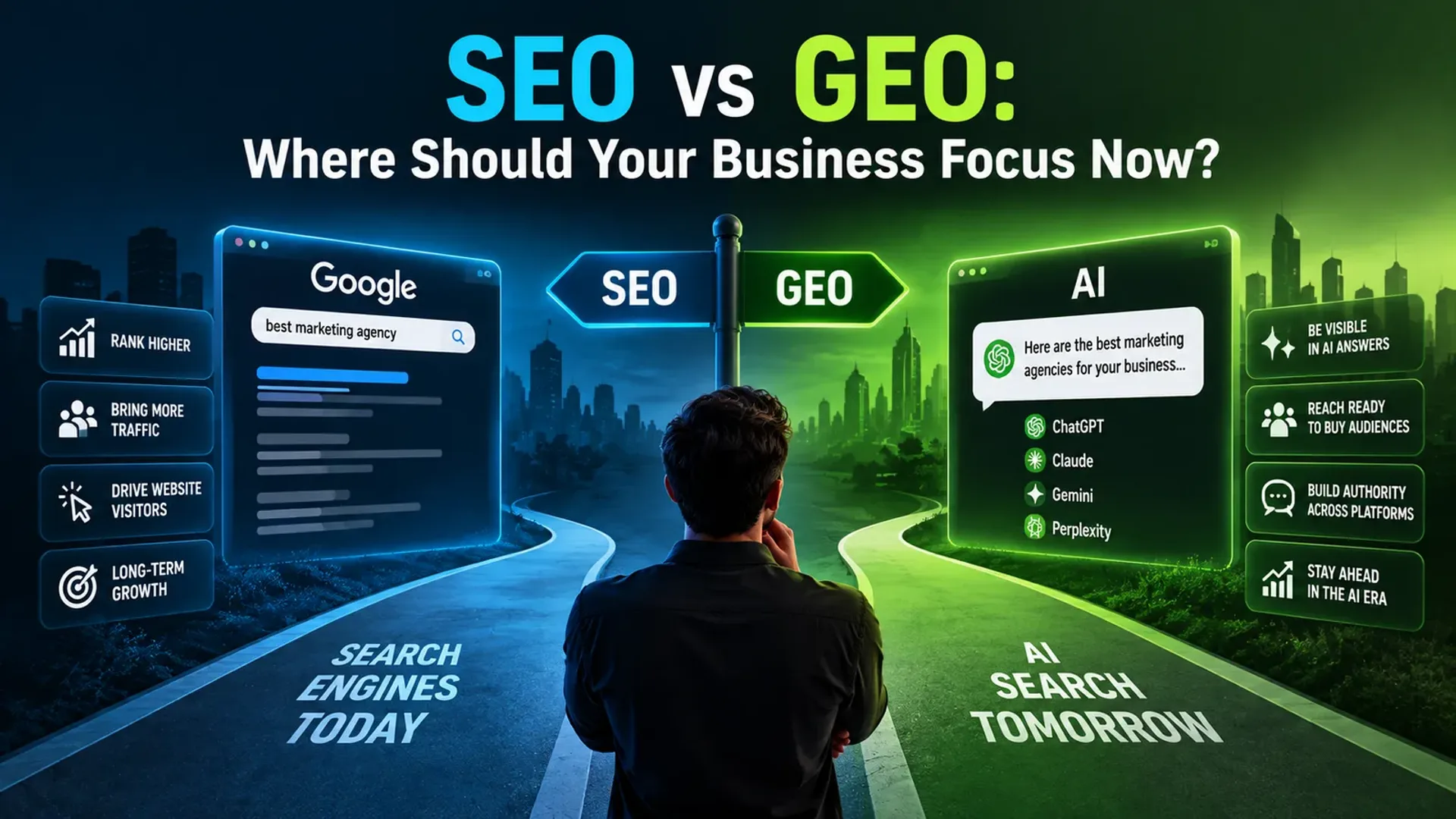
For years, businesses have been told the same thing:
“You need to rank on Google.”
So they hired SEO agencies, published blog posts, built backlinks, fixed technical issues and spent months trying to move from page two to page one.
That still matters.
But search is changing.
People are no longer only typing something into Google and choosing one of ten blue links.
They are asking ChatGPT, Gemini, Perplexity and other AI-powered search tools questions and expecting a direct answer.
Instead of:
“best digital marketing agency in Bangalore”
someone might ask:
“Which digital marketing agencies in Bangalore are good for a growing D2C brand?”
And instead of getting a list of websites, they may get an answer that recommends a few companies and explains why.
This creates a new question for marketers:
If SEO helps you get found on search engines, how do you get found inside AI-generated answers?
That's where GEO comes in.
GEO stands for Generative Engine Optimization.
And while there is a lot of hype around it, the reality is more interesting.
SEO and GEO are not two completely separate strategies.
They overlap.
But they are built around different search experiences.
SEO was built for search results
Traditional SEO is largely about making your website easier for search engines to discover, understand and rank.
You research keywords.
You create useful content.
You optimise pages.
You improve technical performance.
You build authority.
You earn links.
You make sure search engines can crawl your website.
Then you try to rank for the searches that matter to your business.
The end result is usually a search results page where several websites compete for attention.
The goal is to become one of those results.
GEO is about becoming part of the answer
Generative search works differently.
A person asks a question.
The system may search across multiple sources.
It evaluates information.
It combines information from different pages.
Then it generates an answer.
Your website might not be presented as the first result.
Instead, it might be used as a source inside the answer.
That changes the objective.
With SEO, you might ask:
“How do we rank number one for this keyword?”
With GEO, you also need to ask:
“How do we become a source an AI system can confidently use when answering this question?”
That is a different way of thinking about content.
Google itself says SEO still matters for AI search
This is important because there is already a lot of exaggerated advice around GEO.
Some people are claiming SEO is dead.
It isn't.
Google's own Search Central documentation now has guidance specifically around appearing in AI features such as AI Overviews and AI Mode, and explicitly says that existing SEO best practices continue to be relevant for generative AI features in Search.
So if someone tells you:
“Forget SEO. GEO is the new SEO.”
Be careful.
The more accurate answer is:
SEO is still the foundation. GEO adds another layer.
So what actually changes?
The biggest difference is the way people search.
Traditional search often looks like:
Keyword → Search results → Website → Answer
Generative search can look more like:
Question → AI searches multiple sources → Synthesised answer → Sources
That means businesses need to think beyond individual keywords.
They need to understand the questions people are asking.
The language people use.
The comparisons they make.
The problems they're trying to solve.
And the information an AI system would need to confidently recommend a business or explain a topic.
Search is becoming more conversational
Think about how people search today.
A traditional query might be:
“best CRM software”
A conversational query might be:
“What CRM should a 20-person B2B sales team use if they need WhatsApp integration and don't want something complicated?”
That's much more specific.
And it contains several signals:
Company size.
Industry.
Use case.
Feature requirements.
Budget or complexity concerns.
The best content isn't simply repeating the phrase “best CRM software” 20 times.
It actually answers the question.
This is one reason high-quality, genuinely useful content becomes even more important in AI search.
GEO is not about stuffing “AI keywords” into your website
This is another misconception.
There isn't a magic GEO keyword density.
You don't need to write:
“Best AI search optimisation GEO agency.”
fifty times on a page.
That won't suddenly make ChatGPT recommend you.
Instead, think about whether your content is easy to understand, specific, useful and supported by evidence.
If you're making a claim, explain it.
If you're comparing two things, actually compare them.
If you're giving advice, provide the reasoning.
If you're discussing numbers, provide the source.
If you're describing a process, explain the steps.
In other words:
Make your content useful enough that another system can confidently use it to answer someone else's question.
Original information becomes more valuable
This is where things get interesting.
The internet is already full of generic content.
And AI can generate even more of it.
If 500 websites publish almost identical articles about:
“10 Benefits of Digital Marketing”
why should an AI system consider one of them especially valuable?
Now compare that with a company publishing:
“What We Learned After Managing ₹2 Crore in Meta Ad Spend for D2C Brands”
That article contains original experience.
It contains numbers.
It contains observations.
It contains context.
It contains something that can't easily be copied from a generic blog template.
Google's current guidance for generative AI search specifically highlights the importance of non-commodity content rather than simply producing more generic material.
That should be a major signal for content marketers.
Being mentioned is not the same as being cited
GEO discussions often focus on one metric:
“Are we being mentioned by AI?”
That's useful.
But it isn't enough.
Suppose someone asks ChatGPT:
“What are the best performance marketing agencies for ecommerce brands?”
Your agency appears in the answer.
Great.
But why?
Was your website used?
Was a third-party review used?
Was a case study used?
Was an industry publication talking about you?
Was the information current?
Was the AI simply making an inference?
These distinctions matter.
Research into GEO is increasingly looking at multiple stages of AI visibility, including whether a source is discovered, selected, cited and actually influences the generated answer.
So measuring GEO needs to become more sophisticated than simply counting mentions.
Authority matters in both SEO and GEO
This is where the two strategies overlap.
Search engines want useful, trustworthy information.
AI systems also need reliable sources.
That means authority still matters.
But authority isn't only about having a high domain authority score.
Think about real-world authority.
Are other publications talking about your company?
Are experts referencing your research?
Do customers mention your work?
Do industry websites link to your content?
Are your case studies detailed?
Do you have original data?
Are your founders or experts contributing useful information to the industry?
These signals help build a stronger digital footprint.
Third-party mentions can become even more important
Your own website can say:
“We are the best performance marketing agency in India.”
Anyone can say that.
A third-party publication saying:
“Agency X was recognised for its work with fast-growing D2C brands”
is a different signal.
A customer review saying:
“They helped us reduce our customer acquisition cost by 27%”
is stronger again.
A case study showing the actual work and results is stronger still.
This is one reason GEO can push marketers to think beyond publishing content on their own website.
You also need to build earned visibility.
A recent research paper examining AI search found that generative search systems showed a strong preference for earned media and authoritative third-party sources compared with brand-owned and social content in its experimental setting.
The exact behaviour varies by search system, but the strategic lesson is useful:
Don't build your entire online presence on your own website.
Your brand needs to exist outside your website
Imagine an AI system trying to answer:
“Is Alternate a good agency for a company looking for creative and performance marketing?”
It may not only look at Alternate's homepage.
The broader web can matter.
Reviews.
Industry articles.
Case studies.
Business listings.
Interviews.
Social profiles.
Client mentions.
Press coverage.
Other websites.
This is why modern SEO is increasingly becoming a broader digital authority strategy, not just an exercise in optimising pages.
SEO asks: What are people searching?
GEO asks another question: What are people asking?
This sounds like a small difference.
It isn't.
Keyword research traditionally focuses on search volume and competition.
But generative search opens up a much larger set of conversational questions.
For example:
“Best website development agency”
could become:
“Which website development agencies are good for a startup that needs both design and conversion optimisation?”
Or:
“Should a small business hire a freelancer or an agency for its website?”
Or:
“What should I check before hiring a performance marketing agency?”
These are content opportunities.
And they are often much closer to the actual decision-making process.
Your FAQ section just became more useful
A good FAQ isn't only there to answer customer questions.
It can also help structure information clearly.
Instead of writing:
“We offer end-to-end digital solutions.”
you can answer specific questions:
“How much does ecommerce website development cost in India?”
“How long does a website redesign usually take?”
“Should I run Google Ads or Meta Ads for my ecommerce business?”
“How much should a startup spend on performance marketing?”
“What should I expect from a digital marketing agency?”
These are the questions customers actually ask.
Answer them properly.
Don't create a page just because an SEO tool gave you a keyword.
Structured information still matters
Technical SEO isn't disappearing either.
Search engines and AI systems need to crawl and interpret websites.
Clear page structures.
Descriptive headings.
Internal linking.
Accessible content.
Structured data where appropriate.
Fast, usable pages.
Clear author and organisation information.
These things help machines understand what they're looking at.
Google's documentation around AI search continues to point website owners toward established SEO fundamentals rather than a completely separate technical playbook for GEO.
AI search still needs crawlable websites
This is particularly important for businesses that want visibility in ChatGPT search.
OpenAI says public websites can appear in ChatGPT search and recommends allowing its OAI-SearchBot to crawl relevant content. It also notes that there is no guaranteed placement in ChatGPT search.
So before worrying about sophisticated GEO tactics, check the basics.
Can the page be crawled?
Can the important information be accessed?
Is the content visible?
Are pages blocked unnecessarily?
Is the site technically healthy?
You can't optimise information that search systems can't properly access.
Content structure matters more than ever
Imagine an article that contains 2,500 words of text but never actually answers the question.
The introduction takes 500 words.
The writer keeps repeating the same idea.
There are no useful examples.
There are no numbers.
There are no clear conclusions.
There is no evidence.
That's difficult for humans to read.
It's also not great source material for an AI system.
Compare that with:
What is GEO?
Clear definition.
How is GEO different from SEO?
Clear comparison.
Why does GEO matter?
Specific explanation.
How do you improve GEO?
Practical steps.
What mistakes should you avoid?
Examples.
What should businesses measure?
Metrics.
That's easier to understand.
For everyone.
Write for humans first
This is probably the most important point.
Don't start creating strange content just because you want to “optimise for AI.”
Write content that a real person would actually find useful.
Explain things clearly.
Use examples.
Add your experience.
Show evidence.
Answer questions directly.
Don't hide the answer behind 800 words of introduction.
Google's guidance continues to emphasise useful, people-first content and established SEO practices even as AI search features evolve.
That's a good rule to follow.
GEO is not a replacement for content marketing
In fact, it makes good content marketing more valuable.
But the content needs to become more useful.
Instead of publishing:
“Why Digital Marketing Is Important for Businesses”
create:
“How Much Should a D2C Brand Spend on Meta Ads in India?”
Then explain the variables.
Show examples.
Talk about margins.
Customer acquisition cost.
Average order value.
Repeat purchases.
Creative costs.
Media spend.
Profitability.
Now you have something useful.
And potentially something that gets referenced when someone asks an AI system a related question.
Original data can give you an unfair advantage
This is one of the strongest GEO opportunities for agencies.
Agencies have access to enormous amounts of campaign information.
Creative performance.
Conversion rates.
Customer behaviour.
Landing page results.
Ad spend.
Industry benchmarks.
Testing results.
Yet most agencies don't publish much of what they learn.
Imagine an agency publishing:
“We analysed 500 ecommerce ad creatives. Here are the five hooks that consistently generated the strongest click-through rates.”
That's much more valuable than another generic article about:
“How to write great ad copy.”
You have original information.
Use it.
Case studies can become powerful search assets
Case studies are another underused resource.
Don't just write:
“Client X saw amazing results.”
Explain the situation.
The problem
What wasn't working?
The strategy
What changed?
The execution
What did you actually do?
The result
What happened?
The learning
What should other businesses take away?
That gives search engines and AI systems much more useful information to work with.
It also gives potential customers a reason to trust you.
One piece of content can do both jobs.
SEO and GEO need different KPIs
This is where marketing teams need to be careful.
SEO metrics might include:
Organic traffic.
Keyword rankings.
Impressions.
Clicks.
Organic conversions.
Backlinks.
Indexed pages.
GEO introduces additional questions:
Are we appearing in AI-generated answers?
How often?
For which topics?
Which sources are being cited?
Are competitors appearing more frequently?
Are our pages being cited?
Are citations sending traffic?
Are AI-generated answers accurately describing our brand?
Are we being recommended for the right use cases?
These aren't necessarily available in one neat dashboard.
The measurement ecosystem is still developing.
Recent academic work on GEO highlights that visibility involves multiple stages and that simple citation counts don't capture the full picture.
So don't buy a tool promising a magical “GEO score” and assume that number tells the whole story.
Your competitors are already part of the answer
This is another important difference.
In traditional SEO, you're competing for ranking positions.
In AI search, you're often competing to be included in a generated recommendation.
That can make the competitive environment feel very different.
Imagine someone asks:
“What are the best creative agencies for a startup?”
The AI might mention five companies.
You don't necessarily need to beat every competitor for every search.
But you need to become relevant for the questions that matter to your business.
That means understanding:
Which topics do we want to own?
Which questions should we be associated with?
Which customers do we want AI systems to understand us as being relevant to?
That's positioning.
And GEO makes positioning more important.
Your brand positioning affects AI visibility
Suppose your website says:
“We provide creative, digital, technology and marketing solutions.”
That's broad.
Now imagine the company has a strong reputation for:
“Helping growing D2C brands combine creative and performance marketing.”
That's much more specific.
The second description gives search systems a clearer idea of where the business belongs.
It also gives humans a clearer reason to remember the company.
This is another reason GEO isn't just an SEO problem.
It is partly a brand and positioning problem.
So which one should you invest in?
The answer for most businesses is:
Both.
Don't abandon SEO because AI search exists.
Don't ignore AI search because Google still matters.
Build a strong SEO foundation.
Then extend your content and authority strategy for generative search.
Think of it this way:
SEO helps your business become discoverable.
GEO helps your business become referenceable.
And both contribute to the same bigger goal:
being visible when your customers are looking for an answer.
A practical SEO + GEO strategy
If you're starting from scratch, don't overcomplicate it.
Start with your most important business questions.
1. Identify your ideal customers.
Know who you're trying to attract.
2. Map their search behaviour.
What do they search for?
What questions do they ask?
What comparisons do they make?
3. Build strong topic clusters.
Create useful content around important themes rather than random keywords.
4. Answer questions directly.
Don't bury useful information under unnecessary introductions.
5. Add original insights.
Use your experience, data, research and examples.
6. Strengthen your authority.
Earn mentions, links, reviews, references and coverage from credible sources.
7. Improve technical SEO.
Make sure search engines and AI crawlers can access your important content.
8. Build strong case studies.
Show what you actually achieved.
9. Make your brand positioning clear.
Be specific about who you help and what you're known for.
10. Measure both search and AI visibility.
Track traditional organic performance alongside AI mentions and citations where you can.
That's a much more sustainable strategy than chasing every new GEO hack that appears on LinkedIn.
Don't optimise for the machine and forget the customer
This is probably the biggest warning.
Every time a new search technology appears, marketers try to reverse-engineer it.
They look for loopholes.
They create formulas.
They stuff keywords.
They generate hundreds of pages.
They try to manipulate signals.
Eventually, the search engine changes.
The algorithm changes.
The AI model changes.
The tactic stops working.
The businesses that survive these changes usually have something simpler:
They create useful information and build real authority.
That doesn't mean algorithms don't matter.
They do.
But the foundation should remain useful content, strong technical execution, credibility and a clear understanding of your customer.
SEO vs GEO is becoming the wrong question
The debate shouldn't really be:
SEO or GEO?
It should be:
How do we make our business discoverable wherever our customers are searching?
Some people will still search Google.
Some will use AI Overviews.
Some will ask ChatGPT.
Some will use Gemini.
Some will use Perplexity.
Some will discover businesses through social media.
Some will ask friends.
Some will see a recommendation inside an AI-generated answer and never visit a traditional search result at all.
Your job is not to predict exactly which platform wins.
Your job is to build a brand and content ecosystem strong enough to be found across them.
The future belongs to businesses that become useful sources
The internet is moving from a world where people simply find pages to a world where systems increasingly find information and turn it into answers.
That changes the role of content.
Your blog isn't just a traffic machine.
Your case study isn't just a sales document.
Your research isn't just a PR asset.
Your website isn't just a brochure.
Together, they create the information footprint of your business.
And that footprint can influence how search engines, AI systems and potential customers understand you.
SEO still matters.
GEO matters too.
But neither should become the goal by itself.
The goal is much simpler:
Be useful. Be credible. Be easy to understand. And build enough authority that both people and machines have a reason to trust what you say.
Ready to Build Your Search Strategy for the AI Era?
Search is changing, but your customers are still asking questions.
The difference is where they're asking them.
At Alternate, we look at SEO and GEO as part of a bigger digital growth strategy. We combine content, SEO, brand positioning, website experience, creative and performance marketing to help businesses become more visible and more relevant across modern search.
Because ranking on Google is no longer the only visibility that matters.
Your brand needs to be discoverable when your customer searches, and referenceable when your customer asks.
If you're ready to build a search strategy that works across both traditional and AI-powered search, let's talk.
Tap the button and Google will show you our new articles more often — in Search, Top Stories and AI Overviews.
Have a project in mind?
Let’s turn it into an intelligent product. Book a free 30-minute discovery call.
Start your project →