“RAG or fine-tuning?” is one of the most common questions we hear when a company wants to put AI to work on its own data. The good news: the answer is usually clearer than the debate suggests. Here’s a plain-English comparison — what each technique does, when to use which, and why most teams should start with RAG.
The short answer
For the vast majority of business use cases — chatbots, knowledge assistants, support and search — start with RAG. Reach for fine-tuning only when you need the model to adopt a specific style, format or skill that RAG can’t provide. The best systems often use a little of both.
What is RAG (Retrieval-Augmented Generation)?
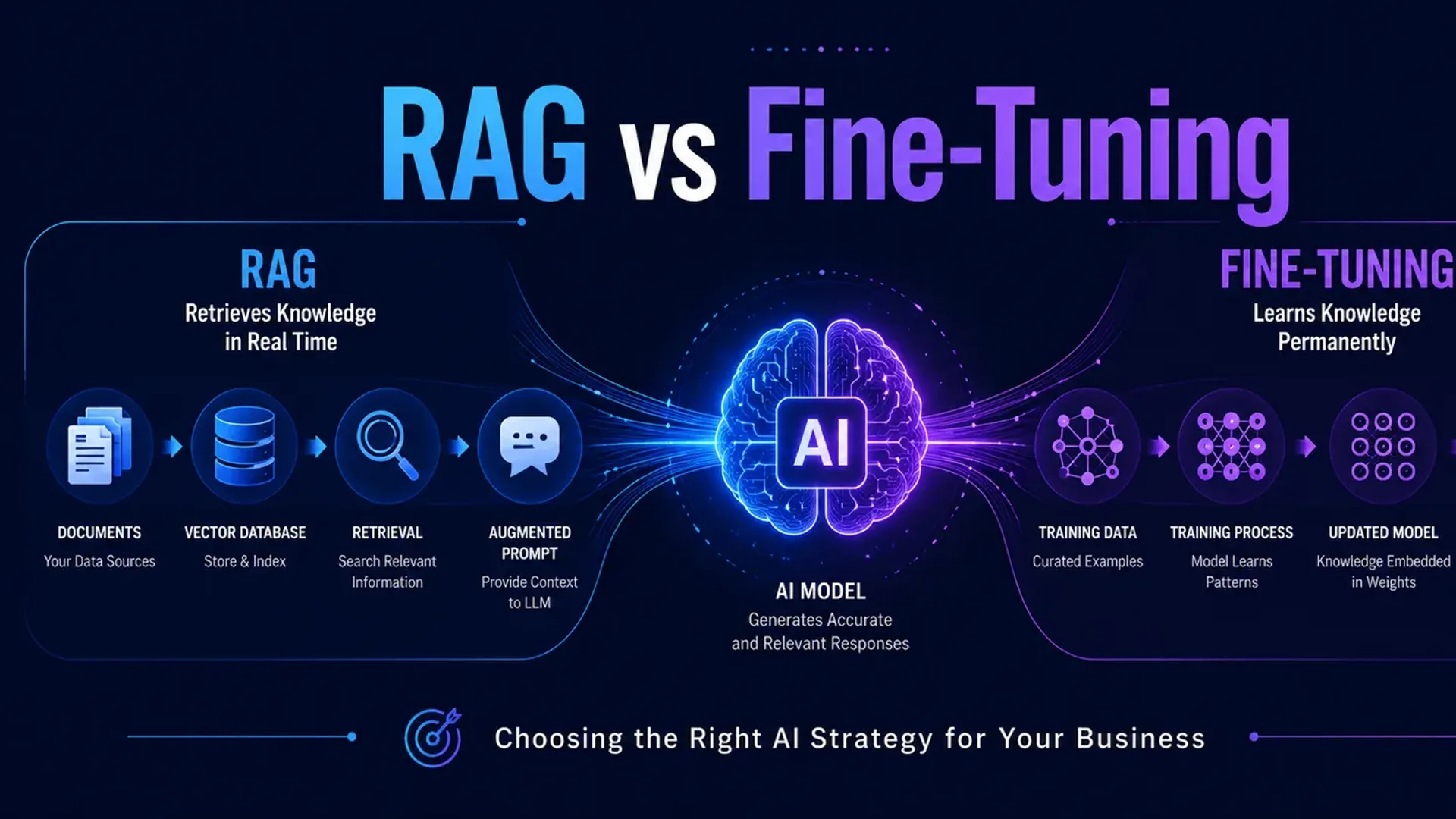
RAG connects a language model to your data at answer time. When a question comes in, the system retrieves the most relevant snippets from your documents and feeds them to the model, which answers using that context — with citations. The model’s core stays unchanged; you’re simply giving it the right information to read.
Strengths: always up to date (change a document, the answers change), accurate and grounded (far less hallucination), cited, and much cheaper and faster to build. Your data stays in your control.
What is fine-tuning?
Fine-tuning further trains the model on your examples, baking new behaviour into its weights — a specific tone, output format, or a narrow skill. You’re teaching the model how to respond, not what facts to know.
Strengths: consistent style and format, handles specialised tasks, and can shorten prompts. Trade-offs: slower and costlier to build, needs quality training data, goes stale as your knowledge changes, and doesn’t learn new facts on its own.
RAG vs fine-tuning, side by side
Use RAG when…
- Your AI needs to answer from your documents, policies or product data.
- Information changes often and you don’t want to retrain every week.
- Accuracy and citations matter (support, search, knowledge bots).
- You want to launch fast and keep costs down.
This covers most chatbots and assistants — see our AI chatbot development.
Use fine-tuning when…
- You need a very specific tone, persona or output format every time.
- You have a narrow, repeatable task with good training examples.
- You want to compress long, repetitive prompts into the model.
Can you use both?
Yes — and the best systems often do. Fine-tune for style and structure; use RAG for facts and freshness. A support assistant might be lightly fine-tuned for your brand voice while using RAG to pull accurate, current answers from your help centre.
The practical recommendation
Start with RAG. It solves 80%+ of real business cases faster, cheaper and more accurately — and it’s far easier to keep correct over time. Add fine-tuning later, only if a clear gap remains. The most common mistake we see is reaching for expensive fine-tuning when a well-built RAG pipeline would have done the job.
Get it right the first time
Choosing — and building — the right approach is where experience pays off. At Alternate, generative AI development is what we do: we’ll recommend the right architecture for your use case and build it to production standard.
Not sure which you need? Book a free 30-minute call → and we’ll map the right approach for your project.
Tap the button and Google will show you our new articles more often — in Search, Top Stories and AI Overviews.
Have a project in mind?
Let’s turn it into an intelligent product. Book a free 30-minute discovery call.
Start your project →