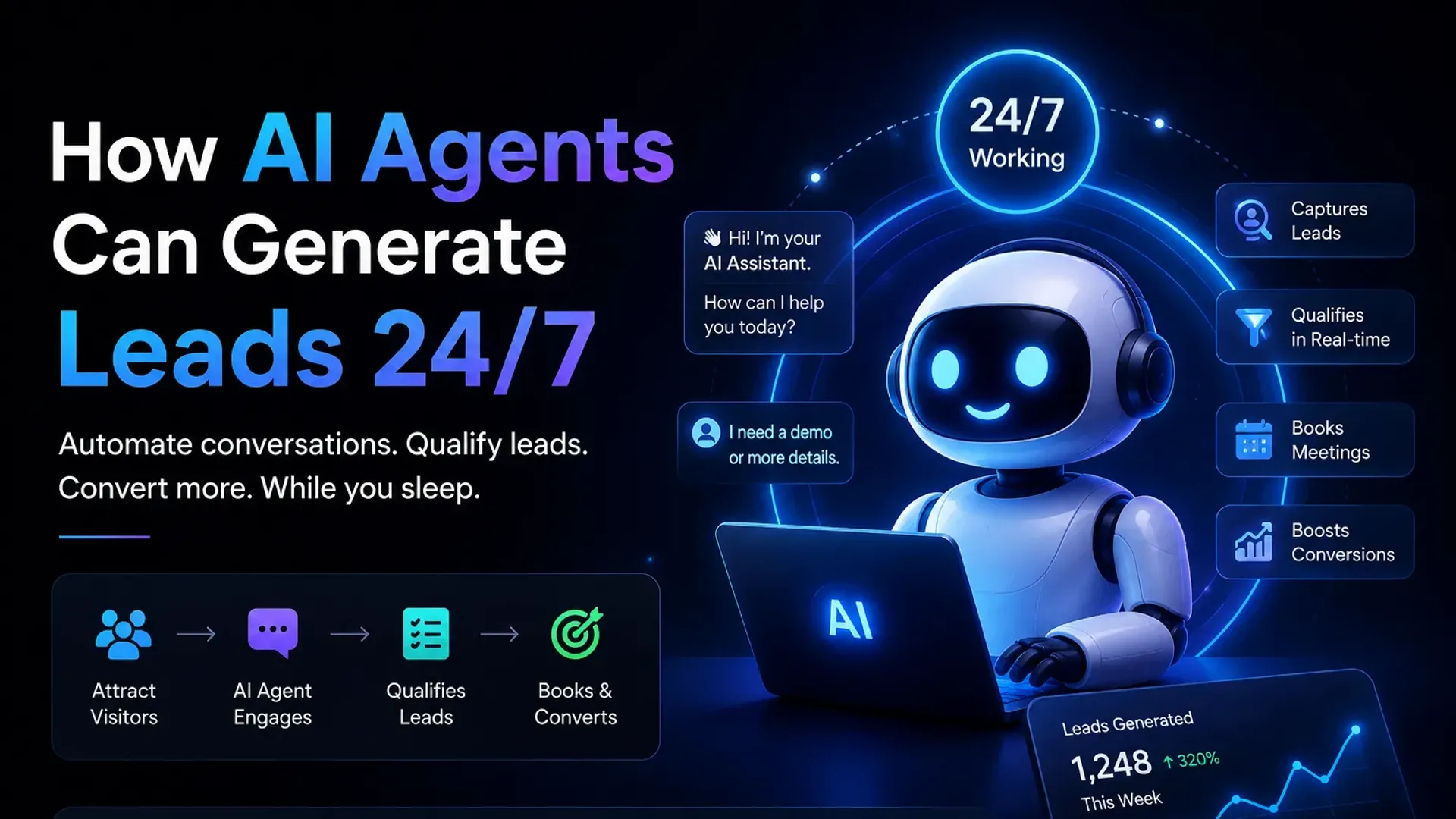
It's 11:47 on a Saturday night. Someone who has been quietly comparing options for a week finally lands on your website, ready to talk. They have one question before they commit — about pricing, or timelines, or whether you've done this for a business like theirs. There's nobody to ask. So they fill in nothing, close the tab, and by Monday they've signed with the competitor who answered first.
You never knew that person existed. That's the thing about lost leads: they don't show up in any report. They just quietly don't happen.
Your best salesperson sleeps, takes holidays, and can only hold one conversation at a time. Your website doesn't have to. And no, this isn't a sci-fi pitch about robots replacing your team. It's a set of fairly unglamorous, surprisingly reliable jobs that software has recently become very good at. Let's separate what's genuinely useful from what's hype.
The leads you're losing are the ones you can't see
Most businesses obsess over the leads in their pipeline and ignore the much larger number that never make it in. People who visited at midnight. People who had a question at the exact moment your contact form felt like too much effort. People who were genuinely interested on Tuesday and had completely forgotten you by Thursday because nobody followed up.
An AI agent's real job isn't to be clever. It's to make sure none of those moments are wasted — to be present, instantly, every hour of every day, so that interest never goes cold for the dumbest possible reason: that no one was around.
You don't lose most leads because your offer is wrong. You lose them because you weren't there at the five minutes that mattered.
First, let's de-hype the word "agent"
"AI agent" has been stretched to mean everything and nothing. So here's a plain definition. An AI agent is software that can understand a request, decide what to do, take action across your tools, and follow up — without a human triggering each step.
A basic chatbot answers a question. An agent reads the question, checks your calendar, books the meeting, adds the person to your CRM, sends a confirmation, and pings your team — then remembers the conversation if that person comes back next week. The difference is the difference between an answering machine and an actual assistant. Everything below is built on that distinction.
Job 1: It answers in seconds, at 2am, every time
This is the unglamorous superpower, and it matters more than anything else on this list. There's a well-known piece of Harvard Business Review research on response time which found that companies contacting a new lead within an hour were around seven times more likely to have a meaningful conversation with a decision-maker than those who waited even sixty minutes — and roughly sixty times more likely than those who waited a day. A separate, widely-cited study put the magic window even tighter: respond within five minutes and your odds of qualifying the lead jump dramatically compared to thirty.
No human team can hit that consistently. Someone is always in a meeting, asleep, or off on a Friday. An AI agent answers in seconds, at full quality, at 3am on a public holiday, to ten people at once. For most businesses, simply closing the response-time gap is the single biggest lead win available — and it requires no extra traffic at all.
Job 2: It qualifies before it ever reaches you
Speed is only half the value. The other half is filtering. Your team's time is expensive, and most of it gets burned on conversations that were never going to convert — the tyre-kickers, the wrong-fit enquiries, the students doing research.
A good agent has a natural conversation that quietly establishes the things you actually need to know: what they're trying to achieve, roughly what they can spend, how soon, and whether they're the person who decides. By the time a lead reaches a human, it arrives with context attached and a score against it.
What that looks like in practice
- A ready-to-buy enquiry with budget and urgency gets flagged as hot and routed to a person immediately, while interest is high.
- A "just looking" visitor gets helpful answers and a gentle nudge to subscribe — captured, not chased.
- An out-of-scope request is handled politely without wasting anyone's afternoon.
Your team stops spending its best hours on its worst-fit leads.
Job 3: It follows up with the 97% who weren't ready yet
Here's a number worth sitting with: the large majority of people who show interest aren't ready to buy today. They're researching, comparing, waiting for budget, or just busy. In most businesses those people are effectively abandoned — one email goes out, nobody replies, and they're forgotten.
This is where an agent quietly earns its keep. It can run a patient, personalised follow-up sequence over days or weeks — answering the question they asked, sharing the case study that fits their industry, checking back when the timing makes sense — and then wake your team the moment someone re-engages. It's the diligent follow-up every sales manager wishes their team did and no human ever has time to do consistently.
Job 4: It books the meeting, not just the email
Collecting an email address is not generating a lead. It's generating homework. The gap between "they gave us their details" and "there's a call in the calendar" is where most pipelines leak.
An agent closes that gap inside the same conversation. It offers real available times, books the slot, sends the invite and reminders, and adds the lead to your pipeline — all before the person's interest has a chance to cool. The most valuable thing it removes is delay: every hour between intent and action is an hour for second thoughts.
Job 5: It can go looking for leads, not just wait for them
Everything so far is inbound — making the most of people who already found you. The more advanced use is outbound: an agent that actively monitors the places your future customers announce they need help — job boards, communities, directories, search — spots the relevant ones, enriches them with company and contact context, and drafts a genuinely personalised, non-spammy opener for your team to approve.
Done carelessly this is just an automated spam cannon, and it deserves the bad reputation those have. Done well — narrowly targeted, genuinely relevant, always with a human approving the send — it turns "we'll do some outreach when things are quiet" into a steady, compounding stream of warm, well-researched conversations. It's the difference between a net cast at random and a line cast where the fish actually are.
Where AI should stop — and the part nobody likes to admit
An honest post about AI has to include the guardrails, because the failure modes are real and they cost you trust.
- It should never pretend to be human. People forgive a bot that's clearly a bot and genuinely helpful. They don't forgive being deceived.
- It should never invent facts. An agent that confidently makes up a price or a feature does more damage than no agent at all. It needs to be grounded in your real information and know when to say "let me get a person for that."
- It should never become a spam machine. Volume is not a strategy. The moment outreach stops being relevant and consented, you're trading short-term contacts for long-term reputation — a terrible deal.
- It should hand off cleanly. The goal isn't to replace your salespeople. It's to deliver them warmer, better-qualified conversations so they spend their time closing, not chasing.
The businesses that win with this treat the agent as the tireless first mile, not the whole journey. Humans still do the part humans are best at: building the relationship and closing the deal.
A realistic 30-day rollout
You don't flip a switch and wake up to a robot sales force. Sensible adoption looks more like this:
- Week 1 — Capture. Put a genuinely helpful AI assistant on your site that answers your real top questions and captures every enquiry, day or night. This alone usually pays for itself.
- Week 2 — Qualify and route. Teach it to ask the few questions that separate hot from cold, and to alert a human instantly when a lead is ready.
- Week 3 — Follow up. Add patient, personalised nurture sequences so the "not yet" leads stop falling through the cracks.
- Week 4 — Book and measure. Connect your calendar so the agent books meetings directly, and start measuring the numbers that matter: response time, qualified leads, meetings booked. Only consider outbound once the inbound machine is humming.
Start where the leak is biggest — for almost everyone, that's response time and follow-up — and expand from there once you trust it.
The point was never to replace people
The promise of an AI agent isn't a workforce of robots. It's something quieter and more valuable: that no genuinely interested person ever again falls through the cracks because it was the weekend, or because your team was buried, or because the follow-up that would have closed them never got sent. Your competitors are still answering on Monday. You could be answering at 11:47 on Saturday night.
This is exactly the kind of system we design and build — practical AI agents grounded in your real business, with the guardrails that keep them helpful instead of embarrassing. If you're curious what one would look like for you, take a look at how we approach AI chatbots and assistants and generative AI development, or just start a conversation. We'll tell you honestly where an agent would move the needle for your business — and where it wouldn't.
New to the concept entirely? Start with our plain-English explainer: what are AI agents — then come back for the lead-gen playbook.
Tap the button and Google will show you our new articles more often — in Search, Top Stories and AI Overviews.
Have a project in mind?
Let’s turn it into an intelligent product. Book a free 30-minute discovery call.
Start your project →