Why Every Second Matters for Your Business
Imagine this.
A potential customer clicks on your website after seeing your Google ad. They're interested, ready to learn more, and maybe even ready to buy.
But your website takes five seconds to load.
Before they see your products, your pricing, or your contact form—they're gone.
You've paid for the click, but you've lost the customer.
Most businesses think website speed only matters for Google rankings. While speed is an important SEO factor, its biggest impact is something much more valuable:
Revenue.
A fast website creates a better first impression, improves customer experience, increases trust, and ultimately generates more sales.
At Alternate, we've seen businesses significantly improve lead generation and conversion rates simply by optimizing website performance—without spending an extra dollar on advertising.
Let's explore why website speed directly affects your bottom line.
Website Speed Is a Business Metric
Many business owners see website speed as a technical issue.
Developers think about page size.
Designers think about animations.
SEO specialists think about rankings.
Customers think about only one thing:
"Why is this website taking so long?"
People don't separate technical performance from your brand.
If your website feels slow, your business feels slow.
The Numbers Don't Lie
Several industry studies have consistently shown that website speed has a measurable impact on user behavior and conversions.
Some of the most widely cited findings include:
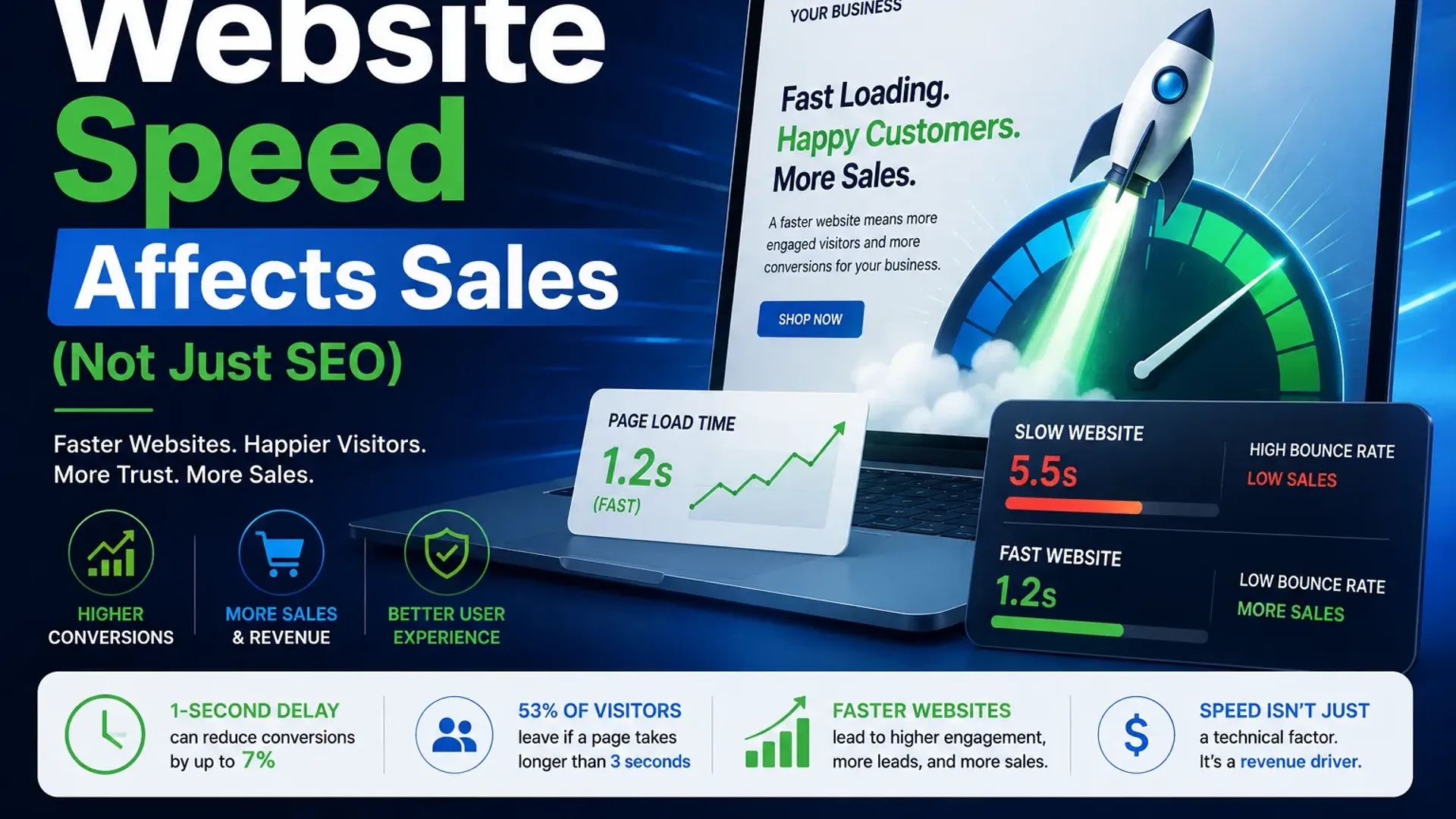
- Nearly 53% of mobile visitors leave if a page takes longer than 3 seconds to load.
- A 1-second delay can reduce conversions by up to 7%.
- Faster websites generally experience lower bounce rates and higher engagement.
- Google has confirmed that page experience and Core Web Vitals influence search rankings.
While the exact impact varies by industry, one trend is consistent:
Faster websites create better business outcomes.
Speed Builds Trust Before Content Does
Visitors judge your business almost instantly.
Before they read your headline...
Before they look at your pricing...
Before they see your portfolio...
They notice how quickly your website responds.
Fast websites communicate:
- Professionalism
- Reliability
- Quality
- Attention to detail
Slow websites communicate the opposite—even if your products are excellent.
How Speed Impacts Sales
1. First Impressions
Imagine visiting two agencies.
The first website loads instantly.
The second takes six seconds.
Which company feels more professional?
Most people instinctively trust the faster experience.
This is psychology in action.
Humans associate speed with competence.
2. Lower Bounce Rates
When pages load slowly, visitors leave before interacting with your content.
Every person who leaves represents:
- Lost revenue
- Lost leads
- Wasted advertising spend
- Missed opportunities
Reducing bounce rate often starts with improving loading speed.
3. Higher Conversion Rates
People complete purchases when the buying experience feels effortless.
If your checkout process loads slowly...
If forms hesitate...
If buttons respond late...
Visitors become uncertain.
Small delays create friction.
Friction reduces conversions.
4. Better User Experience
Speed improves every interaction.
Visitors can:
- Browse products faster
- Read blogs comfortably
- Submit forms easily
- Navigate between pages smoothly
Good user experience increases confidence.
Confidence increases sales.
Real-World Examples
Amazon
Amazon has long emphasized the importance of speed because even tiny delays can affect purchasing behavior.
With millions of customers browsing simultaneously, improving performance translates into measurable revenue gains.
This is one reason Amazon continuously optimizes images, code, caching, and infrastructure.
Walmart
Walmart found that faster page load times were associated with increased conversions.
The company invested heavily in performance optimization because every improvement helped customers complete purchases more efficiently.
Pinterest rebuilt parts of its website to improve perceived performance.
The result?
Visitors spent more time engaging with content, and user activity increased significantly.
These companies invest millions in website performance for one simple reason:
Speed generates revenue.
The same principle applies to small businesses.
Why Speed Matters Even More for Small Businesses
Large brands already have customer trust.
Small businesses don't.
When someone discovers your company for the first time, every interaction matters.
A slow website can make visitors wonder:
- Is this company legitimate?
- Are they still operating?
- Will customer service also be slow?
- Is my payment information safe?
Speed influences trust.
Trust influences buying decisions.
Hidden Costs of a Slow Website
Many businesses only think about SEO.
The hidden costs are much bigger.
Lost Advertising Budget
Imagine spending $3,000 every month on Google Ads.
If visitors leave because your landing page is slow, you're paying for clicks that never become customers.
Lower Lead Generation
Slow contact forms reduce inquiries.
Slow landing pages reduce conversions.
Slow product pages reduce purchases.
Poor Brand Perception
Customers often judge businesses by their digital experience.
Your website is frequently the first interaction with your brand.
A slow experience damages credibility.
Lower Customer Retention
Existing customers also expect speed.
If your client portal or dashboard feels sluggish, customer satisfaction drops.
What Makes Websites Slow?
Several issues contribute to poor performance.
Large Images
Uploading high-resolution images without optimization is one of the biggest causes of slow websites.
Compress images without sacrificing quality.
Too Many Plugins
Every plugin adds additional scripts.
Some websites use 30–50 plugins when only a handful are necessary.
Fewer plugins generally mean better performance.
Poor Hosting
Cheap hosting often struggles under traffic spikes.
Reliable hosting is an investment, not an expense.
Heavy Animations
Animations can improve design—but too many create unnecessary delays.
Use motion intentionally.
Unoptimized Code
Unused CSS, JavaScript, and third-party libraries increase loading times.
Regular code cleanup improves performance.
No Browser Caching
Caching stores website assets locally so returning visitors experience much faster load times.
Core Web Vitals: Google's Performance Signals
Google measures website performance using three key metrics known as Core Web Vitals.
Largest Contentful Paint (LCP)
Measures how quickly the main content becomes visible.
Target:
Under 2.5 seconds
Interaction to Next Paint (INP)
Measures how responsive your website feels after a visitor interacts with it.
Visitors expect buttons and forms to respond immediately.
Cumulative Layout Shift (CLS)
Measures visual stability.
If buttons move while someone tries to click them, the experience feels broken.
Stable layouts improve both usability and trust.
Practical Ways to Improve Website Speed
Here are some improvements every business should prioritize.
Compress Images
Use modern formats like WebP.
Resize images before uploading.
Choose Better Hosting
A reliable hosting provider dramatically improves loading times.
Reduce Third-Party Scripts
Every external tool increases loading time.
Only keep tools that provide measurable business value.
Enable Lazy Loading
Load images only when users scroll to them.
This reduces initial page weight.
Minify CSS and JavaScript
Removing unnecessary code makes websites faster.
Use a Content Delivery Network (CDN)
A CDN delivers your website from servers closer to each visitor, reducing latency.
Optimize Fonts
Limit font families and weights.
Too many fonts slow rendering.
Why Speed Improves SEO Too
Although this article focuses on sales, website speed also supports SEO.
Google rewards websites that provide better user experiences.
Fast websites often benefit from:
- Better crawl efficiency
- Lower bounce rates
- Longer session durations
- Improved Core Web Vitals
- Better search rankings over time
SEO gets people to your website.
Speed helps keep them there.
Speed Is Part of Conversion Rate Optimization (CRO)
Think about your sales funnel.
Traffic → Website → Trust → Lead → Customer
A slow website interrupts this journey before visitors even engage with your content.
Improving performance is one of the highest-impact CRO strategies because it reduces friction at every stage.
The best part?
Unlike paid advertising, speed improvements continue delivering value long after implementation.
How Alternate Builds High-Performance Websites
At Alternate, performance isn't treated as an afterthought.
Every website we build is designed around three priorities:
- Speed
- User Experience
- Conversions
Our approach includes:
- Performance-first development
- Optimized image delivery
- Clean, lightweight code
- Mobile-first design
- Core Web Vitals optimization
- UX improvements
- Conversion-focused page structure
- Continuous performance monitoring
The result is a website that not only ranks better—but also converts better.
Final Thoughts
Website speed isn't just a technical metric.
It's a business advantage.
Every second your visitors spend waiting is another opportunity for them to leave, choose a competitor, or lose confidence in your brand.
A faster website creates better first impressions, builds trust, improves user experience, strengthens SEO, and most importantly—drives more sales.
If you're investing in content marketing, SEO, paid ads, or social media, make sure your website is fast enough to convert the traffic you're already earning.
Because the fastest way to grow your business may simply be making your website faster.
Ready to Speed Up Your Website?
If your website feels slow, underperforms in search, or isn't converting visitors into customers, Alternate can help.
We build lightning-fast, conversion-focused websites optimized for performance, user experience, and business growth.
Get in touch with Alternate today for a website performance audit and discover how much revenue your slow website could be costing you.
Speed is only one reason enquiries dry up. See the full list in our guide to why your website isn't generating leads.
Tap the button and Google will show you our new articles more often — in Search, Top Stories and AI Overviews.
Have a project in mind?
Let’s turn it into an intelligent product. Book a free 30-minute discovery call.
Start your project →