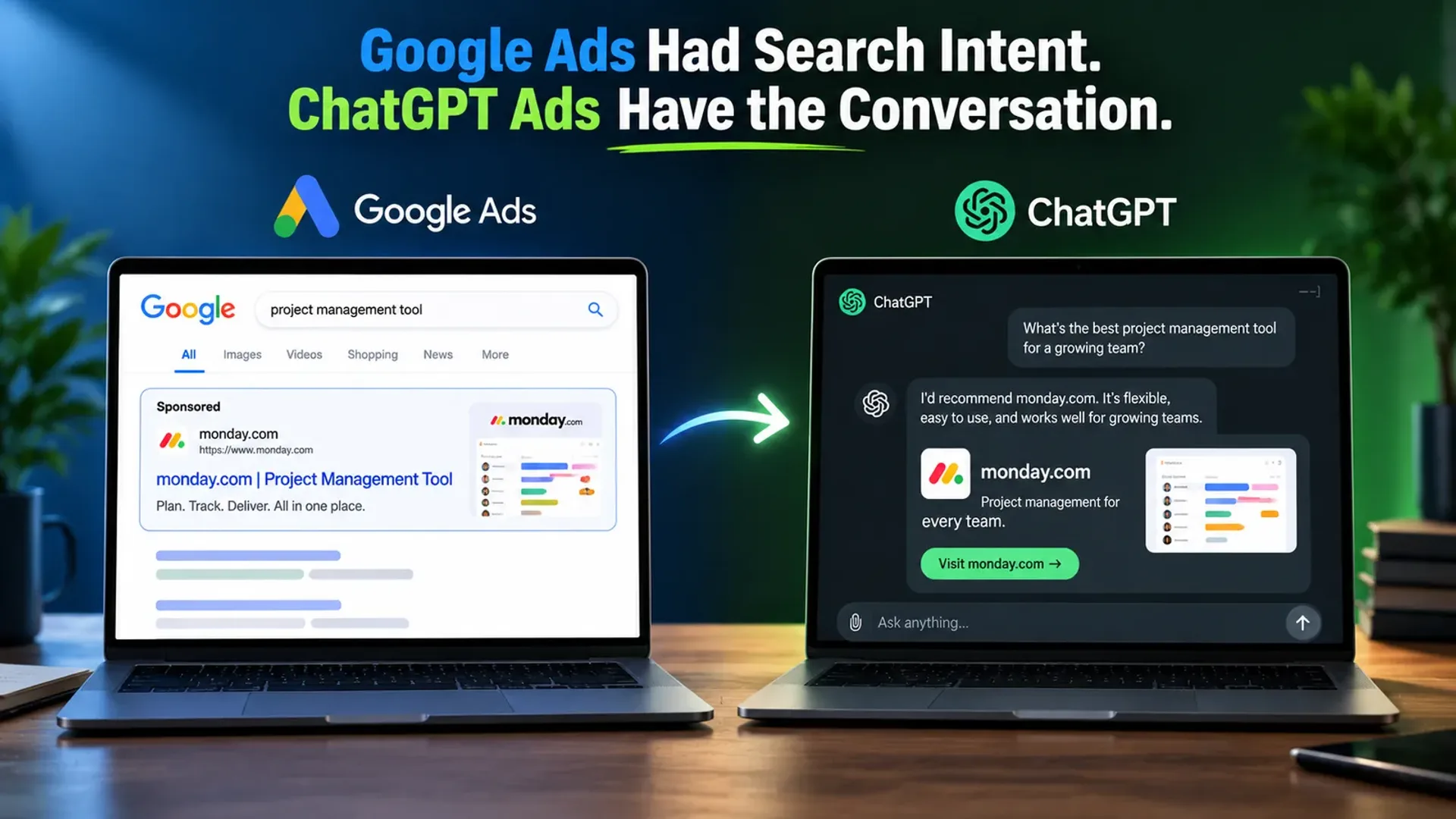
For years, digital advertising has revolved around one basic question: What is this person searching for?
Google built an enormous advertising business around the answer.
Meta took a different route. It learned from what people do, who they interact with, what they engage with and what interests them.
Now ChatGPT is introducing a different kind of advertising environment.
Instead of starting with a keyword or scrolling through a feed, a customer can simply explain what they are trying to do.
“I need a CRM for a 20-person sales team.”
“Which running shoes are best for someone training for a marathon?”
“I’m comparing accounting software for a small business.”
“I need a new website for my law firm.”
The conversation itself contains context.
And that changes the advertising game.
OpenAI is now expanding ChatGPT Ads into more international markets while building the infrastructure advertisers need to treat ChatGPT as a measurable advertising channel. The latest expansion includes India, Europe, the Middle East and North Africa, alongside new audience targeting, conversion measurement, reporting and campaign management capabilities.
That matters to businesses far beyond the technology industry.
Because if customers are increasingly using AI to research products, compare businesses and make decisions, advertising inside those conversations could become an important part of how brands compete for attention.
ChatGPT Ads Are Becoming a Real Performance Channel
When ChatGPT Ads first appeared, it was reasonable for marketers to treat them as an experiment.
That is getting harder to justify.
OpenAI says ChatGPT Ads reached a $1 billion annualized revenue run rate in less than 200 days after launch, with tens of thousands of advertisers using the platform. OpenAI has also expanded advertising to more than 40 countries and built an ecosystem of more than 50 technology and measurement partners.
That is a very different proposition from a small advertising beta.
OpenAI is building the infrastructure behind the ads.
Advertisers can now work with custom audiences, geographic targeting, conversion tracking, product feeds, Pixels and the Conversions API. OpenAI is also adding stronger reporting and optimization capabilities.
In other words, the company isn't simply placing sponsored messages underneath AI responses.
It is building an advertising platform around them.
And that distinction is important.
Why Advertising on ChatGPT Is Different From Google
Imagine two customers.
Customer A goes to Google and searches:
“Best project management software for small businesses.”
Customer B opens ChatGPT and says:
“I run a 15-person marketing agency. We currently use spreadsheets and Slack for project management. We need something affordable, easy for clients to use and capable of tracking deadlines and profitability. What should we consider?”
Both customers have commercial intent.
But the second customer has already provided considerably more context.
They have explained their company size.
Their current workflow.
Their pain points.
Their budget considerations.
Their requirements.
Their decision criteria.
That information can make the advertising environment fundamentally different.
OpenAI describes ChatGPT as a place where people explore options, compare alternatives and make decisions. Its advertising system can use the context of the current conversation to make ads more relevant, with additional personalization possible depending on the user's settings and market.
This creates an interesting middle ground between search advertising and social advertising.
Google understands the query.
Meta understands the audience.
ChatGPT can understand the conversation.
That could become one of the most valuable characteristics of AI advertising.
The Keyword May No Longer Tell the Whole Story
Traditional paid search depends heavily on keywords.
A business might bid on:
“best accounting software”
“accounting software for small business”
“CPA software”
“QuickBooks alternatives”
Each keyword represents a different combination of intent and competition.
But conversational AI doesn't require the customer to reduce their problem to three or four words.
They can describe the entire problem.
That means marketers need to start thinking beyond keyword lists.
The question becomes:
What problems does our ideal customer describe before they are ready to buy?
For a cybersecurity company, that might be:
“We have 50 employees, remote workers and no dedicated IT security team. What security tools should we prioritize?”
For an ecommerce brand:
“I need a laptop for video editing, but I don't want to spend more than $1,500.”
For a healthcare software company:
“We're a 25-doctor practice and our current scheduling system creates too many no-shows. What should we look for in a replacement?”
Those are not traditional keywords.
They are buying situations.
And brands that understand those situations may have an advantage as conversational advertising develops.
OpenAI Is Building the Boring Stuff That Actually Matters
The flashy part of ChatGPT advertising is the ad appearing underneath a conversation.
But the more important development may be everything happening behind the scenes.
Targeting.
Measurement.
Conversion matching.
Reporting.
Optimization.
Campaign management.
These are the systems that determine whether advertisers eventually move meaningful budgets onto a platform.
OpenAI's latest updates include stronger custom audience management, additional identifiers for conversion matching, product-level reporting and more sophisticated measurement through its Pixel and Conversions API.
That sounds less exciting than a new ad format.
It is arguably more important.
A platform becomes a serious part of a media strategy when marketers can answer questions like:
How many people saw the campaign?
Who clicked?
Who converted?
Which audiences performed?
Which products generated demand?
What did the campaign cost?
What revenue did it influence?
Which creative worked?
What should we change next?
That is the infrastructure advertisers expect from Google and Meta.
OpenAI is building toward that standard.
The Biggest Opportunity May Be for High-Consideration Businesses
Not every business should immediately move budget into ChatGPT Ads.
And that is an important point.
The best opportunities are likely to emerge where customers already spend time researching, comparing and evaluating before purchasing.
Think about:
B2B software.
Professional services.
Financial products.
Education.
Travel.
Home improvement.
Technology.
Healthcare services.
Automotive.
Ecommerce with considered purchases.
Real estate.
Business consulting.
These categories often involve questions before transactions.
And questions are exactly where conversational AI is becoming useful.
If someone is spending 20 minutes explaining what they need from a software platform, the marketing opportunity is very different from showing them a banner based on a demographic segment.
The customer has effectively told the platform what matters to them.
That is valuable context.
But There Is a Problem: Your Ad Still Has to Earn the Click
A better targeting system cannot rescue a weak offer.
This is where many brands could make the same mistake they have made with every new advertising platform.
They discover a new channel.
They launch campaigns.
They reuse the same creative.
They send traffic to the homepage.
They complain that the channel doesn't work.
ChatGPT Ads do not remove the fundamentals of advertising.
Your message still needs to be clear.
Your offer still needs to be relevant.
Your landing page still needs to build trust.
Your brand still needs to look credible.
Your conversion experience still needs to work.
And your campaign still needs enough data to learn.
If someone is asking ChatGPT for the best accounting software for a 25-person company and your ad says nothing more than “Powerful Accounting Solutions for Modern Businesses,” you have wasted an opportunity.
The customer has already explained their problem.
Your advertising should respond to it.
This Is Where Creative Strategy Becomes More Important
AI advertising could make targeting more sophisticated.
It could also create a new creative problem.
If platforms become better at identifying what someone wants, advertisers will need better messages to meet that intent.
That means creative teams cannot simply produce attractive advertisements.
They need to understand customer problems.
They need to understand objections.
They need to understand buying triggers.
They need to understand the language customers actually use.
A good ChatGPT advertising strategy may begin long before Ads Manager.
It starts with customer research.
Then positioning.
Then messaging.
Then creative.
Then landing page experience.
Then measurement.
That is why ChatGPT Ads should not be treated as a standalone media purchase.
It belongs inside a broader marketing system.
Your Website Matters More Than Ever
There is another reason this development matters.
AI advertising can increase the importance of your website rather than reduce it.
If an advertisement sends someone to your site, the site has to continue the conversation.
If the ad promises a specific solution, the landing page should immediately reinforce that promise.
If the customer was researching alternatives, your website needs to explain why your business is different.
If the customer has objections, the page should answer them.
This creates a connected journey:
AI conversation → advertisement → landing page → proof → conversion
Break one part and the entire system becomes weaker.
A brilliant ad pointing to a confusing website is still a bad campaign.
ChatGPT Ads and GEO Are Going to Intersect
There is another layer businesses should be watching closely.
Paid visibility and organic AI visibility are beginning to sit next to each other.
A customer could ask ChatGPT:
“What are the best digital marketing agencies for a U.S. SaaS company?”
Your company might appear organically in the answer.
Your competitor might appear as a recommendation.
Another company might appear through an advertisement.
The customer can then compare all three.
That means the future of AI marketing will not be purely about buying visibility.
It will also be about earning visibility.
This is where GEO, or Generative Engine Optimization, becomes increasingly relevant.
Your brand needs to be discoverable.
Your content needs to be useful.
Your positioning needs to be clear.
Third-party sources need to validate your expertise.
Your website needs to explain what you actually do.
And your business needs enough authority that AI systems can understand and reference it.
Paid and organic AI visibility can reinforce each other.
Measurement Will Become More Complicated
There is one issue marketers should not ignore.
Attribution.
If someone sees your company mentioned in an AI answer, then later searches your brand on Google, visits your website directly and eventually fills out a form, which channel gets credit?
The answer may be different depending on what your analytics system can see.
OpenAI is clearly investing in this problem. Its Pixel and Conversions API are designed to improve conversion measurement and matching, while its latest advertising updates expand the information available to advertisers.
But marketers should still be careful about assuming that every customer interaction can be perfectly attributed.
Discovery can happen in one place.
Research in another.
The final click somewhere else.
That means marketing teams need to look beyond last-click reporting.
The better question is:
Which channels are helping create demand, influence consideration and generate customers?
Don't Move Your Entire Budget to ChatGPT Tomorrow
There is a temptation with every new platform.
“Should we move our Google budget?”
“Should we reduce Meta?”
“Should we put everything into AI?”
No.
That is not strategy.
ChatGPT Ads should be tested against business objectives.
Start with a defined audience.
Choose a specific customer problem.
Create a relevant offer.
Build dedicated creative.
Use a landing page that matches the conversation.
Set up conversion measurement.
Give the campaign enough time and budget to produce useful data.
Then compare it with your existing channels.
The goal is not to replace Google or Meta because ChatGPT is new.
The goal is to understand whether ChatGPT can generate incremental business at an acceptable cost.
Agencies Need to Change Too
This development also creates a challenge for marketing agencies.
If an agency's job is simply to manage Google Ads, Meta Ads and monthly reporting, its role becomes increasingly narrow.
Modern customers don't move through one channel.
They discover brands through search.
They see content on social media.
They ask AI tools for recommendations.
They visit websites.
They compare reviews.
They return through direct traffic.
They talk to sales teams.
They convert later.
An agency needs to understand the entire journey.
That means paid media, SEO, GEO, content, creative, websites, analytics and AI cannot operate as completely separate departments.
They need to inform one another.
The same customer insight should influence the ad.
The landing page.
The content.
The SEO strategy.
The brand messaging.
The sales pitch.
That is where integrated marketing becomes much more valuable.
What Businesses Should Do Right Now
You do not need to launch a huge ChatGPT advertising campaign tomorrow.
But you should start preparing.
1. Identify your high-intent customer questions.
Look at the questions prospects ask your sales team, customer support team and website. These questions can reveal the conversational intent that matters to your business.
2. Build content around real problems.
Generic “10 tips” content will not give you much differentiation. Create useful pages, guides, comparisons, case studies and original insights that demonstrate genuine expertise.
3. Improve your brand positioning.
If an AI system cannot easily understand who you help, what you offer and why you're different, customers may struggle to understand it too.
4. Create landing pages for specific customer intent.
Don't send every paid visitor to your homepage. Match the landing page to the problem that brought the customer there.
5. Start tracking AI-driven traffic.
Use the available referral and conversion measurement tools, but also monitor branded searches, direct traffic, assisted conversions and changes in lead quality.
6. Test before scaling.
Treat ChatGPT Ads like a performance channel. Establish a hypothesis, define a conversion goal and measure the result.
7. Keep investing in Google and other channels.
AI advertising is expanding. That doesn't make traditional search irrelevant. Customers will continue to use multiple discovery paths.
The Bigger Shift Is Happening Before the Ad
The most interesting part of ChatGPT Ads isn't really the advertisement.
It is the environment in which the advertisement appears.
A Google search begins with a query.
A social feed begins with content.
A ChatGPT conversation can begin with a problem.
That difference matters.
When someone explains what they are trying to accomplish, they are giving a marketing platform something far more useful than a keyword alone: context.
OpenAI is now building the targeting, measurement and optimization infrastructure to turn that context into an advertising business. The company says ChatGPT Ads have already reached a $1 billion annualized revenue run rate and are expanding into more markets, with additional formats, buying options and measurement capabilities planned.
The opportunity for marketers is significant.
But the companies that win will not necessarily be the ones that spend the most.
They will be the ones that understand the customer best.
They will know what customers ask.
What customers worry about.
What customers compare.
What makes them trust a company.
And what finally makes them buy.
That has always been good marketing.
AI is simply giving us a new place to do it.
Ready for the Next Generation of Advertising?
ChatGPT Ads are moving from an interesting experiment toward a serious global advertising platform. But succeeding on a new channel requires more than opening an Ads Manager account.
At Alternate, we bring strategy, creative, performance marketing, web development, SEO, GEO, AI and analytics together so your marketing doesn't operate in disconnected pieces.
We can help you understand where your customers are discovering your brand, what they are looking for, how your competitors are showing up and where paid and organic AI visibility can create new opportunities.
Because the future of advertising isn't about choosing between Google, Meta or ChatGPT.
It's about understanding how your customers move between all of them.
And building a brand that is ready to be found wherever that journey begins.
Explore Alternate Creative Agency
Explore OpenAI Ads
Tap the button and Google will show you our new articles more often — in Search, Top Stories and AI Overviews.
Have a project in mind?
Let’s turn it into an intelligent product. Book a free 30-minute discovery call.
Start your project →