From Brief to Billboard: What Actually Happens Inside a High-Performing Creative Agency
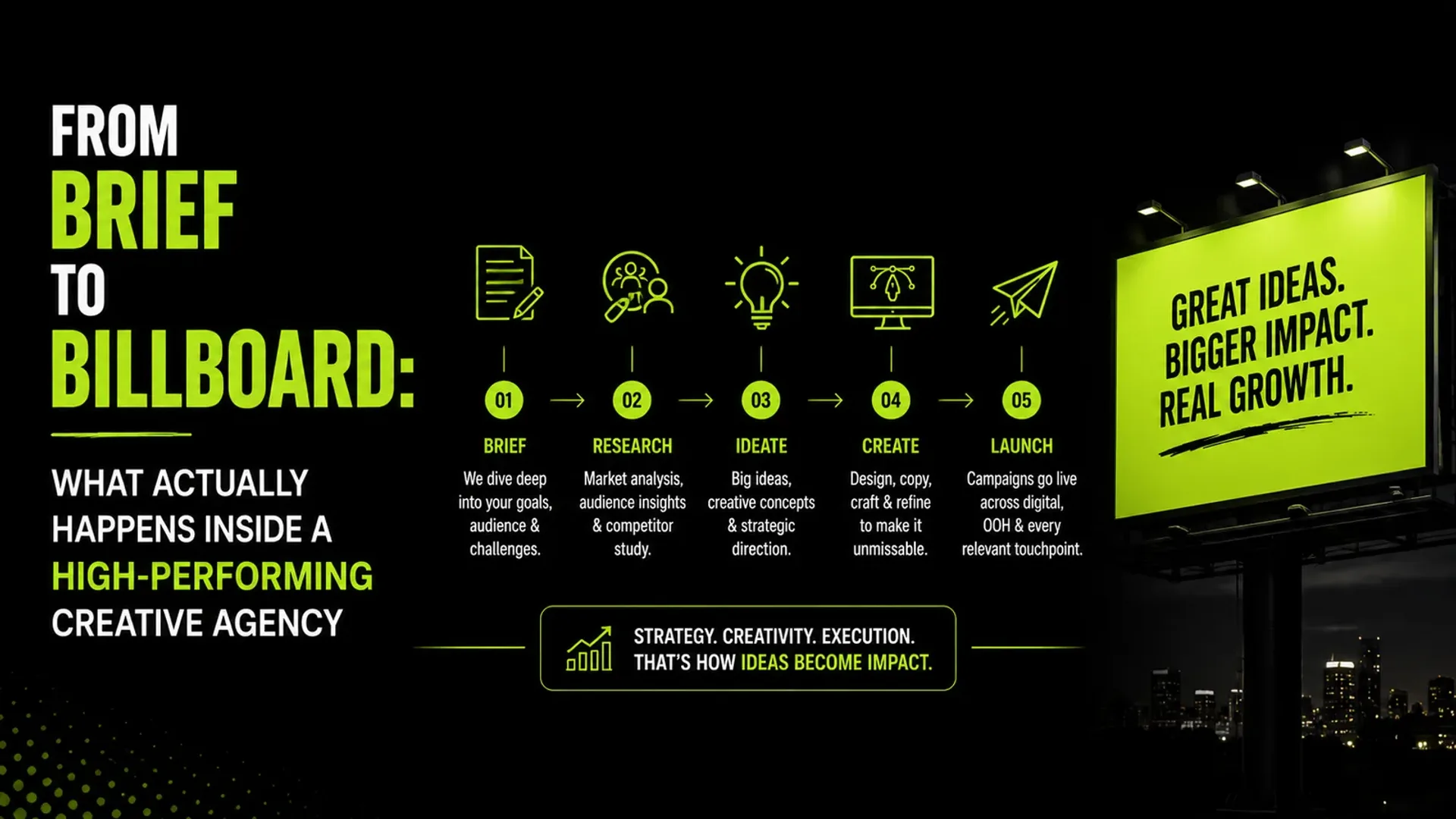
A client sends an email.
“We need a campaign.”
Maybe there's a product launch coming up.
Maybe sales have slowed down.
Maybe a new service is being introduced.
Maybe the company wants to look more premium.
Sometimes the brief is detailed.
Sometimes it's just:
“We need something that stands out.”
And that's where the real work begins.
Because what the client sees at the end is usually one advertisement, one video, one website or one campaign.
What they don't see is everything that happens before that final piece appears.
The research.
The questions.
The arguments.
The bad ideas.
The first drafts.
The changes.
The testing.
The data.
The late realization that the original idea wasn't actually the right idea.
A good creative agency isn't just a place where designers make things look good.
It is a place where business problems are turned into ideas that people can understand, remember and act on.
And there is a lot that happens between receiving a brief and putting the final campaign in front of an audience.
It starts with a problem, not a design
This is probably the biggest difference between good agency work and average agency work.
Average process:
Client gives brief → Designer opens Photoshop.
Better process:
Client gives brief → Team tries to understand the problem.
Those two processes can produce completely different results.
Suppose a client says:
“We need a new social media campaign.”
That's not really a problem.
It's a requested solution.
The agency needs to ask:
Why do you need a campaign?
What isn't working right now?
Are people not aware of the product?
Are people aware but not interested?
Are they interested but not buying?
Is the competition taking market share?
Is the product difficult to understand?
Is the offer weak?
Is the brand looking outdated?
The answer changes the campaign.
If you don't understand the problem, you can produce beautiful work that solves nothing.
The first meeting is usually more important than the first design
A good agency asks questions before it starts making things.
Sometimes clients find this frustrating.
They came expecting ideas.
Instead, they're asked questions for an hour.
But those questions matter.
Who is the customer?
What are they buying?
Why do they buy?
Why don't they buy?
Who are the competitors?
What makes the business different?
What has already been tried?
What worked?
What failed?
What does the sales team hear from prospects?
What does the business actually want from the campaign?
More importantly:
What does success look like?
Because “make us famous” and “generate 500 qualified leads” require very different campaigns.
Then comes the research
This is the part most people never see.
The creative team starts looking at the market.
Competitor campaigns.
Customer reviews.
Social comments.
Search behaviour.
Industry conversations.
Existing brand material.
Previous advertising.
Website analytics.
Sales information.
Sometimes even customer interviews.
The purpose isn't to collect information for the sake of it.
It's to find something useful.
A tension.
A frustration.
A desire.
An objection.
A gap in the market.
A phrase customers keep using.
A competitor assumption that everyone has accepted.
That insight can become the foundation of the campaign.
Your customers are usually better at describing the problem than your marketing team
This is why customer language is so valuable.
Imagine a software company says:
“Our platform improves operational efficiency through intelligent automation.”
Sounds like corporate marketing.
Then you talk to customers.
They say:
“I was spending every Sunday night doing this manually.”
Now you have something real.
The second sentence tells you what the problem actually feels like.
That can become a headline.
A video.
A campaign concept.
A landing page.
A sales argument.
Good agencies learn to listen for these moments.
Then the strategy team starts connecting the dots
Once the research is done, the agency needs to decide what the campaign is actually trying to say.
This is where positioning comes in.
You might discover that everyone in the category talks about price.
So perhaps your client should focus on speed.
Or everyone talks about features.
Maybe the opportunity is simplicity.
Or everyone talks about technology.
Maybe the customer actually cares more about support.
The strategy isn't:
“Let's make something cool.”
It is:
“What is the most useful thing we can say, to the right person, at the right time?”
That's the foundation of the creative work.
Then the creative team gets involved
Now the fun starts.
And also the arguments.
A creative brief might contain:
Audience
Problem
Insight
Positioning
Key message
Reason to believe
Desired action
Then copywriters, designers, art directors, video teams and strategists start turning that information into ideas.
The first idea is rarely the final idea.
Sometimes the first idea is terrible.
Sometimes it looks good on paper and feels completely wrong when you see it.
Sometimes everyone loves an idea except the person who has to approve it.
That's normal.
Creative work is not a straight line.
Good agencies create multiple routes
If there is only one idea on the table, you're not really exploring.
You're defending.
A strong creative team might develop several different routes.
For example:
Route 1: The problem
Show the frustration customers already experience.
Route 2: The transformation
Show what life looks like after using the product.
Route 3: The unexpected
Take a surprising or unconventional approach.
Route 4: The proof
Build the campaign around evidence and results.
Route 5: The human story
Let the customer or founder tell the story.
Each route has a different personality.
The strategy decides which direction makes the most sense.
Then someone asks the uncomfortable question
“Will this actually work?”
This is where a good agency is different from a purely creative studio.
An idea can be beautiful and still be ineffective.
It can win awards and fail to generate demand.
It can get millions of views and produce very few customers.
That's why creative decisions need to connect to the objective.
If the campaign is designed for awareness, attention and memorability matter.
If it's designed for lead generation, the offer and conversion path matter.
If it's a product launch, understanding and desire matter.
The objective should influence the creative.
The creative needs to survive the real world
A campaign doesn't exist only in a presentation.
It has to work in actual environments.
A billboard might have three seconds of attention.
An Instagram Reel might have even less.
A website needs to work on a phone.
A YouTube ad needs to hold attention long enough to deliver the message.
A paid social ad needs to compete with everything else on the feed.
So the creative team has to think beyond the idea.
Where will this appear?
How will people see it?
How much time will they give us?
What happens if they see it without sound?
What happens on a small screen?
What happens after they click?
A good idea has to survive those questions.
Then comes production
This is the part people usually imagine when they hear “creative agency.”
Cameras.
Lights.
Design software.
Editors.
Motion graphics.
Actors.
Voiceovers.
Photographers.
Developers.
AI tools.
But production is only one part of the process.
And good production doesn't automatically make a good campaign.
A $50,000 video with a weak idea is still a weak advertisement.
A simple phone video with a strong idea can sometimes outperform it.
The job of production is to execute the idea in a way that makes it clear, believable and compelling.
Not everything needs a huge production budget
This is especially true in social media.
People have become used to seeing polished advertising.
But they also consume enormous amounts of content that feels informal.
A founder talking to a camera.
A customer explaining a problem.
A screen recording.
A product demonstration.
A behind-the-scenes video.
A simple before-and-after.
These formats can feel more natural in a social environment.
The right choice depends on the brand, audience and objective.
There is no prize for spending the most money.
Then the campaign gets adapted
One master creative rarely works everywhere without changes.
A billboard needs one kind of thinking.
An Instagram Reel needs another.
A LinkedIn post needs another.
A Google Display asset needs another.
A landing page needs another.
The central idea should remain consistent.
The execution needs to respect the medium.
This is why a good campaign is often less about making one perfect asset and more about building a family of connected assets.
Then performance marketing gets involved
This is where creative and media need to work together.
The media team looks at:
Who are we reaching?
Where are they?
What placements are available?
What is the objective?
What budget do we have?
What happens after the click?
What does the conversion path look like?
The creative team needs to understand these questions too.
Because a creative idea that works beautifully as a brand film may not work as a paid social ad.
And an ad that gets a high CTR may still produce poor-quality leads.
Creative and media cannot operate as completely separate worlds.
The campaign goes live
This is the exciting part.
The work is finally out.
But the agency's job isn't finished.
In many ways, this is where the campaign starts teaching you something.
People interact with the creative.
Some stop.
Some scroll.
Some click.
Some buy.
Some ignore it completely.
The data starts coming in.
And sometimes the results are surprising.
The ad everyone expected to win doesn't.
The simple version performs better.
The expensive video loses to a basic customer testimonial.
The headline nobody liked produces the most conversions.
That's why testing matters.
Data can challenge creative opinions
Creative teams are full of opinions.
That's part of the job.
But performance data can challenge those opinions.
Maybe the team loves Concept A.
The audience prefers Concept B.
Maybe the most beautiful creative produces fewer conversions.
Maybe a less polished video produces twice the leads.
This doesn't mean data should control every creative decision.
It means data should be part of the conversation.
A good agency knows when to trust experience and when to listen to evidence.
The campaign becomes a learning exercise
This is where the best agency relationships become valuable.
Suppose a campaign teaches you:
Customers respond strongly to a specific pain point.
Customer stories outperform generic claims.
Short videos outperform longer videos.
A particular offer attracts better-quality leads.
Mobile users drop off at a specific part of the landing page.
Those insights should not disappear when the campaign ends.
They should influence the next campaign.
Great agencies don't start from zero every time
One of the biggest advantages of a long-term agency relationship is accumulated knowledge.
After working with a client for a while, the agency should know:
What the customer cares about.
What messages have already been tested.
Which creative formats work.
Which ones don't.
Which offers attract the wrong customers.
Which objections keep appearing.
Which competitors are becoming aggressive.
That context makes future campaigns better.
You are no longer guessing.
You're building on what you've already learned.
There is usually a lot of bad work before the good work
This is something clients rarely see.
The rejected headline.
The concept that looked great in the meeting but terrible in production.
The storyboard that didn't work.
The first version of the video.
The landing page that was redesigned three times.
The campaign idea that sounded brilliant until someone asked:
“But why would the customer care?”
Creative work can look effortless when you only see the final result.
It isn't.
The polished campaign is usually the result of a lot of decisions that never make it to the final presentation.
The best creative work is usually simpler than it looks
When a campaign works really well, people sometimes assume it must have been obvious.
It wasn't.
Someone had to remove the unnecessary parts.
The extra message.
The clever line.
The complicated explanation.
The unnecessary visual.
The second CTA.
The feature nobody cared about.
Good creative often becomes simpler through iteration.
The final idea may look obvious.
Getting there isn't.
What happens after the campaign?
The work shouldn't simply be archived.
The agency should review:
What worked?
What didn't?
What surprised us?
What did customers respond to?
What did they ignore?
What should we do differently next time?
This is where the campaign turns into knowledge.
And that knowledge is often more valuable than the campaign itself.
Because the next brief starts from a better place.
So, what actually happens inside a high-performing creative agency?
It isn't just designers making beautiful things.
It isn't just copywriters writing headlines.
It isn't just media buyers running campaigns.
It isn't just account managers sending emails.
It is a chain of decisions.
Understand the problem.
Research the customer.
Find the insight.
Build the strategy.
Develop the idea.
Test the idea.
Produce the work.
Launch it.
Measure it.
Learn from it.
Make the next version better.
That's the real process.
And the billboard, Instagram ad, website or campaign you eventually see is simply the most visible part of it.
The best agency work happens long before the audience sees the final creative.
Because great advertising isn't created when someone opens a design file.
It starts when someone asks the right question.
Tap the button and Google will show you our new articles more often — in Search, Top Stories and AI Overviews.
Have a project in mind?
Let’s turn it into an intelligent product. Book a free 30-minute discovery call.
Start your project →