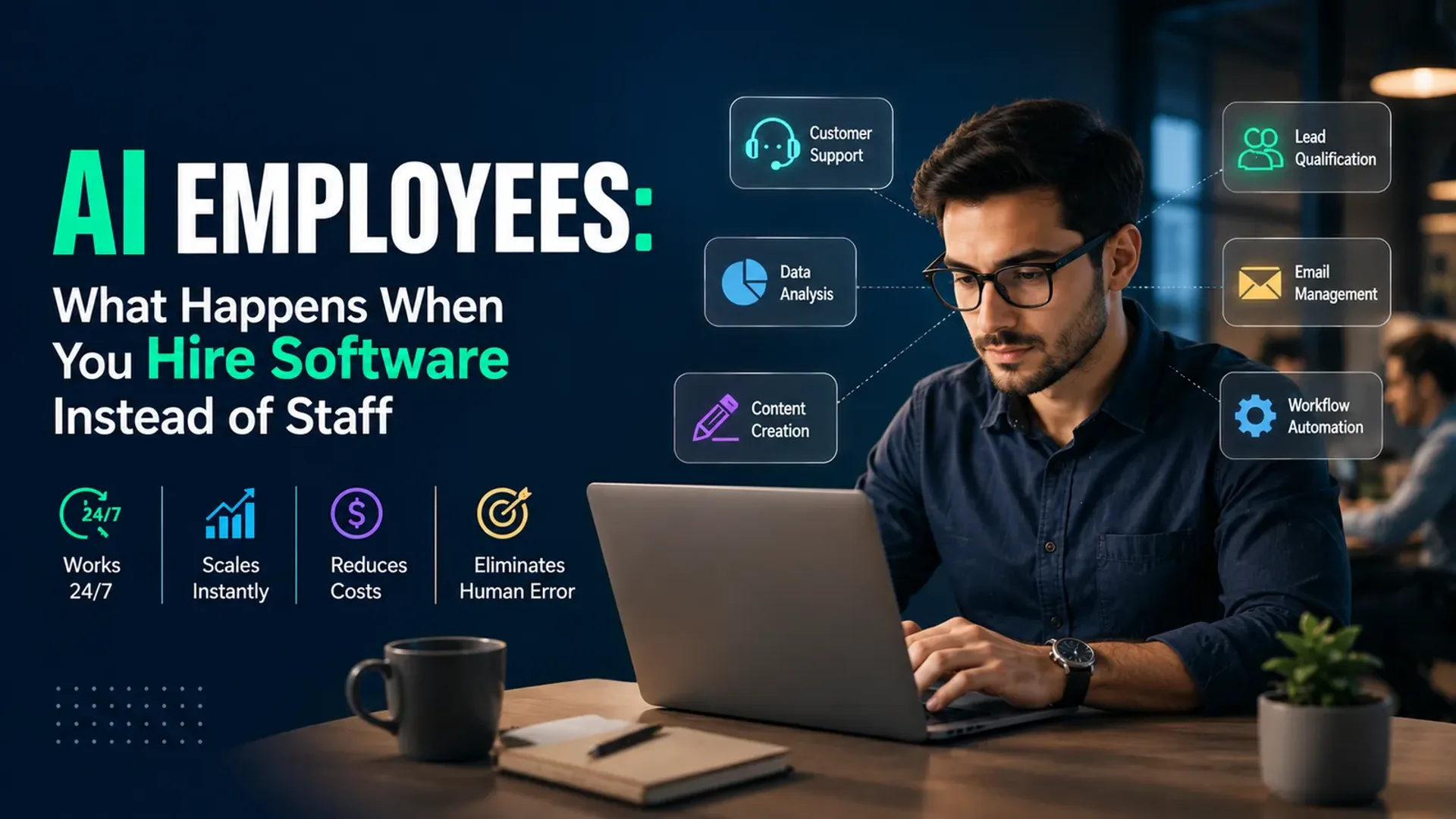
The pitch is everywhere in 2026, and it is seductive: an 'AI employee' that works 24 hours a day, never calls in sick, never quits, and costs a fraction of a salary. Some of it is genuinely real and changing how businesses operate. Some of it is a plain chatbot wearing a nice suit. Knowing the difference — and how to actually deploy the real thing — is the difference between a quiet competitive edge and an expensive, embarrassing mess.
Let us cut through it honestly: what an AI employee actually is, what it is genuinely good at today, where it still fails, and how to put one to work without it promising a customer something it should not.
What an AI 'employee' actually is
Unlike a simple chatbot that answers one question and stops, an AI employee owns a workflow. You give it a goal — 'qualify this lead', 'resolve this ticket', 'chase this overdue invoice' — and it can gather what it needs from your tools, take a sequence of steps, and hand off cleanly when it hits something it cannot handle. It is the difference between a calculator and a bookkeeper: one answers a question, the other does the job.
That capability leans heavily on the connective tissue we covered in our piece on AI agents — the ability to actually use your systems, not just talk about them. If you want the fuller distinction, custom AI agent vs ChatGPT lays out exactly what separates a doer from a talker.
What they are genuinely good at today
Well-scoped, high-volume, rules-plus-judgment work. First-line customer support. Lead qualification and appointment setting. Data entry and moving information between systems. Research and summarisation. Drafting first versions of emails, proposals, and reports. Anywhere the volume is high and each case is broadly similar, an AI employee shines — and it frees your humans for the work that genuinely needs a human.
This is often the fastest, safest first automation a business can make — the same category of quiet time-saving behind how owners reclaim 20+ hours a week.
Where they still fail — and it matters
Ambiguity, high-stakes decisions, and genuine relationship-building. An AI employee that confidently invents a policy, promises a refund it should not, or fumbles a delicate complaint costs you far more than it ever saved. These systems are fluent, which makes their mistakes look authoritative — a dangerous combination if you let them run unsupervised on sensitive work.
The rule is simple: let the AI handle the 80% that is routine, and escalate the 20% that needs a person. Deploy it like a capable, fast junior hire — trusted with volume, supervised on judgment, never left alone with the keys to anything irreversible.
How to deploy one responsibly
Start with a single, contained role — first-line support or lead qualification are ideal because they are high-volume, pattern-heavy, and have a natural human escalation path. Give it least-privilege access to only the tools that role needs. Put a human approval step in front of anything that changes records or sends external messages. Watch its work for a couple of weeks, tune the edge cases, then widen its remit. Trust earned, not assumed.
Frequently Asked Questions
Will an AI employee replace my staff?
For most businesses it augments rather than replaces — it absorbs repetitive volume so your team can do higher-value work. Full replacement only fits narrow, fully-repetitive roles; most jobs are a mix the AI handles the routine part of.
How much does an AI employee cost?
Far less than a salary — typically a monthly tool or usage fee — but budget for setup, integration, and ongoing oversight. The real cost is deploying it badly on sensitive work, not the software itself.
What's the safest first role to give an AI employee?
First-line support or lead qualification: high volume, clear patterns, and an obvious human escalation path for anything it cannot confidently handle. Start there before anything customer-critical.
Can an AI employee make mistakes with customers?
Yes — and because they sound confident, mistakes can look authoritative. That is why you keep a human approval step on anything irreversible and let the AI handle the routine 80% while people own the sensitive 20%.
Curious whether an AI employee fits a real workflow in your business — and which one? Book a free call and we will tell you honestly where it would help and where it would not.
Tap the button and Google will show you our new articles more often — in Search, Top Stories and AI Overviews.
Have a project in mind?
Let’s turn it into an intelligent product. Book a free 30-minute discovery call.
Start your project →