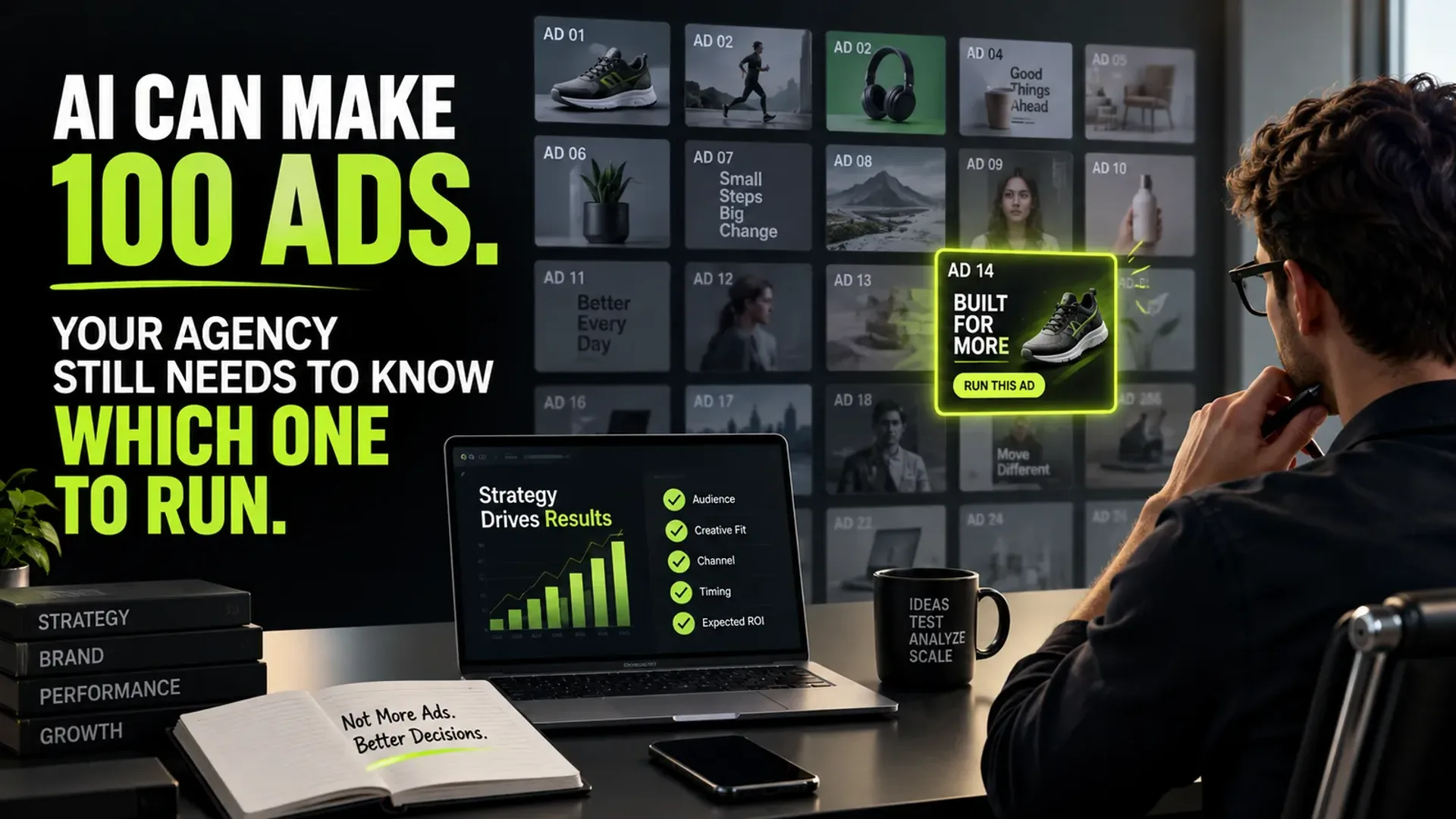
A few years ago, creating 100 different ad variations sounded like a serious production project.
You needed designers, copywriters, video editors, motion designers, a media team, a lot of time and usually, a lot of back and forth.
Today, AI can change that equation completely.
Give an AI tool a product, a target audience and a basic brief, and you can generate dozens of headlines, images, videos, hooks and variations in a very short time.
Google is already building generative AI directly into its advertising ecosystem. Performance Max can use AI to combine creative assets, generate additional text and image assets, and create video variations for campaigns. Google also recommends giving campaigns multiple creative assets so its systems have more combinations to work with. Google Ads: Performance Max creative assets
So yes, we are entering a world where producing ads is becoming dramatically easier.
But that creates a different problem.
If everyone can make 100 ads, the real advantage is no longer making more ads.
The advantage is knowing which ideas are worth putting money behind.
That's where a good agency still matters.
AI has made creative production cheap
Let's start with the obvious change.
AI can now help with almost every part of ad production.
Need 20 headlines?
Generate them.
Need five different hooks for a video?
Generate them.
Need the same concept in square, vertical and landscape formats?
Easy.
Need different versions for different customer segments?
Possible.
Need a product image in a different setting?
AI can help with that too.
The production barrier has fallen dramatically.
Google's advertising tools now allow advertisers to generate headlines, descriptions, images and even video assets using AI in eligible Performance Max workflows. Google Ads: Generative AI asset creation
That is useful.
But there's a difference between creating an asset and creating an effective advertisement.
Those are not the same thing.
More ads don't automatically mean better advertising
Imagine an ecommerce brand selling premium running shoes.
An AI tool creates 100 ads.
One says:
“Run Further. Feel Better.”
Another says:
“Your Long Run Just Got Easier.”
Another focuses on cushioning.
Another talks about lightweight design.
Another shows a runner on a mountain trail.
Another shows a close-up of the sole.
Another uses a discount.
Another talks about performance.
Another talks about comfort.
You now have 100 ads.
But which one should receive ₹10 lakh of media spend?
That's the real question.
AI can give you options.
It doesn't automatically give you business judgment.
The agency's job is changing
This is where agencies need to rethink their role.
For a long time, one of the biggest things an agency sold was production.
“We can create your ads.”
Today, that proposition is becoming less powerful.
Because clients can create ads themselves.
They can use ChatGPT for copy, image generation tools for visuals, AI video tools for short-form content and advertising platforms that automatically create variations.
So the agency needs to move further upstream.
The valuable question becomes:
What should we create in the first place?
And then:
Which version deserves the budget?
That requires strategy, not just production.
The best creative idea isn't always the best-performing ad
This is something marketers learn quickly.
An ad can look brilliant in a presentation and perform terribly in the market.
Another ad can look almost boring and generate excellent results.
That's because advertising isn't judged by how much the marketing team likes it.
The customer gets the final vote.
A creative director might love a beautifully produced brand film.
But if a simple product demonstration generates more qualified leads, the simple ad wins.
A designer might prefer one visual.
The data might strongly prefer another.
A copywriter might love a clever headline.
The audience might respond better to a very direct one.
Performance marketing creates an uncomfortable but useful reality:
The market doesn't care how much effort went into the ad.
It cares whether the ad gives people a reason to stop, pay attention and take action.
This is why testing matters more than opinions
A strong agency shouldn't sit in a meeting and argue endlessly about which ad is better.
It should create a structured way to find out.
For example, instead of producing 20 completely random ads, the team might test five different creative ideas:
Concept 1: Problem-focused
“Your website gets traffic. But where are the leads?”
Concept 2: Outcome-focused
“Turn more website visitors into qualified enquiries.”
Concept 3: Proof-focused
“How we helped a B2B company increase qualified leads by 38%.”
Concept 4: Fear-focused
“Your competitors may be converting the traffic you're paying for.”
Concept 5: Education-focused
“3 reasons your landing page is losing potential customers.”
Now you're not just testing designs.
You're testing ideas.
That's a much more useful experiment.
AI should increase the number of experiments
This is probably one of the biggest opportunities AI gives marketers.
Before AI, creative testing could be expensive.
If you wanted 10 different concepts, you needed to brief designers, writers and editors.
That meant teams naturally produced fewer variations.
Now the cost of producing variations is much lower.
That means agencies can spend more time testing.
You can test different hooks, offers, customer problems, visual styles, proof points, CTAs, formats and audience angles.
Google itself recommends creating variations of assets and adding multiple assets so its systems can find combinations that perform better. Google Ads: Creative asset best practices
But there is an important distinction.
AI should help you test more ideas, not replace the thinking behind those ideas.
Don't test 100 versions of the same bad idea
This is where many teams will get it wrong.
Imagine your original ad is weak.
The message is unclear.
The offer isn't attractive.
The audience is wrong.
The landing page doesn't match the ad.
You ask AI to create 100 variations.
Now you have 100 versions of a weak strategy.
The problem was never the number of ads.
The problem was the idea.
This is why creative strategy becomes even more important as production becomes easier.
When creating an ad costs less, bad creative can scale faster too.
Your agency needs to understand the customer before the prompt
One of the biggest differences between an experienced agency and someone simply generating AI ads is context.
AI doesn't automatically know why your best customers buy from you.
It doesn't automatically understand the objection that stops someone from purchasing.
It doesn't know which competitor customers are switching from.
It doesn't know which feature your sales team hears about every week.
It doesn't know that your “premium” product is actually chosen because customers get better support.
That information usually comes from research.
Customer interviews.
Sales calls.
Reviews.
CRM data.
Website behaviour.
Previous campaigns.
Competitor analysis.
Search data.
Support conversations.
That is where better creative ideas come from.
The prompt comes later.
Great advertising starts with a strong insight
Suppose you're marketing accounting software.
You could tell AI:
“Write 20 ads for accounting software.”
You'll get 20 ads.
Probably perfectly acceptable ones.
But suppose your agency has discovered something through customer interviews:
Small business owners aren't actually worried about accounting software.
They're worried about discovering a tax problem six months too late.
That's a different insight.
Now the campaign could be built around:
“Know what's wrong before tax season tells you.”
That's a much stronger creative territory.
The AI can then help generate 50 variations around that idea.
The intelligence came first.
The scale came second.
The winning ad may not be the prettiest one
This is especially important for social media advertising.
People don't open Instagram or Facebook thinking:
“I hope I see a beautifully art-directed advertisement today.”
They're scrolling.
They're distracted.
They're comparing products.
They're talking to friends.
They're watching videos.
Your ad has to interrupt that behaviour.
Sometimes the most effective creative is highly polished.
Sometimes it looks like a customer testimonial.
Sometimes it's a founder talking into a phone camera.
Sometimes it's a simple product demonstration.
Sometimes it's just text on screen.
The format should serve the idea.
Not the other way around.
This is where performance data becomes creative intelligence
A good performance marketing team doesn't just report:
Ad A: ₹420 CPA
Ad B: ₹510 CPA
Ad C: ₹390 CPA
It asks why.
Why did Ad C work?
Was the hook stronger?
Did it attract a different audience?
Was the offer clearer?
Did the visual communicate the product faster?
Was the customer problem more relevant?
Did the landing page match the promise?
Was the ad simply reaching a cheaper audience?
These questions turn performance data into creative learning.
And that learning should influence the next round of ads.
CTR is not enough
A high click-through rate can look great in a report.
But clicks aren't the final goal.
Imagine an ad gets a 3.5% CTR but almost nobody who clicks becomes a customer.
Another ad gets a 1.8% CTR but generates highly qualified leads.
Which one is better?
The answer depends on the business objective.
This is why creative decisions shouldn't be made around one metric.
Look at the full journey.
Impression → Click → Landing Page → Lead → Qualified Lead → Sale → Revenue
The ad is only one part of the system.
A creative that generates cheap clicks but poor customers may not be a winning creative at all.
AI can help the platform find combinations. Your agency still needs to define the rules.
Modern advertising platforms are becoming increasingly automated.
Google Performance Max, for example, uses AI across bidding, audiences, creative combinations and optimisation based on the goals and inputs provided by advertisers. Google Ads: Performance Max campaigns
That doesn't make strategy irrelevant.
It arguably makes strategy more important.
Because automation is only as good as the inputs and objectives behind it.
If you tell the system that every lead is equally valuable when they're not, it can optimise toward the wrong outcome.
If you give it weak creative, it has fewer strong options.
If your conversion tracking is poor, your optimisation can be based on bad information.
If your positioning is unclear, generating more variations doesn't solve the positioning problem.
Automation can optimise the machine. Someone still needs to decide where the machine should go.
A good agency should know when to kill an ad
This is another area where experience matters.
Sometimes an ad simply isn't working.
The numbers are weak.
The audience isn't responding.
The message isn't connecting.
The cost is too high.
Kill it.
Don't keep it alive because someone spent three days making it.
Don't keep spending money because the founder likes it.
Don't keep defending it because it won an internal creative award.
The purpose of an advertising creative is to perform its job.
If it isn't doing that, learn from it and move on.
But don't kill an ad too quickly either
The opposite mistake is just as common.
A team launches an ad.
It gets weak results for a few hours.
Someone says:
“It's not working. Turn it off.”
That's not testing.
That's impatience.
Campaigns need enough data to make useful decisions, and the amount of time required depends on budget, conversion volume, audience size and campaign structure.
Google, for example, recommends waiting two to three weeks before deciding to replace low-performing Performance Max assets, while also encouraging regular creative refreshes. Google Ads: Performance Max creative assets
The exact decision window will vary by campaign.
The point is simple:
Don't confuse a bad first impression with a proven loser.
Creative testing needs a system
If an agency is producing hundreds of ads, there needs to be a framework behind them.
A useful creative testing system might look at:
Hook
Does the opening make people stop?
Problem
Does it address something the customer actually cares about?
Promise
Is the outcome clear?
Proof
Why should the customer believe you?
Format
Does the creative fit the platform?
Offer
Is there a compelling reason to act?
CTA
Is the next step obvious?
Audience
Is the message relevant to the person seeing it?
Now your team can understand what is actually being tested.
Otherwise, you're just producing variations.
Build a creative matrix, not a pile of ads
Let's say you're running campaigns for a SaaS company.
Instead of asking the creative team for 50 random ads, build a matrix.
Across one side:
Customer problems
• Too much manual work
• High operational costs
• Slow reporting
• Poor visibility
• Human errors
Across the other:
Creative angles
• Cost savings
• Time savings
• Proof
• Education
• Fear of falling behind
• Customer story
• Product demonstration
Now you have a structured testing system.
AI can help turn these combinations into dozens of executions.
The agency decides which combinations are worth testing.
That's a much smarter use of AI.
Creative strategy is becoming more important, not less
This might sound strange.
If AI can create more ads, shouldn't creative strategy become less important?
Actually, the opposite can happen.
When there are only five possible ads, choosing one is relatively easy.
When there are 500 possible ads, choosing the right five becomes difficult.
More options create a new problem:
Selection.
Someone needs to decide:
Which idea fits the brand?
Which message fits the audience?
Which offer is strong enough?
Which creative deserves budget?
Which result is meaningful?
Which test should come next?
Which creative should be killed?
Which winner should be scaled?
That is strategy.
The future agency won't be the one with the biggest creative team
It may be the one with the best creative system.
A modern agency could have strategists who understand customers, creative directors who develop concepts, performance marketers who understand numbers, designers who turn ideas into assets, AI tools that accelerate production, automation that manages variations and analysts who turn results into insights.
The advantage comes from connecting all of these things.
Strategy creates the direction.
AI increases production speed.
Performance data provides feedback.
The team learns.
Then the next round gets better.
That's the real creative advantage.
Human judgement still matters
AI is very good at generating possibilities.
People are still needed to evaluate those possibilities in context.
Should this brand use humour?
Should the campaign be aggressive?
Should the ad mention price?
Should the founder appear on camera?
Should the brand challenge the market leader?
Should we focus on a pain point or an aspiration?
Should we make the ad feel premium or relatable?
These aren't simply production questions.
They're business questions.
And they depend on context.
The best agencies will use AI without making everything look like AI
This matters too.
The easiest way to recognise a weak AI-driven advertising strategy is that everything starts looking the same.
Same lighting.
Same exaggerated expressions.
Same generic headlines.
Same polished product shots.
Same predictable hooks.
Same “revolutionary” language.
When everyone has access to the same tools, sameness becomes a problem.
The agency's job is to bring original thinking into the process.
AI can produce the ingredients.
The creative team needs to make sure the final dish doesn't taste like everyone else's.
AI makes speed a competitive advantage
There is another important benefit.
Speed.
A campaign doesn't have to wait three weeks for a complete production cycle every time a new idea appears.
A strategist can identify a new angle.
The creative team can develop it.
AI can help produce multiple executions.
The performance team can test them.
The results can feed back into strategy.
The entire loop becomes faster.
That can be a major advantage in competitive categories where customer behaviour changes quickly.
The agency-client relationship will change too
Clients used to ask:
“How many creatives are you going to deliver this month?”
That question may become less useful.
If AI can produce 100 creatives, quantity isn't a strong measure of agency value.
A better question is:
“What did we learn from our creative testing this month?”
Even better:
“Which creative ideas are driving profitable growth, and what should we test next?”
That's a much more meaningful conversation.
So, how many ads should you actually make?
There isn't a magic number.
The answer depends on your budget, audience size, campaign objective, conversion volume, product, sales cycle, creative fatigue and existing performance data.
The goal isn't to hit 100 ads.
The goal is to have enough meaningful creative variation to learn what works.
Sometimes that's 10.
Sometimes it's 50.
Sometimes you may need hundreds of variations across markets, audiences and formats.
The number itself isn't the strategy.
The testing framework is.
What should an agency actually do with AI?
A practical approach looks something like this:
1. Start with customer research.
Understand the audience, problems, objections and motivations.
2. Define the creative strategy.
Decide what ideas, offers and angles are worth testing.
3. Use AI to expand the possibilities.
Generate hooks, copy variations, visual directions and formats.
4. Human-edit everything important.
Remove generic language. Check facts. Protect the brand voice. Make sure the message actually makes sense.
5. Launch structured tests.
Don't throw 50 unrelated ads into a campaign and call it testing.
6. Read the performance data.
Look beyond CTR. Understand leads, qualified leads, conversions and revenue.
7. Find patterns.
Which messages consistently work?
Which audiences respond?
Which offers attract better customers?
8. Scale the winners.
Create more variations around the strongest ideas.
9. Kill weak concepts.
Don't keep spending because of sunk production costs.
10. Start the next cycle.
The learning should feed the next round of creative.
That's how AI becomes a competitive advantage instead of just another tool.
The real advantage isn't making 100 ads
We're going to see more businesses producing huge amounts of creative.
More AI-generated videos.
More AI-written copy.
More product variations.
More automated assets.
More testing.
The volume will keep increasing.
But consumers don't have unlimited attention.
They still see one ad at a time.
That means the question isn't:
“Can we create more?”
We already can.
The better question is:
“Do we understand what is worth creating?”
That's where agencies still have a very important role.
The best agencies won't compete with AI.
They'll use it.
They'll use it to move faster, test more ideas, reduce production costs and learn faster.
But they'll keep the parts that require human judgement.
Customer understanding.
Strategy.
Positioning.
Creative direction.
Brand thinking.
Performance analysis.
Business context.
Because when everyone can make 100 ads, the agency that knows which five deserve the budget has the real advantage.
Ready to Turn AI Into Better Advertising?
AI can give your business more creative output than ever before.
But more ads don't automatically mean more sales.
At Alternate, we combine creative strategy, performance marketing, design, technology and AI to build advertising systems that are designed around business outcomes, not just content volume.
We use AI where it makes the process faster and smarter, while keeping strategy and creative judgement at the centre.
Because the goal isn't to make 100 ads just because we can.
The goal is to find the ideas that deserve to scale.
If you're ready to build a smarter creative and performance marketing system for your business, let's talk.
Tap the button and Google will show you our new articles more often — in Search, Top Stories and AI Overviews.
Have a project in mind?
Let’s turn it into an intelligent product. Book a free 30-minute discovery call.
Start your project →