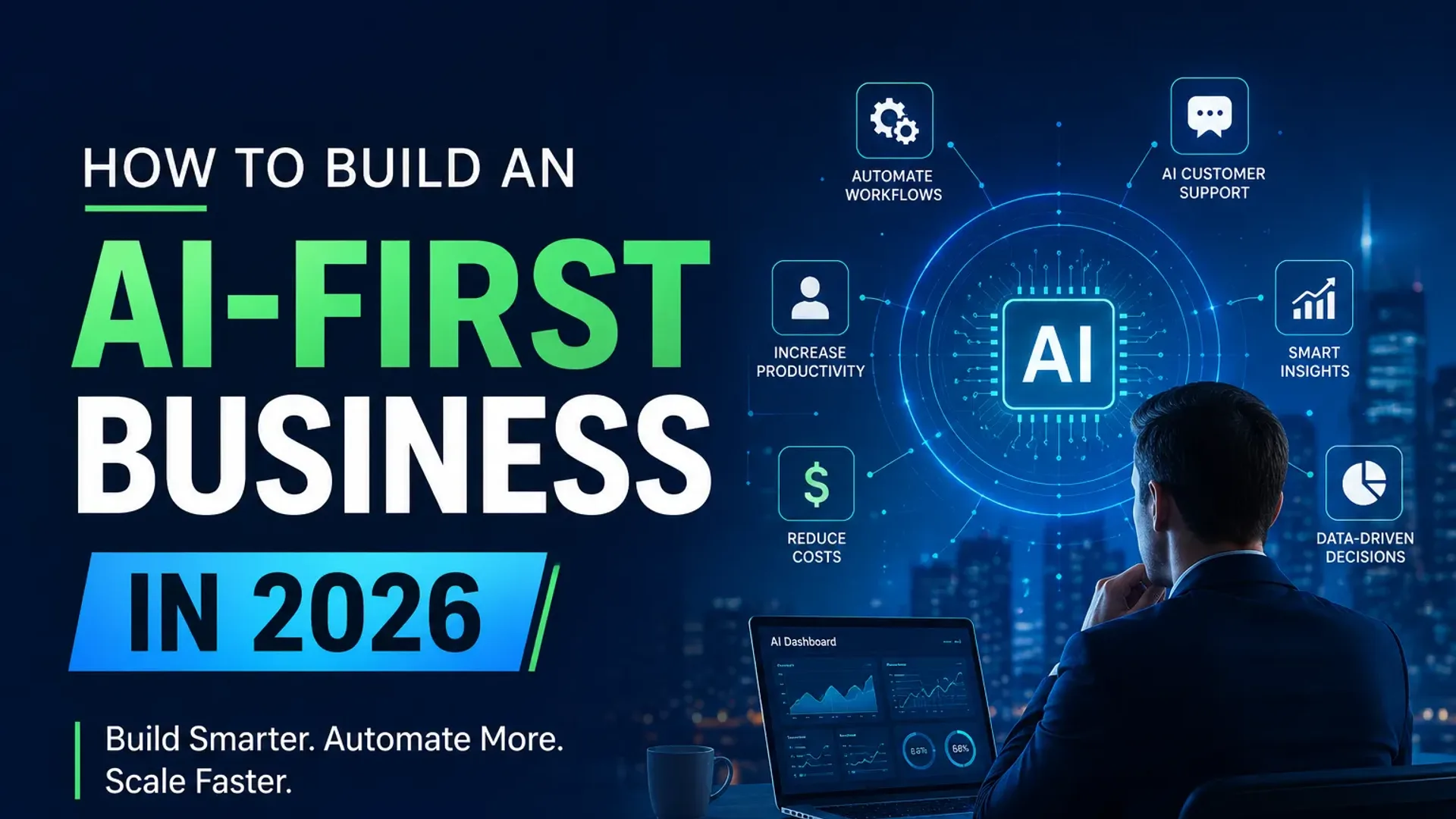
A few years ago, every business wanted a website.
Then everyone wanted a mobile app.
Today, every business wants AI.
The problem? Most companies are approaching AI the wrong way.
They're adding ChatGPT to their workflow, experimenting with a chatbot, or paying for a handful of AI tools. While these can be useful, they don't fundamentally change how the business operates.
An AI-first business takes a different approach.
Instead of asking, "Where can we use AI?" it asks, "Should a human even be doing this task in the first place?"
That mindset shift is what separates businesses that simply use AI from businesses that grow faster, operate more efficiently, and scale without dramatically increasing costs.
In this guide, we'll explore what an AI-first business really means, why it matters in 2026, and how you can start building one today.
What Is an AI-First Business?
An AI-first business is a company that designs its workflows around automation and artificial intelligence from the beginning, rather than treating AI as an add-on.
This doesn't mean replacing employees with software.
It means allowing AI to handle repetitive, predictable, and time-consuming tasks so people can focus on creative thinking, decision-making, and building relationships.
Imagine your business on a typical Monday morning.
Your team is:
- Replying to repetitive emails
- Updating spreadsheets
- Entering customer data into a CRM
- Creating meeting summaries
- Scheduling appointments
- Following up on leads
- Generating weekly reports
Now imagine if 70–80% of those repetitive tasks happened automatically.
That's what an AI-first business looks like.
Instead of hiring more people to manage growing workloads, you build systems that allow your existing team to accomplish more in less time.
Why 2026 Is the Turning Point
Artificial intelligence has become more accessible than ever.
What once required enterprise budgets and dedicated engineering teams can now be implemented by small businesses and startups.
This means your competitors no longer need massive resources to automate operations.
Whether you're running a marketing agency, healthcare practice, eCommerce store, or SaaS company, AI tools are becoming part of everyday business.
Companies that embrace automation today will be able to:
- Respond to customers faster
- Reduce operational costs
- Improve employee productivity
- Deliver better customer experiences
- Scale without hiring at the same pace
Businesses that delay adoption risk spending more time and money on manual work while competitors move faster with leaner teams.
AI-First Doesn't Mean AI-Only
One of the biggest misconceptions about AI is that it's here to replace people.
In reality, the most successful businesses use AI to support people—not replace them.
Think of AI as a highly efficient digital employee that never sleeps.
It can:
- Draft emails
- Organize information
- Answer common customer questions
- Generate reports
- Analyze data
- Search company documents
- Schedule appointments
But it still needs human oversight for strategy, creativity, relationship building, and important business decisions.
The goal isn't fewer people.
The goal is fewer repetitive tasks.
Start With Your Processes, Not Your AI Tools
This is where many businesses go wrong.
They subscribe to multiple AI tools before understanding what actually needs to be improved.
Buying software without fixing inefficient processes simply automates confusion.
Instead, map out how work currently flows through your business.
Ask yourself questions like:
- Which tasks are repeated every day?
- What activities consume the most employee time?
- Where do mistakes happen most often?
- Which tasks don't require human judgment?
Those answers become your automation opportunities.
Five Areas Every Business Should Automate First
1. Customer Support
Many businesses receive the same questions every day.
"What are your prices?"
"Can I schedule a consultation?"
"Where's my order?"
Rather than having employees answer these repeatedly, AI chatbots can provide instant responses 24/7.
For more complex issues, AI can collect customer information before transferring the conversation to a human representative.
Customers get faster responses, and your team spends less time answering repetitive questions.
2. Lead Qualification
Every new inquiry doesn't deserve the same amount of attention.
AI can automatically:
- Score incoming leads
- Categorize prospects
- Route inquiries to the correct salesperson
- Schedule meetings
- Send personalized follow-up emails
This ensures your sales team spends more time selling and less time organizing leads.
3. Internal Knowledge Management
Employees waste countless hours searching for information.
Company policies.
Training documents.
Project files.
Previous proposals.
Instead of asking coworkers or digging through folders, employees can simply ask an AI assistant questions and receive instant answers pulled from your company's knowledge base.
This dramatically reduces internal delays and improves productivity.
4. Administrative Work
Administrative tasks rarely create business growth.
Yet they consume hours every week.
AI can automate:
- Meeting summaries
- Calendar management
- Invoice generation
- Data entry
- CRM updates
- Document organization
- Expense categorization
Removing these repetitive tasks allows employees to focus on work that directly impacts customers and revenue.
5. Marketing Content
Content creation is often one of the biggest bottlenecks for growing businesses.
AI can assist with:
- Blog outlines
- Social media captions
- Email newsletters
- Ad copy
- Product descriptions
- SEO research
This doesn't eliminate the need for human creativity.
Instead, it speeds up the first draft so marketers can spend more time refining strategy and messaging.
A Real-World Example
Imagine a growing digital agency with eight employees.
Every week, the team spends time:
- Creating meeting notes
- Updating project management software
- Writing follow-up emails
- Preparing proposals
- Generating monthly reports
Each employee loses around five hours per week to administrative work.
That's roughly 40 hours every week across the company—the equivalent of one full-time employee.
By introducing AI-powered workflows, these repetitive tasks can be automated or significantly reduced.
The result?
The team gets an extra workweek every week without hiring anyone.
That's the real value of becoming AI-first.
Common Mistakes Businesses Make
Automating Broken Processes
If your workflow is already inefficient, AI won't magically fix it.
Document your processes first.
Simplify them.
Then automate.
Using Too Many AI Tools
It's easy to sign up for ten different AI platforms.
It's much harder to get employees to use them consistently.
Start with one or two tools that solve real business problems before expanding.
Ignoring Employee Training
Technology only delivers value when people know how to use it.
Invest time in helping your team understand why automation is being introduced and how it benefits their daily work.
When employees see AI as a productivity partner instead of a threat, adoption becomes much smoother.
How to Start Building an AI-First Business
You don't need a massive budget or an in-house AI team.
Start small.
Choose one repetitive workflow.
Measure the time it currently takes.
Implement automation.
Track the results.
Once you see measurable improvements, move to the next process.
Over time, these incremental improvements compound into a faster, leaner, and more scalable business.
The Future Belongs to Businesses That Move Faster
Every major shift in technology creates two groups of businesses.
The first group waits until change becomes unavoidable.
The second group adapts early and gains a competitive advantage.
AI is no different.
Businesses that embrace AI-first thinking today won't just save time.
They'll serve customers faster, make better decisions, reduce operating costs, and create more room for innovation.
The companies that thrive in 2026 won't necessarily have the biggest teams.
They'll have the smartest systems.
Final Thoughts
Building an AI-first business isn't about chasing the latest technology trend.
It's about removing unnecessary work, improving efficiency, and giving your team more time to focus on what humans do best.
Whether you're running a startup, a healthcare practice, an agency, or an established small business, the journey doesn't begin with buying another AI tool.
It begins by identifying the repetitive work that's slowing your business down.
Start there.
Automate one process.
Then another.
Before long, you'll have a business that's not only more efficient but also better prepared for the future.
Frequently Asked Questions
What is an AI-first business?
An AI-first business is a company that designs its operations around artificial intelligence and automation, allowing employees to focus on strategic and creative work instead of repetitive tasks.
Do small businesses need to become AI-first?
Yes. AI is no longer limited to large enterprises. Small businesses can use affordable AI tools to automate workflows, improve customer service, and reduce operating costs.
Will AI replace employees?
Not entirely. AI is best suited for repetitive, rules-based tasks, while employees continue to handle strategy, creativity, customer relationships, and decision-making.
What's the first process I should automate?
Most businesses see quick wins by automating customer support, lead management, appointment scheduling, data entry, or reporting.
Ready to Build an AI-First Business?
At Alternate, we help businesses move beyond basic AI tools by designing intelligent workflows, AI agents, and custom automation systems tailored to the way they operate.
Whether you want to automate customer support, streamline operations, or build an AI-powered workflow from the ground up, our team can help you implement solutions that deliver measurable results.
The future isn't about using more AI tools. It's about building a smarter business.
Tap the button and Google will show you our new articles more often — in Search, Top Stories and AI Overviews.
Have a project in mind?
Let’s turn it into an intelligent product. Book a free 30-minute discovery call.
Start your project →