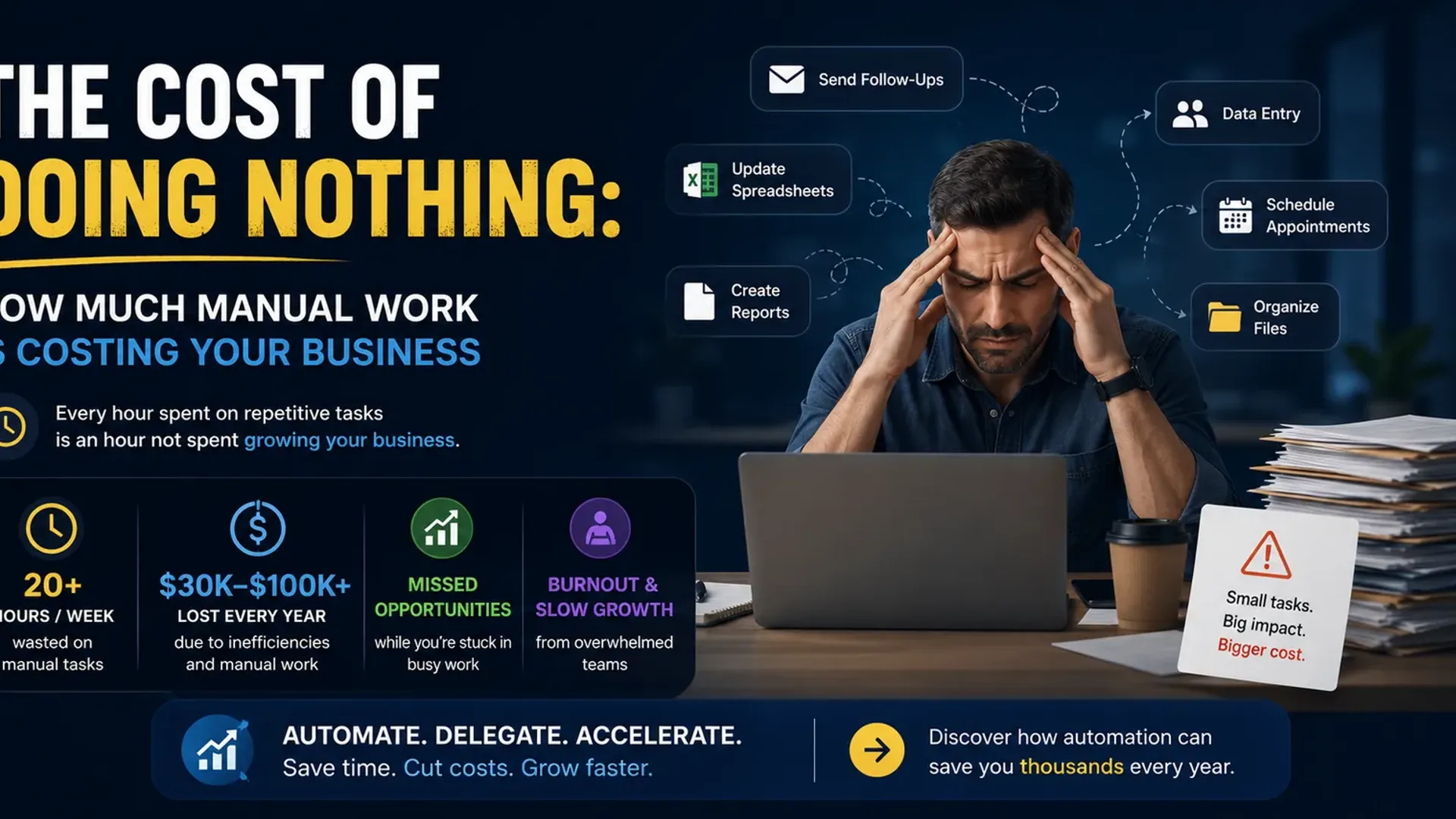
Most businesses don't realize they're spending $30,000–$100,000 per year on tasks that software could handle.
It doesn't show up as a line item. There's no invoice for it, no vendor to blame, no monthly charge to cancel. It hides inside salaries you're already paying — in the hours your team burns copying data between systems, chasing approvals, re-typing the same information into three different tools, and fixing the errors all that manual handling creates. You're paying for it whether you notice or not. That's what makes it dangerous: the cost of doing nothing feels like zero, right up until you actually do the math.
So let's do the math.
The Hidden Invoice You're Already Paying
Manual work doesn't announce itself. It accumulates quietly across every department, a few minutes here and a few minutes there, until it adds up to a full-time salary's worth of wasted effort. Here's where it usually hides.
Data entry and re-entry. A lead comes in through a form, gets typed into a spreadsheet, then re-typed into your CRM, then copied again into your invoicing tool. The same five fields, entered four times, by people you're paying $25–$50 an hour.
Chasing and following up. Manually sending reminder emails, following up on unpaid invoices, nudging team members for status updates. Work that has to happen, but that no human should be doing by hand.
Reporting. Someone spends every Monday morning pulling numbers from four sources into a spreadsheet to build a report that's outdated by Tuesday.
Approvals and handoffs. A request sits in someone's inbox for two days because the next person didn't know it was their turn. Multiply that delay across every process in the business.
Fixing mistakes. Manual processes produce errors — a wrong figure, a missed step, a duplicated record — and then someone has to find and fix each one. The error is expensive; the hunt for it is more expensive.
None of these tasks is dramatic on its own. That's exactly why they survive. They're too small to fight about and too constant to escape.
Let's Put a Number On It
Vague claims don't move anyone. Here's a concrete, conservative calculation you can run for your own business right now.
Take a single employee paid roughly $50,000 a year — about $24 an hour. Suppose just two hours of their day go to repetitive, automatable tasks: data entry, copying between tools, manual follow-ups, status chasing. That's not an extreme case; for many roles it's an underestimate.
- 2 hours/day × 5 days = 10 hours per week on automatable work
- 10 hours × ~50 working weeks = 500 hours per year
- 500 hours × $24/hour = $12,000 per year — from one employee
Now scale it. A team of five in that situation is burning $60,000 a year. A team of ten, $120,000. And this only counts the direct wage cost. It ignores the slower invoicing, the leads that go cold while someone gets around to them, the errors that reach customers, and the simple fact that your most capable people are spending a quarter of their week on work that creates no value.
That's the real shape of the number in the hook. It's not hype — it's just arithmetic most businesses never sit down to do.
The Costs That Don't Show Up in the Spreadsheet
The wage math is only the part you can see. The deeper costs of manual work are harder to quantify but often hurt more.
Opportunity cost. Every hour your team spends on busywork is an hour they're not spending on customers, strategy, or growth. You didn't hire skilled people to copy and paste. When they're stuck doing it anyway, you're paying premium salaries for clerical output.
Speed. Manual processes move at human pace, and humans need sleep, lunch, and weekends. Automated ones run instantly, around the clock. In a market where the first business to respond to a lead usually wins it, that lag has a direct revenue cost.
Errors and risk. Humans doing repetitive work make mistakes — not because they're careless, but because repetition breeds inattention. A mistyped invoice, a missed compliance step, or a dropped follow-up can cost far more than the task ever did.
Morale and turnover. Talented people quietly resent doing robotic work. It's a leading reason good employees disengage and leave — and replacing them costs a fortune. Automation doesn't just save hours; it gives your team back work worth doing.
Scalability. With manual processes, growth means proportional pain: more volume requires more headcount doing the same grind. Automated processes absorb growth without breaking. The business that automates can take on twice the work without doubling its costs. The one that doesn't, can't.
What Automation Actually Does About It
The promise of workflow automation is simple: software handles the repetitive, rule-based work so your people don't have to. The benefits compound quickly.
The lead that used to be entered four times is now entered once and flows automatically into every system. The follow-up that someone used to remember to send goes out on its own, on schedule, every time. The Monday-morning report builds itself and lands in your inbox. The approval that sat for two days routes instantly to the right person with a nudge attached. The errors that came from manual handling largely disappear, because the data only gets touched once.
This is where business automation ROI becomes obvious. A workflow that costs a few hundred dollars a month to run can replace thousands of dollars a month in manual labor — and unlike an employee, it never forgets, never gets tired, and scales for free. The automation cost savings aren't a one-time win; they recur every single month, and they grow as your volume grows.
The point isn't to replace your team. It's to stop wasting them. Automate the work that's beneath them, and redirect those hours toward the work only humans can do — judgment, relationships, creativity, growth.
The Question That Matters
Here's the uncomfortable truth about the cost of doing nothing: it's not stable. It's not a fixed tax you can budget around and ignore. It compounds. Every month you delay, the wasted hours keep accruing, the errors keep happening, the opportunities keep slipping, and the gap between you and the competitors who did automate keeps widening.
The businesses that win aren't necessarily the ones with the best product or the biggest budget. Increasingly, they're the ones who freed their people from busywork and pointed that energy at growth instead.
So the real question isn't "Can we afford to automate?" It's "Can we afford to keep paying for work that software could do for a fraction of the price?"
Find Out What Manual Work Is Actually Costing You
You don't have to guess at the number. The fastest way to find out is to look at where your team's hours actually go — which tasks are repetitive, which are automatable, and what those hours are costing you each year.
That's exactly what an automation audit does. We map your current workflows, identify the highest-cost manual tasks, and show you precisely where automation would pay for itself — usually within the first few months. No commitment, no obligation: just a clear picture of the invoice you're already paying, and how much of it you could stop paying.
Ready to see the number for your business? Book your Automation Audit and we'll show you exactly where your hours — and your money — are going.
Tap the button and Google will show you our new articles more often — in Search, Top Stories and AI Overviews.
Have a project in mind?
Let’s turn it into an intelligent product. Book a free 30-minute discovery call.
Start your project →