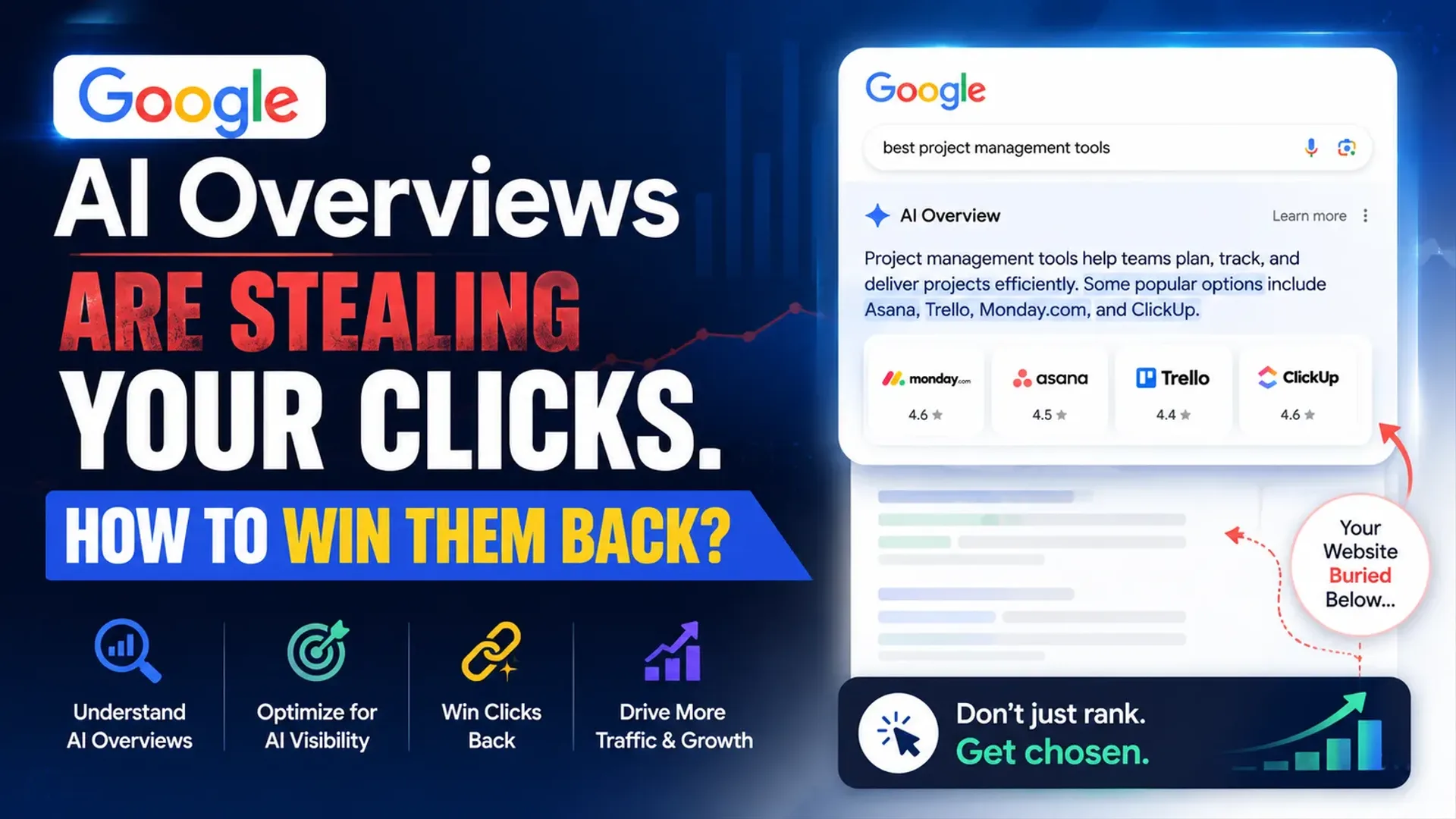
You did everything right. You ranked. And your traffic still slid. If that describes the last year of your analytics, you are not imagining it — Google's AI Overviews now answer many queries directly at the top of the page, and a searcher who gets their answer there has no reason to click. The link is still there. The click is gone.
This is the zero-click reality maturing in real time. It is tempting to panic or to declare SEO dead. Both reactions are wrong. AI Overviews are brutal on some queries and almost irrelevant on others. The winners are not fighting the format — they are shifting effort toward the searches that still send clicks and still convert.
Here is how to adapt without torching what already works.
Understand which clicks you actually lost
AI Overviews are strongest on informational, top-of-funnel questions with a clean, factual answer: definitions, quick how-tos, simple comparisons. Those are exactly the queries where a summary satisfies the searcher completely. If your traffic leaned heavily on that kind of content, you felt the hit hardest.
What AI Overviews handle poorly — and where clicks survive — tends to be:
- Commercial and transactional intent, where people want to choose, buy or hire, not just learn.
- Nuanced or subjective questions where one tidy paragraph is not credible.
- Queries needing tools, calculators or interaction a summary cannot replicate.
- Fresh, evolving or local topics where searchers want to verify a live source.
Stop mourning the clicks AI took. Start owning the clicks it can't.
Reallocate toward bottom-funnel, commercial intent
The single highest-leverage move is to shift content and optimization toward queries that sit closer to a decision. Someone searching "best X for Y," "X vs Z pricing," or "how to hire an X" is not looking for a one-line answer — they are looking for someone to trust. Those pages still earn clicks, and those clicks are worth more.
Build genuinely useful decision content
Comparison pages, buyer's guides, pricing explainers and honest "who this is right for" pages convert far better than another definitional blog. Route this energy into the pages tied to what you sell — your digital marketing, social media marketing and brand marketing service pages — so the traffic that arrives is ready to act.
Make the remaining click irresistible
When you do win a click, earn the next step. Strong page design, fast load, clear value and an obvious call to action turn a scarce visit into a lead instead of a bounce.
Target queries AI Overviews answer badly
Not every keyword is a lost cause. Do a deliberate audit: search your priority terms and see which trigger an AI Overview that fully satisfies the searcher. Then reweight.
- Lean into long-tail, specific and intent-rich queries over broad definitions.
- Prioritize topics that demand experience, opinion or original data — things a summary cannot fake.
- Create interactive assets like a free website audit that deliver value only a click can unlock.
Build brand and community so demand isn't rented
The deeper lesson of the AI Overviews era is that traffic you rent from a search box is fragile. Traffic driven by people who already know your name is not. When someone searches for you directly, no AI summary stands between you and the click.
- Invest in brand. A recognizable point of view earns branded searches that AI Overviews can't intercept.
- Own an audience. Email lists, communities and social followings let you reach people without a search intermediary.
- Be worth returning to. A useful resource hub turns one-time visitors into a habit.
This is why smart teams treat SEO and audience-building channels as one system rather than competing budgets. The channel that survives every algorithm change is the one where people seek you by name.
Capture the click that remains
Because clicks are scarcer, each one has to work harder. Tighten the whole path from result to conversion.
- Write titles and descriptions that promise something the AI summary did not deliver.
- Answer the searcher's question and then go deeper, so the click clearly beats the summary.
- Capture the visitor before they leave — a relevant offer, a resource, a reason to share their email.
- Remove friction: fast pages, clean design, one obvious next action.
Use structured content to appear inside the Overview itself
Losing the click is one problem. Being invisible inside the AI Overview is a bigger one. When an Overview appears, it often cites the sources it drew from — and being one of those cited sources keeps your brand in front of the searcher even on a zero-click query. That visibility builds recognition that later converts into branded searches and direct visits.
To earn a place inside the summary, make your content easy for the system to lift:
- Answer clearly and early. State the core answer near the top, in a compact, self-contained way.
- Structure for extraction. Descriptive headings, short paragraphs and lists give the system clean units to quote.
- Be demonstrably credible. Original data, real expertise and third-party corroboration make you a source worth citing.
Treat the Overview not only as a threat to clicks but as a new placement to win. If a searcher keeps seeing your name inside the answers, your brand compounds even when the click does not come today.
Rebuild your measurement around impressions, not just clicks
The old scoreboard — sessions and clicks — undercounts your real impact in an AI-mediated world. A searcher can absorb your brand, your point of view and your recommendation inside an Overview and never register as a click. If you judge success only by traffic, you will kill the very content that is building demand.
Widen the lens:
- Track branded search growth as a proxy for the awareness Overviews create.
- Watch direct and referral visits, not just organic sessions.
- Monitor which of your pages get cited in AI answers for your priority queries.
- Tie channels together so a decline in one surface and a rise in another read as a shift, not a loss.
This is why treating SEO in isolation is a trap. When it works alongside performance marketing and brand, a query that no longer sends a click can still produce a customer weeks later through a different door.
The bottom line
AI Overviews did not kill search — they changed which searches are worth chasing. Give up the top-funnel clicks a summary now owns, and pour that effort into commercial intent, brand demand and owned audiences where clicks still flow and still convert. Then make every surviving click count. The businesses that adapt this way will quietly gain ground while competitors keep grieving traffic that was never coming back.
Should I stop doing SEO because of AI Overviews?
No. You should redirect it. Informational, easily-summarized queries lose value, but commercial-intent, decision-stage and brand searches still drive clicks and revenue. SEO is shifting, not disappearing.
How do I know if AI Overviews are hurting a specific page?
Look for pages that still rank well but have lost clicks and click-through rate. Then search those queries yourself. If an AI Overview fully answers the question, that page's role should shift toward supporting deeper, higher-intent content rather than chasing the click directly.
What is the safest long-term defense?
Brand and owned audience. When people search for you by name or come through email, community and referrals, no AI summary sits between you and them. That demand is the one asset algorithm changes can't tax.
Losing clicks you used to count on? Book a free call and we will audit where AI Overviews are hurting you and build a plan to win back traffic that actually converts.
Related reading: ranking in AI search · turning traffic into customers
Tap the button and Google will show you our new articles more often — in Search, Top Stories and AI Overviews.
Have a project in mind?
Let’s turn it into an intelligent product. Book a free 30-minute discovery call.
Start your project →