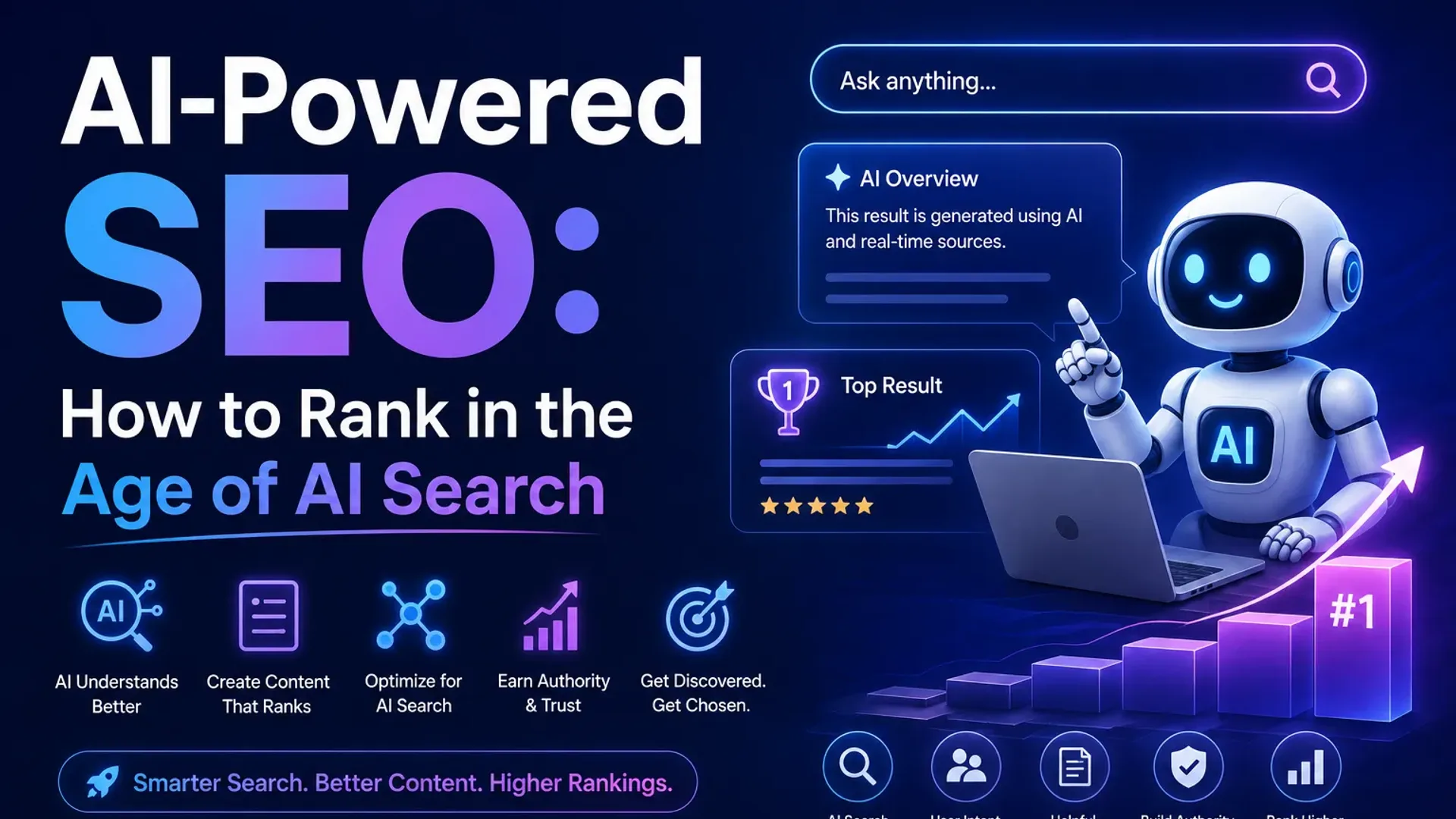
Picture this: a business owner opens Google to check how they rank for their main service. The top of the page is taken up by a paragraph of AI-generated text that answers the question completely — no need to click anything. Their site is nowhere in sight, even though they spent two years building it up. They close the laptop and wonder if SEO is finished.
That panic is understandable. But it's also based on a partial picture of what's actually happening. AI search — Google's AI Overviews, ChatGPT Search, Perplexity, and similar tools — is changing how traffic flows. Some of it will not come back. But the businesses that understand what's actually shifting, rather than reacting to headlines, are in a better position than they think.
This post is an honest look at AI-powered SEO: what's getting harder, what's getting more important, and what you should do differently starting this week. No cheerleading. No "SEO is dead" catastrophising either. Just a clear-eyed view of the new rules.
What AI Search Is Actually Doing to Your Traffic
Google's AI Overviews (formerly called SGE — Search Generative Experience) generate a summarised answer at the top of the results page for many informational queries. Perplexity and ChatGPT Search do the same, often without the traditional blue links below. These are called "zero-click" results because the user gets what they need without visiting any website.
Early data from 2024–2025 shows that zero-click results are highest for simple informational queries — "what is X", "how does Y work", "best time to do Z". For these, organic click-through rates have dropped noticeably. If your traffic was built on thin FAQ pages or definitional content, that traffic is genuinely at risk.
But here's what the headlines miss: not all queries go zero-click. When someone searches "digital marketing agency in Dubai" or "custom website for my restaurant", they are not getting an AI summary — they need to see options, compare, and choose. Commercial and local queries still drive clicks. Comparison queries still drive clicks. Queries where trust matters (lawyers, accountants, medical, financial) still drive clicks. The picture is more nuanced than "AI killed SEO".
The question is not whether AI search changes things. It does. The question is whether your site is the kind of source AI wants to cite — or the kind it ignores entirely.
The Real Shift: From Keywords to Authority
Traditional SEO rewarded volume and technical optimisation — produce enough content, get enough links, tick the right technical boxes, and you could rank. That model was already fraying. AI search accelerates its end.
What AI Overviews and answer engines actually pull from are sources they deem authoritative and trustworthy. Google's own documentation talks about E-E-A-T: Experience, Expertise, Authoritativeness, and Trustworthiness. This was guidance before AI Overviews existed; now it is the filter that determines whether your site gets cited in an AI answer or gets ignored entirely.
What "authority" actually means in practice
It means your content demonstrates real, first-hand knowledge — not a regurgitation of what five other sites already said. A plumber who writes a post about the three most common pipe failures they see in older Sydney homes, with specific observations from actual jobs, is demonstrating experience. A generic "10 signs you need a plumber" list that could have been written by anyone demonstrates nothing.
It means your site has a coherent, recognisable point of view. Brands that take positions — "here's why we recommend X over Y in most cases, and here's when we'd say the opposite" — tend to attract links, mentions, and citations naturally. Sites that produce content designed purely to capture keywords tend to look interchangeable.
It means your business exists credibly off your own website. Mentions in industry publications, a Google Business Profile with genuine reviews, real social media presence, your team's professional profiles — these signals tell AI systems (and Google's ranking algorithm) that your site represents a real entity, not a content farm.
Original Data and First-Hand Insight Are Now SEO Assets
Here is something that has quietly become more valuable than almost any keyword tactic: information that only you can provide.
If you run a marketing agency and you publish a post analysing 50 campaigns you ran last year — what worked, what didn't, which channels surprised you — that data does not exist anywhere else. AI cannot summarise it from other sources. Journalists and bloggers who cover your space will link to it. Other sites will cite it. And when someone asks an AI search engine a question your data speaks to, there is a reasonable chance your post gets cited as the source.
This is not theoretical. Perplexity and ChatGPT Search already cite specific pages when they answer questions. Becoming a citation source for AI answers is the new backlink — and the pathway to it is the same: produce something genuinely useful and original that no one else has.
Practical examples of original content that earns citations:
- Proprietary surveys of your customer base ("We asked 200 e-commerce founders what they wished they'd done differently in year one")
- Anonymised case data from your own client work with real numbers
- Documented experiments ("We tested three different checkout flows on the same site for 60 days — here are the results")
- Contrarian takes backed by evidence ("Everyone says post three times a day on LinkedIn — we found the opposite for B2B service businesses")
Structure and Clarity Are More Important Than Ever
AI systems that generate summaries pull from pages that are well-structured and easy to parse. This is actually good news if your content is already organised — it just raises the bar for clarity.
What good structure looks like for AI-era SEO
Use descriptive H2 and H3 headings that answer a question directly, not clever or vague ones. "How long does SEO take to work?" beats "The timeline question" every time. AI models scan headings to decide what a page is about and what passages are relevant to a given query.
Answer the core question early. The old trick of burying your answer halfway through a 2,000-word post to keep people reading longer no longer serves you. If your answer is at the top, clear and specific, you're more likely to be pulled into an AI summary — with your site cited as the source.
Use structured lists for steps, comparisons, and feature breakdowns. These are easier for AI to extract and render in an answer. They are also easier for humans to skim and return to, which improves time-on-site signals.
Write genuinely complete answers to the questions you target. Thin pages that gesture at a topic without actually resolving it are being filtered out faster than before. If your page on "how to choose an SEO agency" doesn't actually help someone make that decision, it should not exist.
How to Use AI to Help With SEO (Without Creating Slop)
There's an uncomfortable irony in AI-powered SEO: the businesses most tempted to use AI to produce content at scale are creating exactly the kind of generic, sourceless text that AI search deprioritises. Meanwhile, businesses that use AI tools intelligently — to support their thinking rather than replace it — are pulling ahead.
Here is what that actually looks like:
Research and gap analysis
AI tools are excellent for mapping what questions exist around a topic and finding content gaps in your competitors' coverage. Use them to plan, not to draft. Ask ChatGPT or Claude to list every question a potential customer might have before buying your service — you'll get a smarter editorial calendar than any keyword tool alone.
Drafts as scaffolding, not finished product
If you use AI to draft content, treat the output as a first skeleton — then add your own experience, opinions, and data. The test: does this page contain something only your business could have written? If the answer is no, it belongs in a drawer, not on your site.
Optimising existing content
AI can review a page you've already written and flag where structure could be clearer, questions go unanswered, or headings could be more descriptive. That's where it adds real value without compromising originality.
Publishing mediocre AI content at volume is not an SEO strategy. It is a reputation risk. One page that demonstrates genuine expertise outranks ten that demonstrate none.
Brand Search and Direct Mentions Matter More Now
One of the quieter effects of AI search is that brand recognition is becoming an indirect SEO factor. When enough people search for your business name, or mention your brand in contexts AI systems can read (reviews, publications, forums), the AI starts to treat your brand as a known, trusted entity. This affects how likely you are to be cited in AI-generated answers.
This is a reason to invest in brand marketing alongside technical SEO. A business that is well-known in its niche — that gets mentioned in trade publications, that has a reputation people can verify — is more search-resilient than one with perfect keyword coverage but zero brand awareness.
It is also a reason to take your Google Business Profile seriously, encourage genuine client reviews, and maintain a professional presence on LinkedIn and whatever platforms your clients use. These are not social media vanity metrics. They are trust signals that AI systems read.
Technical SEO Still Matters — It's Just Table Stakes Now
None of the above replaces the basics. A slow site, broken mobile experience, or pages that can't be crawled are still disqualifiers. They just no longer differentiate you — they just stop you from being excluded. If you're not sure whether your site has technical problems that are limiting your visibility, an independent website audit will surface them quickly.
Specific technical factors worth checking in 2025 and beyond:
- Core Web Vitals — page speed and layout stability, particularly on mobile
- Structured data (Schema markup) — helps search engines understand what your page is about and can make you eligible for rich snippets
- Crawlability — confirm your important pages are indexed and not accidentally blocked
- Internal linking — a clear site structure helps both crawlers and human visitors
If your site was built on a cheap builder and hasn't had a technical review in two years, that's worth fixing before investing more in content. You can read more about the signals that stop your site from converting — many of them are the same ones that suppress rankings.
Actionable Takeaways
- Audit your existing content for originality. Flag every page that could have been written by someone with no real experience of your business. Rewrite those pages with genuine insight, data, or opinion.
- Identify one original data source you control. A survey, a set of anonymised client results, a documented experiment. Publish it in a format that earns citations.
- Restructure your highest-traffic pages for clarity. Move the answer up. Use descriptive H2/H3 headings. Make lists genuinely useful, not padding.
- Check whether you have an E-E-A-T problem. Does your site have visible author bios? Do those authors have verifiable credentials or experience? Is there an "About" page that establishes who you are?
- Build your off-site presence intentionally. Pursue one or two industry publication mentions per quarter. Keep your Google Business Profile current. Encourage reviews from clients who are genuinely satisfied.
- Use AI tools for research and structure, not finished content. Every page that goes live should pass the "only we could have written this" test.
- Get a technical audit done if you haven't had one in the past 12 months. Fix what's broken before pouring more into content.
Frequently Asked Questions
Is SEO dead because of AI search?
No. Some informational traffic will shift to zero-click answers, but search-driven discovery of businesses is not going away. Commercial intent queries, local searches, and comparisons still drive clicks. The businesses hurt most are those whose SEO relied on thin, interchangeable content. Genuine expertise is more valuable now, not less.
Can my site become a source cited by AI Overviews or ChatGPT?
Yes. AI systems pull from pages they deem authoritative and well-structured. Original content with clear structure, genuine expertise, and external trust signals — reviews, mentions, backlinks from credible sources — improves your chances of being cited. There is no guaranteed formula, but the path is the same as always: earn trust.
How does Google decide what goes into an AI Overview?
Google hasn't published a full technical breakdown, but evidence points to existing ranking signals (authority, relevance, E-E-A-T) combined with page structure. Pages that clearly answer the query with structured headings and a track record of trust are more likely to be included. Structured data (Schema markup) also helps for certain query types.
Should I stop targeting informational keywords and focus only on commercial ones?
Not entirely. Informational content still builds authority and puts your brand in front of people at the research stage. Be more selective — focus on topics where you can add genuine insight, not ones where a generic answer will do. Track whether those pages contribute to enquiries over a 6–12 month window.
How much of my SEO work should use AI tools?
AI tools are useful for research, keyword gap analysis, content briefs, and structural review. They should support your thinking, not replace it. The test: does the final page contain something only your business could have produced? If the page reads like a confident summary of what everyone else already said, it will perform like one.
How long before I see results from changing my SEO approach?
Expect 3–6 months before content changes show meaningful ranking movement, longer for compounding authority effects. Building genuine expertise and a recognisable brand pays dividends across channels — it is more durable than chasing algorithm updates.
The Honest Bottom Line on AI-Powered SEO
AI search is not a cliff edge. It's a filter — one that has always existed in principle but is now harder to game. The sites that will thrive are the ones that were actually worth visiting in the first place: built with real expertise, structured for human clarity, and trusted by enough people that the algorithm notices.
If your site is currently built on content that could have come from anywhere, AI search is the pressure that will expose it. But if you are willing to invest in original thinking, real authority, and a coherent brand presence, the same shift that worries your competitors becomes an opportunity to pull ahead of them.
At Alternate, we work with businesses on exactly this — the strategy behind what to create, how to build authority, and how to structure a site that search engines and real customers trust. If you want a clear picture of where you stand and what to do next, start a conversation with our team. Or if you'd prefer a technical baseline first, our free website audit is a good place to begin.
SEO isn't dead. It just got less forgiving. That's actually fine, if you're building something worth finding.
Tap the button and Google will show you our new articles more often — in Search, Top Stories and AI Overviews.
Have a project in mind?
Let’s turn it into an intelligent product. Book a free 30-minute discovery call.
Start your project →