How to Get Your Business Recommended by ChatGPT, Perplexity & Google AI Overviews (2026 GEO Playbook)
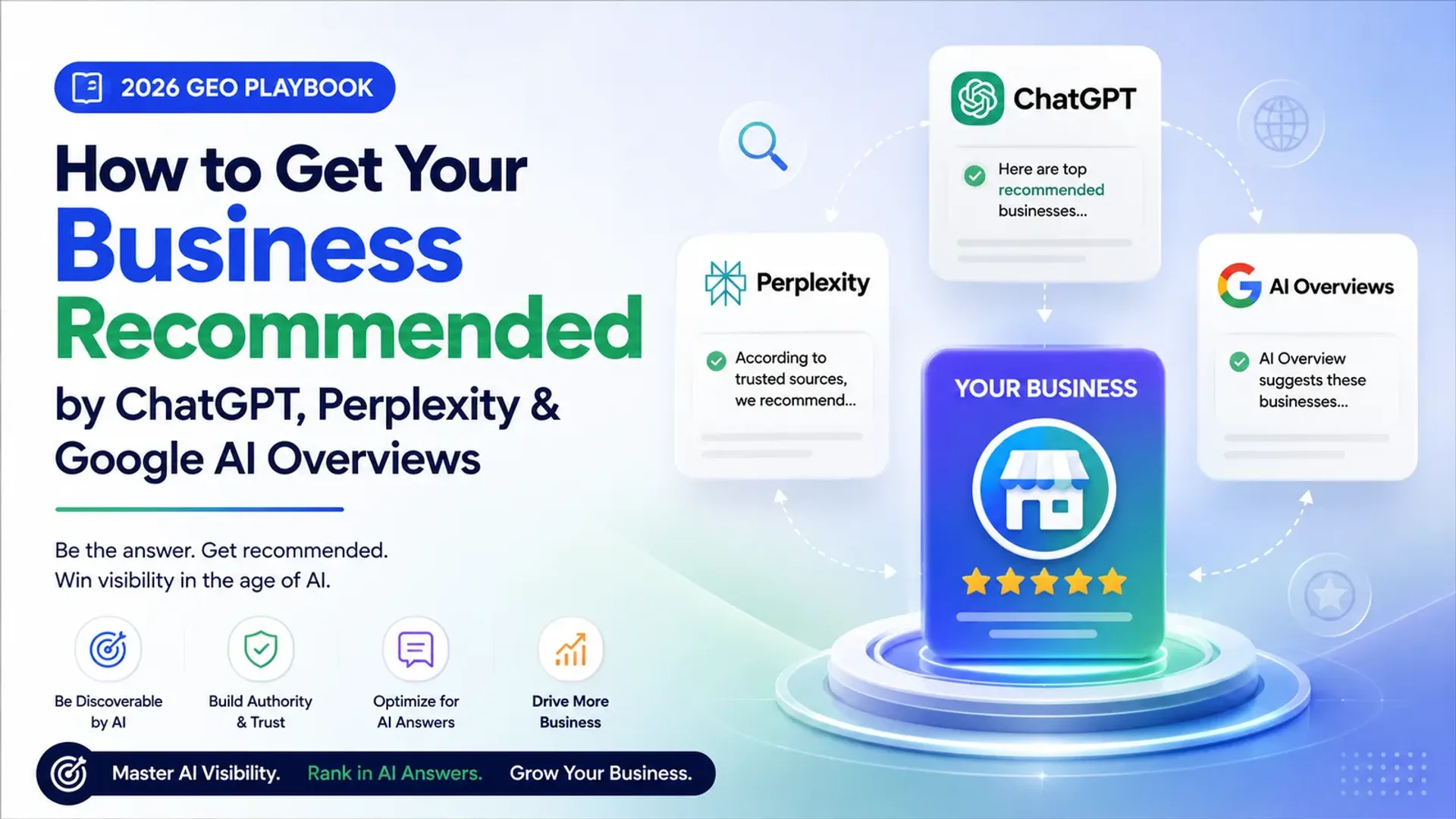
A growing share of your future customers will never see a list of ten blue links. They will ask ChatGPT for the best agency in their category, ask Perplexity to compare vendors, or read a Google AI Overview that answers their question before they scroll. In each of those moments, one thing decides whether you exist: whether the model names you.
This is the discipline people now call Generative Engine Optimization (GEO) or Answer Engine Optimization. It is not a rebrand of SEO, and it is not about ranking a page. It is about becoming the trusted, quotable entity that AI systems reach for when someone asks a buying question. The good news is that the levers are concrete and largely within your control.
Here is the playbook we use to make brands the answer, not just a result.
Understand how AI assistants actually choose who to recommend
Large language models do not "visit" your website in real time the way a shopper does. They draw on what they learned during training, and increasingly on live retrieval from the web when a question needs fresh information. To be recommended, you need to be present in both layers: baked into the model's understanding of your category, and easy to retrieve and quote right now.
Three signals do most of the heavy lifting:
- Clarity — the model can plainly understand what you do, who you serve, and where you operate.
- Corroboration — other credible sources say the same thing about you, so the model treats it as fact rather than marketing.
- Quotability — your content is structured so a machine can lift a clean, self-contained answer from it.
Ranking gets you a click. Being quotable gets you the recommendation itself.
Build a strong, consistent entity
AI models think in entities, not keywords. Your company is an entity, and the model wants a confident, consistent picture of it. Fragmented or contradictory information makes you a weak entity the model will avoid recommending.
Nail your own "about" surface
Your site should state, in plain language, exactly what you offer and to whom. A clear services architecture helps enormously here — pages like web development, UI/UX design and generative AI development that each define one capability crisply are far easier for a model to parse than a single vague page.
Stay consistent everywhere else
Your name, description and category should match across your website, business profiles, review platforms and directories. Contradictions dilute the model's confidence. Consistency compounds it.
Write content AI can lift and quote
Models favor content that answers a question completely in a compact, self-contained chunk. If a reader would have to piece your answer together from five scattered paragraphs, a model will skip you for a competitor who said it in three tight sentences.
- Lead with the answer. State the conclusion first, then justify it. Do not bury it under 400 words of throat-clearing.
- Use clear structure. Descriptive headings, short paragraphs and lists give machines clean units to extract.
- Add specifics. Concrete steps, defined terms and clear comparisons are more quotable than generic adjectives.
- Answer the real questions. Cover the comparisons, objections and "how do I choose" queries your buyers actually ask.
This is exactly why a well-planned content hub outperforms a pile of disconnected posts: it lets you own an entire topic cluster in a way both readers and models understand.
Earn corroboration from sources AI trusts
Models weight independent, third-party mentions heavily, because you saying you are great is expected — others saying it is evidence. To be recommended, you need to be talked about on sites the model already trusts.
- Reviews and ratings on established platforms, kept current and genuine.
- Editorial mentions in industry publications, roundups and "best of" lists.
- Community presence where your buyers gather and where opinions get indexed.
- Partnerships and directories that place your name alongside category peers.
You do not need to fake this. You need to earn it deliberately — through genuinely useful work, real relationships and PR-minded outreach. A strong, verifiable body of work gives journalists and reviewers something concrete to point to, which is what turns a pitch into a citation.
Add structure machines can read
Beyond the words, give machines a scaffold. Clean, semantic HTML, sensible heading hierarchy and structured data help systems understand what your page is about and which parts answer which question. Fast, accessible, well-built pages are easier to crawl and interpret — another reason technical site quality and thoughtful information design pay off in the AI era, not just the human one.
Turn on AI conversation, not just AI search
Being cited in an answer is powerful, but you can also meet buyers who prefer to converse rather than search. Many customers now expect to ask questions and get instant, accurate replies on your own turf. An assistant trained on your real offering lets you capture that intent directly, and it reinforces the clarity signals that help models understand you elsewhere. Done well, an AI chatbot both serves visitors and sharpens your entity, forcing you to define in plain language exactly what you do. If you want to experiment, our AI tools and build teams can help you deploy it without guesswork.
Measure the right things
Old dashboards will not tell you if this is working. Track new signals:
- Whether you appear when you ask ChatGPT, Perplexity and Google's AI Overviews the buying questions in your category.
- Referral traffic arriving from AI assistants and answer engines.
- Mentions and citations of your brand across the sources models rely on.
- Branded search demand — a leading indicator that people are hearing your name inside AI answers.
The bottom line
Getting recommended by AI is not a trick. It is the reward for being a clear, well-corroborated, genuinely useful entity that is easy to quote. Define what you do with precision, earn credible third parties to vouch for you, structure your content so a machine can lift a clean answer, and make sure your name is consistent everywhere it appears. Do that, and you stop competing for a scroll position and start becoming the answer.
Is GEO different from SEO?
They overlap but are not the same. SEO optimizes a page to rank in a list of links. GEO optimizes your entire presence so AI systems understand, trust and quote you when they generate an answer. Strong SEO fundamentals help, but GEO adds entity clarity, corroboration and quotability as first-class goals.
How long does it take to get recommended by AI assistants?
It varies by category and starting point. Retrieval-based surfaces like Perplexity and Google AI Overviews can reflect new, credible content relatively quickly, while a model's baked-in knowledge shifts more slowly. Consistency and third-party corroboration are what accelerate it.
Can we control what AI says about us?
Not directly, but you strongly influence it. By publishing clear information, earning credible mentions and correcting inaccurate sources, you shape the raw material these systems learn from and retrieve.
Want to become the business AI assistants recommend? Book a free call and we will map out a GEO plan tailored to your category, your buyers and the questions they are already asking.
Related reading: AI-Powered SEO · SEO for business owners
New to the terminology? Start with the short explainer — what generative engine optimization is — then work this playbook.
Tap the button and Google will show you our new articles more often — in Search, Top Stories and AI Overviews.
Have a project in mind?
Let’s turn it into an intelligent product. Book a free 30-minute discovery call.
Start your project →