Conversion Rate Optimization: How to Get More Sales From the Traffic You Already Have
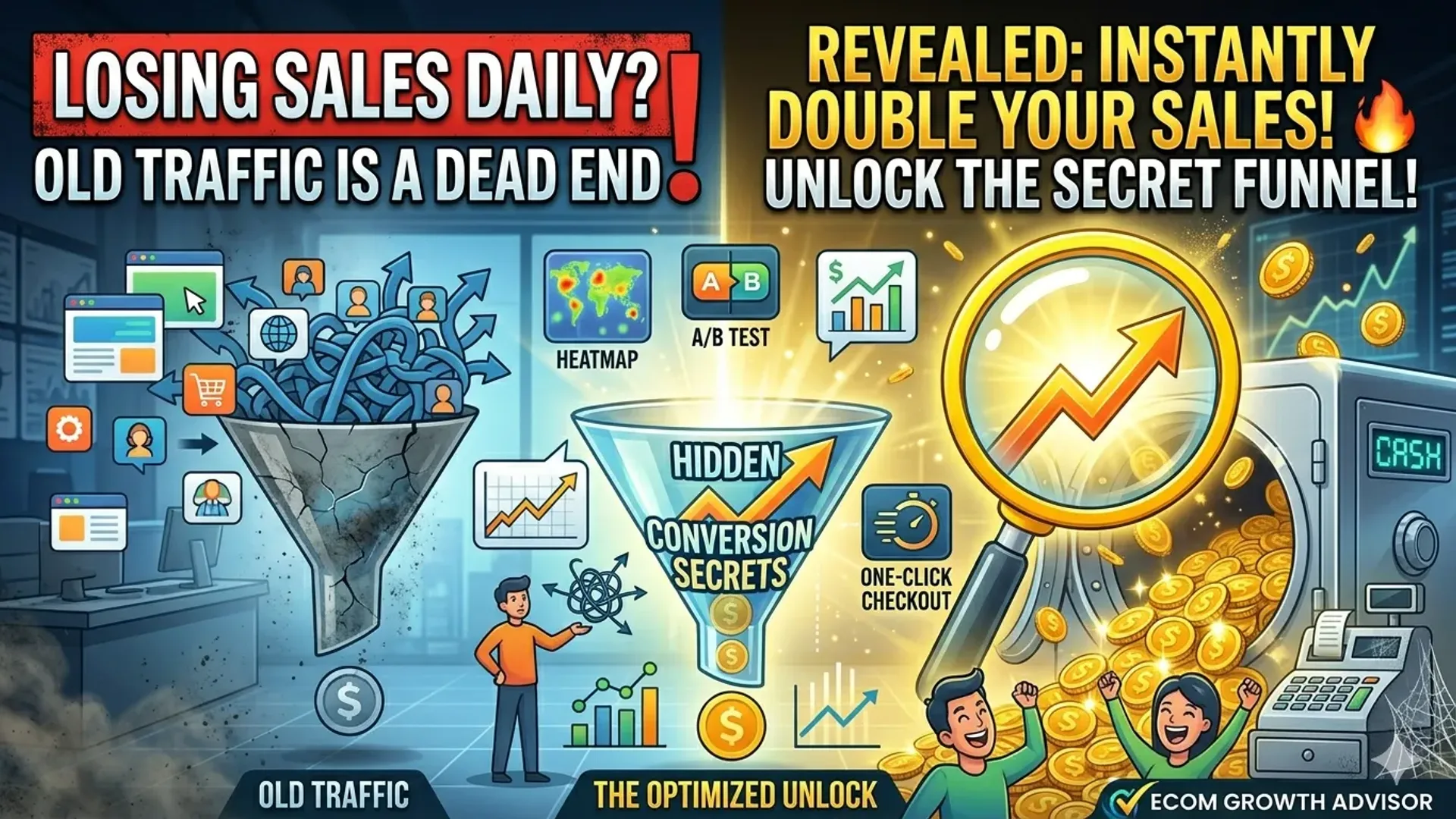
Sarah runs an e-commerce store selling handmade leather goods. Last year she spent $4,000 on Google Ads, doubled her traffic, and watched her revenue go up by about 12%. She came to us frustrated, convinced the problem was the platform, the targeting, the algorithm — something out there. When we looked at her checkout flow, we found a form with eleven fields, a shipping cost that only appeared on step three, and a mobile layout where the "Buy Now" button sat below the fold. She was pouring water into a bucket with holes in the bottom.
That's the maths most business owners miss. If 2% of your visitors buy today, doubling your traffic gets you 4% buying — but it costs you the same again in ad spend, content effort, or SEO time. Fix the conversion rate to 4% first, and suddenly that same traffic budget doubles your revenue without spending another cent on acquisition. The leak multiplies everything else.
Conversion rate optimization — CRO for short — is simply the discipline of finding those leaks and fixing them, one at a time. It's not magic, and it's not a one-time project. But it is, pound for pound, the highest-leverage activity most growing businesses ignore. This guide walks you through how to think about it, how to measure what's actually happening, and the concrete changes that move the needle fastest.
The Leak-Fixing Mindset (Not a Growth Hack)
The phrase "conversion rate optimization" sounds technical, which puts people off. Strip it back: your website is a path from stranger to customer. At every step, some percentage of people keep walking, and the rest leave. CRO is the process of asking why people leave and removing the reasons one by one.
That mindset shift matters because it changes what you look for. You stop asking "how do I get more people here?" and start asking "what's stopping the people already here from taking the next step?" Those are completely different questions, and they lead to completely different actions.
Traffic is a volume problem. Conversion is a friction problem. You can't solve friction by adding volume.
The other shift worth making: CRO is not about tricking people. The best conversion improvements come from removing genuine obstacles — unclear messaging, unexpected costs, confusing navigation, a form that asks for things you don't actually need. When you make it easier for the right customer to say yes, everyone wins.
Step One: Measure What's Actually Happening
You can't fix a leak you haven't found. Before you change a single button colour, spend a week properly understanding your current numbers.
Define your conversion
This sounds obvious but is often skipped. What counts as a conversion for your business? A purchase, a form submission, a phone call, a newsletter signup, a booking? Pick one primary conversion for each page or funnel, and make sure it's tracked in Google Analytics (or whatever tool you use). If you're not tracking it, you're guessing.
Find your conversion rate baseline
Your overall conversion rate is sessions divided by conversions, expressed as a percentage. E-commerce typically sits between 1–3%, B2B lead-gen pages between 2–5%, dedicated landing pages can hit 10%+ when done well. Don't obsess over benchmarks. What matters is your number, over time, improving.
Add behavioural data
Analytics tells you what people do; behavioural tools tell you how. A heatmap tool (Hotjar, Microsoft Clarity — Clarity is free) shows you where people click, where they scroll to, and where they stop. Session recordings let you watch real visits and spot the moments people hesitate or abandon. You'll see things you'd never guess: a button that looks clickable but isn't, a paragraph everyone highlights, a mobile menu no one can find.
Spend real time in these tools before you form opinions. The data will surprise you.
Step Two: Find the Biggest Leak
Most websites have dozens of friction points. The temptation is to fix them all at once. Resist that. You want to find the one place where the most people are dropping off, because that's where fixing something will have the biggest impact.
Build a simple funnel in your analytics: Homepage → Product/Service page → Enquiry or Checkout → Confirmation. At which step do you lose the most people? If 80% of people who visit your pricing page never reach the contact form, the pricing page is your biggest leak. If 60% of people who start your checkout abandon it before completing, that's where to focus.
The goal isn't to fix everything. It's to fix the right thing first.
Step Three: Form a Hypothesis — Then Test One Change
Here's where most CRO attempts go wrong. Someone reads that red buttons convert better than green ones, changes every button on their site, and calls it done. A month later their conversion rate is slightly lower and they have no idea why, because they changed six things at once.
A proper hypothesis has three parts: what you're changing, why you think it will help (based on your data), and what result you expect. For example: "Our checkout form has seven fields. Customers are dropping off at the form step. Reducing it to four required fields should improve completions."
Then test one change. If you have enough traffic, run an A/B test — show the original to half your visitors and the new version to the other half, so external factors don't skew the result. Lower traffic? A before-and-after comparison over a consistent time period still gives useful signal.
Keep what wins. Move to the next hypothesis.
Quick Wins Worth Testing First
Theory is useful; a list of things that actually tend to work is more useful. These are the improvements that consistently produce results across the sites we work on.
Clarity before cleverness
Your headline should tell a visitor, in plain English, what you do and who it's for — within five seconds of landing. "Creative solutions for forward-thinking businesses" tells no one anything. "Custom websites for trades and service businesses in the UK" tells someone exactly whether they're in the right place. Vague headlines bleed conversions. Test a more direct, specific headline and watch your time-on-page go up.
One clear CTA per page
If every page has six different calls to action — follow us, subscribe, book a call, download this, read that, contact us — visitors experience decision paralysis and do none of them. Pick the one action that matters most for each page and make everything else secondary. On a service page, that's probably "Get a quote" or "Book a free consultation." Everything else should support that goal, not compete with it.
Trust signals near the point of decision
People hesitate just before they commit. Placing trust signals — testimonials, review scores, client logos, case study snippets, security badges on checkout pages — right next to your CTA directly addresses that hesitation at the moment it happens. A testimonial buried on a separate "Reviews" page is worth far less than one sentence from a real customer sitting next to your enquiry form.
Page speed
Google's data is blunt: as load time goes from one second to three seconds, bounce probability rises 32%. From one to five seconds, it jumps 90%. If your site takes more than three seconds on mobile — check for free at PageSpeed Insights — you have a conversion problem that no copy or design tweak will fix underneath it. Sort the speed first.
Shorter, smarter forms
Every field you add is a small tax on the person filling it in. Audit your forms and ask honestly: do I need this before the first conversation? Most businesses ask for things out of habit — company size, job title, how they heard about you — that can wait. Remove unnecessary fields. Test a shorter version. Almost always, it converts better.
Friction audit on mobile
Pull up your own website on your phone and try to do the thing you want visitors to do. Try to find the pricing. Try to fill in the contact form. Try to complete a purchase. Do it on a small screen with one thumb, the way most of your visitors actually will. You will find friction you never knew existed. Tap targets too small. Text too small to read without zooming. A checkout button hidden below the keyboard. Fix what you find.
The Things CRO Won't Fix
Honest caveat: conversion rate optimization has limits, and it's worth knowing them.
If your core offer is wrong — if the price is genuinely too high for the market, if the product doesn't solve a real problem well enough — no amount of button testing will rescue you. CRO optimizes the path to yes. It can't manufacture a yes that the product or the market doesn't support.
Similarly, if your traffic is fundamentally mismatched — people arriving from a keyword that doesn't match what you sell, or an ad that overpromises — a better landing page will help marginally, but the mismatch is the root problem. This is one reason the reasons your website isn't generating leads often trace back to audience and messaging, not just design.
CRO also isn't a one-time project. Consumer expectations change, your offer evolves, competitors change the context — what converts well today may need revisiting in six months. The mindset is ongoing iteration, not a one-off campaign.
What Good CRO Actually Looks Like Over Time
A realistic timeline: in the first month, you're measuring, finding your baseline, and identifying the biggest leak. In months two and three, you're running your first tests. By month four or five, you're seeing reliable improvements and compounding them.
The compounding is the point. A site converting at 1.5% that reaches 2.1% over six months has grown lead volume by 40% without touching the traffic budget. Each improvement multiplies on what came before, and it costs nothing extra to run.
CRO is the only marketing activity where the gains sit permanently in your baseline. Every improvement you make runs 24 hours a day, for every visitor, forever — until you break it.
That's why the businesses that take it seriously — and treat it as an ongoing programme rather than a one-off fix — consistently outperform those that don't, even with identical traffic and budgets.
Actionable Takeaways
- Define your primary conversion for each key page and confirm it's tracked in your analytics tool.
- Install Microsoft Clarity (free) and spend 30 minutes watching session recordings on your highest-traffic pages this week.
- Map your funnel — identify the step with the highest drop-off rate. That's where you start.
- Audit your headline on the most important landing page. Could a stranger tell what you do and who it's for in five seconds?
- Count the fields on your main form. Remove any that you don't absolutely need before the first conversation.
- Check your PageSpeed Insights score on mobile. If it's below 70, fix the speed before anything else.
- Move one trust signal — a testimonial, a client logo, a review snippet — to sit directly next to your primary CTA.
- Test one thing at a time. Document what you changed, when, and what the result was. Keep a simple log.
Frequently Asked Questions
What is a good conversion rate for a website?
It depends on your industry and what you're counting as a conversion. For e-commerce, 1–3% is typical. For B2B service enquiries, 2–5% is a reasonable benchmark. For a dedicated landing page tied to a specific offer, 5–15% is achievable with the right setup. Don't benchmark against other industries — track your own number over time and focus on improving it consistently.
How long does CRO take to show results?
For a site with moderate traffic (a few hundred visits per week), you can expect to see meaningful data from a test within two to four weeks. Lower-traffic sites take longer to accumulate statistically useful results, but even directional improvements over six to eight weeks are worth acting on. The important thing is to start — the clock doesn't run until you begin measuring.
Do I need to run A/B tests, or can I just make changes?
A/B testing is the gold standard because it removes the influence of time-based variables — seasonality, news events, algorithm changes — on your results. But if your traffic is low, a careful before-and-after comparison (same day of week, similar time period) gives you useful signal. Start with what you can actually run. Waiting for perfect conditions is just procrastination.
What tools do I need for conversion rate optimization?
At minimum: Google Analytics 4 for funnel and conversion tracking, and Microsoft Clarity (free) for heatmaps and session recordings. For A/B testing, VWO and Optimizely are solid paid options; smaller businesses often start with manual version-switching. The tools matter far less than the discipline of forming a hypothesis and measuring the result.
Can CRO work if my traffic is low?
Yes, but it changes the approach. With low traffic, formal A/B tests need weeks or months to reach statistical significance, so they're less practical. Instead, focus on qualitative research: watch session recordings, talk to customers who did convert, ask people who enquired why they almost didn't. These insights often reveal bigger levers than a button-colour test would, and they don't require high traffic volumes to act on.
Should I hire someone for CRO or do it myself?
The fundamentals — defining conversions, reading heatmaps, shortening a form, improving a headline — are learnable and worth doing yourself. Where professional help pays off is in reading the data accurately and knowing which lever to pull once you've cleared the obvious wins. For a site generating meaningful revenue, a proper CRO audit typically pays for itself within a few months.
The Maths Are on Your Side — If You Do the Work
Most businesses will spend thousands on the next traffic campaign before they spend a week understanding why their current traffic isn't converting. That's understandable — growth feels exciting, optimization feels like maintenance. But the numbers don't lie. A consistent improvement in conversion rate, compounded over twelve months, will outperform most ad budgets.
You already have the traffic. You already have the product. The gap between what your website produces today and what it could produce is almost entirely fixable friction — unclear messaging, too many choices, a form that asks too much, a mobile layout no one tested on a real phone.
If you want to know where your specific leaks are — not a generic checklist, but an actual review of what's holding your site back — we offer a free website conversion audit for business owners. We'll look at your funnel, your analytics, and your key pages and tell you honestly what we'd fix first. No pitch, no obligation. Just a straight answer.
If you'd rather talk through your situation first, get in touch and we'll figure out together whether CRO is the right place to start — or whether there's a bigger lever worth pulling.
Tap the button and Google will show you our new articles more often — in Search, Top Stories and AI Overviews.
Have a project in mind?
Let’s turn it into an intelligent product. Book a free 30-minute discovery call.
Start your project →